A musty or mildew-like smell from a coffee maker usually comes from trapped moisture, stale water, old coffee residue, or contamination somewhere water or coffee remains after brewing. Start with the parts you can safely remove and wash. Then clean the internal water path only with the method approved for your exact model.
Quick Answer
Unplug and cool the machine. Wash every removable part with warm water and mild dish soap, then dry it completely. For the internal water path, follow the exact model manual: some machines allow diluted white vinegar, while others require a cleaner or descaler. Rinse with fresh water until no cleaner smell remains.
Key Takeaways
- Check the owner’s manual before putting vinegar, descaler, or another cleaner into the reservoir.
- Wash the carafe, filter basket, reusable filter, pod holder, drip tray, lid, and removable reservoir before cleaning the internal water path.
- Vinegar is not approved for every machine, and it should never be mixed with bleach or another cleaning chemical.
- White scale, brown coffee oils, stale water, and possible microbial growth require different cleaning approaches.
- Stop using the machine and seek service or replacement when contamination remains inside sealed, inaccessible parts.
At a Glance
| Time Required | Varies by model; allow about 30–60 minutes for washing and rinsing, plus complete drying time |
| Difficulty | Easy for accessible residue; service may be needed for sealed internal contamination |
| Tools Needed | Mild unscented dish soap, soft cloth, soft brush, fresh water, and a manual-approved cleaner or descaler |
| Cost | Often $0 with supplies already on hand; cleaner, descaler, filters, or replacement parts add cost |
Why Does My Coffee Maker Smell Like Mildew?
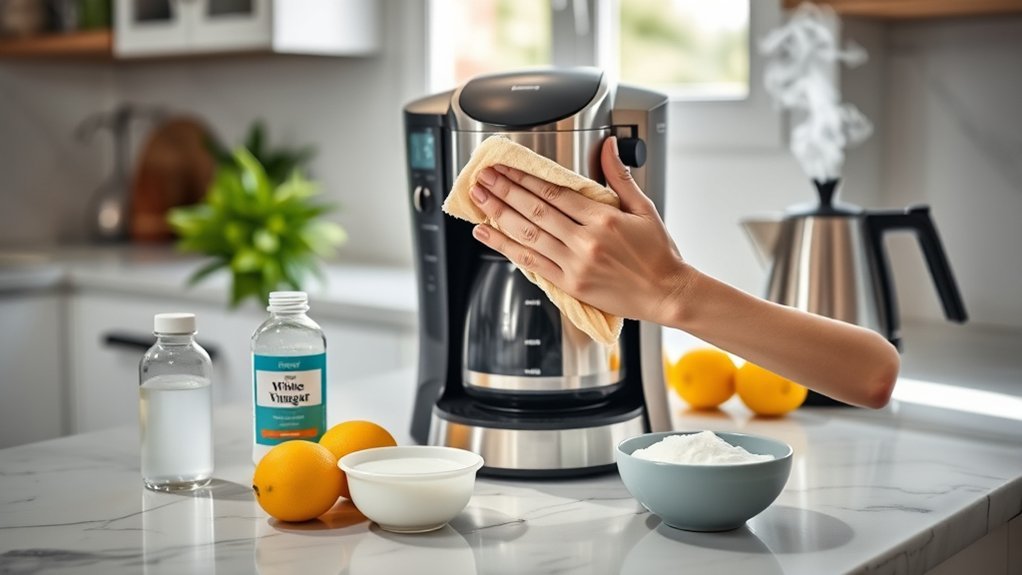
A mildew-like smell does not prove that a particular type of mold is present. Odor can also come from stagnant water, damp coffee grounds, an old pod, coffee oils, a dirty filter basket, or microbial residue on a wet surface.
Coffee makers contain several areas that can stay damp after brewing, including the reservoir, filter basket, pod holder, drip tray, lid, valves, and internal tubing. In its 2011 household germ study, NSF reported that coffee-maker reservoirs were among kitchen items found to contain bacteria or yeast and mold. That finding shows that reservoirs can become a contamination point; it does not mean that every coffee maker contains mold.
Moisture is the main condition that allows mold to keep growing. The U.S. Environmental Protection Agency identifies moisture control, cleaning, and complete drying as the core steps for controlling mold on hard household surfaces.
A coffee maker that stays wet and holds old coffee residue gives odors and microbial residue more opportunity to develop than one that is emptied, washed, and allowed to dry.
Note: White or chalky deposits are usually mineral scale, while brown or sticky residue is often coffee oil. Fuzzy, slimy, spotted, or colored growth is more concerning for possible mold or other microbial contamination.
Power your essentials anywhere with a 999Wh pure sine wave power station delivering up to 1000W continuous with 2000W surge. It supports fast charging via USB-C PD 60W and USB-A QC 18W, plus simultaneous output for multiple devices through AC, USB, wireless, and car/DC ports. Recharge using AC, car, or solar with a built-in MPPT controller and dual cooling fans, while the upgraded battery management system protects against surges, short circuits, and overheating.

Bulk Coffeemaker Decalcifier Tablet: 24 Tablets Work out to a Year Supply or more. Compare to other products like powder, pods, sachet, packets. Choose ACTIVE Cleaning Tablets for better Values

1-Year Supply, Better Value - Includes 24 coffee maker descaling tablets—enough for monthly cleaning for up to a year. A cost-effective alternative to powders, liquids, pods, sachets, or packets.
What You Need to Clean Your Coffee Maker Right
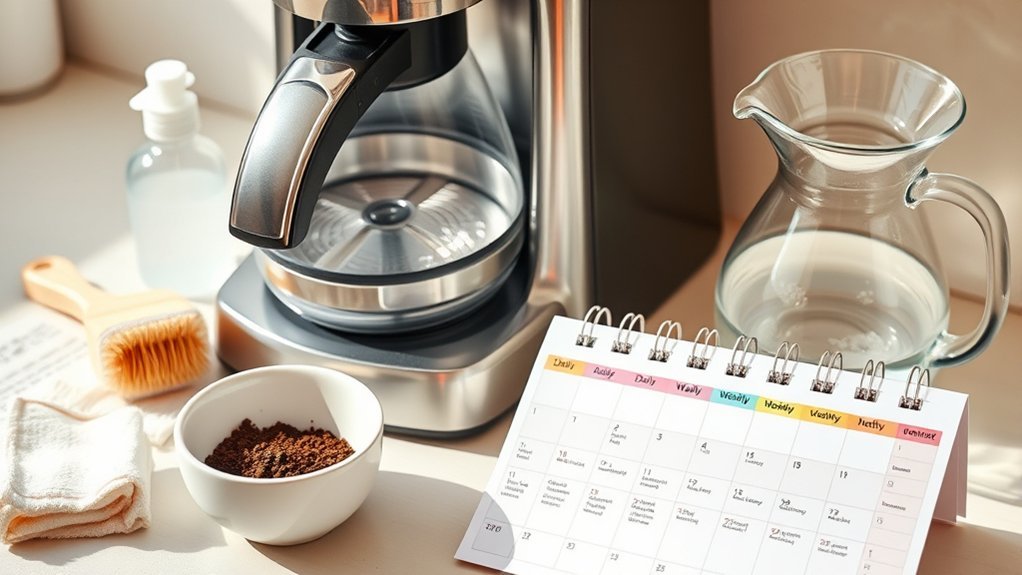
Gather your supplies before taking the machine apart. The owner’s manual is the most important reference because it tells you which parts are removable, which are dishwasher-safe, and whether vinegar or a particular cleaner can be used in the internal water path.
Essential Cleaning Supplies Needed
- Warm water
- Mild, unscented dish soap
- A soft sponge or microfiber cloth
- A small soft-bristled brush or clean toothbrush
- Fresh rinse water
- Paper towels or a clean drying towel
- White vinegar only if the manual allows it
- A manufacturer-approved cleaner or descaler when required
- Replacement water filter, if the machine uses one and the manual says it is due
Avoid abrasive pads, steel wool, strongly scented soap, and sharp tools that could scratch surfaces, puncture tubing, or damage seals.
Recommended Cleaning Solutions
| Cleaning Solution | Appropriate Use |
|---|---|
| Mild dish soap and water | Wash removable reservoirs, carafes, filter baskets, reusable filters, pod holders, lids, and drip trays. |
| White vinegar and water | Use in the internal water path only when the exact model instructions permit vinegar, and follow the stated ratio. |
| Affresh Coffee Maker Cleaner Tablets | Designed to address mineral buildup in compatible coffee makers. Follow the product directions and confirm compatibility with the appliance. |
| Urnex Coffee and Espresso Machine Descaling Powder | A household descaling product for mineral scale. Follow its current directions and the coffee maker’s own descaling instructions. |
| Biocaf Coffee Equipment Cleaning Powder | Removes coffee oils and residue in compatible equipment. Do not describe it as a sanitizer or disinfectant unless the current label specifically makes that claim. |
| Routine maintenance | Wash removable parts after use and run internal cleaning or descaling cycles at the interval stated in the machine manual. |
Tools for Deep Cleaning
A soft brush is useful for seams, corners, lid channels, reusable-filter mesh, and filter-basket grooves. Use cotton swabs only on accessible, unpowered surfaces where they cannot leave fibers behind or be pushed into openings.
Baking soda may help with stains on a detached carafe or another washable part when the manufacturer allows it. For example, some manufacturer guidance suggests a baking-soda paste for deeper carafe stains. Do not put baking soda into the reservoir or internal water path unless the exact appliance instructions specifically permit it.
Filtered water is optional. Depending on the filter and local water, it may reduce some mineral buildup, but it does not sanitize the appliance or replace routine washing and drying.
Step-by-Step Guide to Clean Your Coffee Maker
Warning: Unplug the coffee maker and let it cool before washing or wiping it. Never immerse the powered base, cord, or plug. Do not mix vinegar with bleach, descaler, ammonia, or another cleaner. The CDC warns that mixing bleach with other cleaning products can release dangerous vapors.
- Read the manual. Confirm which parts are removable, which are dishwasher-safe, and which product or solution is approved for internal cleaning.
- Empty the machine. Discard coffee grounds, paper filters, capsules, pods, and standing water. Remove the water filter only if the cleaning instructions require it.
- Wash removable parts. Clean the carafe, reusable filter, filter basket, pod holder, drip tray, lid, and removable reservoir with warm water and mild dish soap. Scrub seams and corners gently.
- Inspect the machine. Look for colored film, slippery residue, old grounds, coffee oils, damaged seals, cracks, and white mineral scale.
- Clean accessible fixed surfaces. Wipe them with a damp cloth. Do not let water run into controls, vents, wiring, or the powered base.
- Clean the internal water path. Use the vinegar ratio, branded cleaner, or descaling solution approved for the model. Never combine products.
- Rinse thoroughly. Run the number of freshwater cycles stated in the manual or cleaner directions. Continue until the discharged water is clear and has no cleaner smell or foam.
- Dry and reassemble. Let washed components air-dry completely before reinstalling them. Leave the lid or reservoir opening ajar when the design permits safe ventilation.
- Check before brewing coffee. Run any final freshwater rinse required by the manual. Confirm that the reservoir, carafe, and discharged water no longer smell like cleaner, vinegar, or mildew before making a drink.
Pro Tip: Smell each removable part separately after washing and drying it. This can reveal whether the odor comes from the reservoir, carafe lid, reusable filter, drip tray, pod holder, or the machine’s internal water path.
How to Use Vinegar for Eliminating Mildew Smells
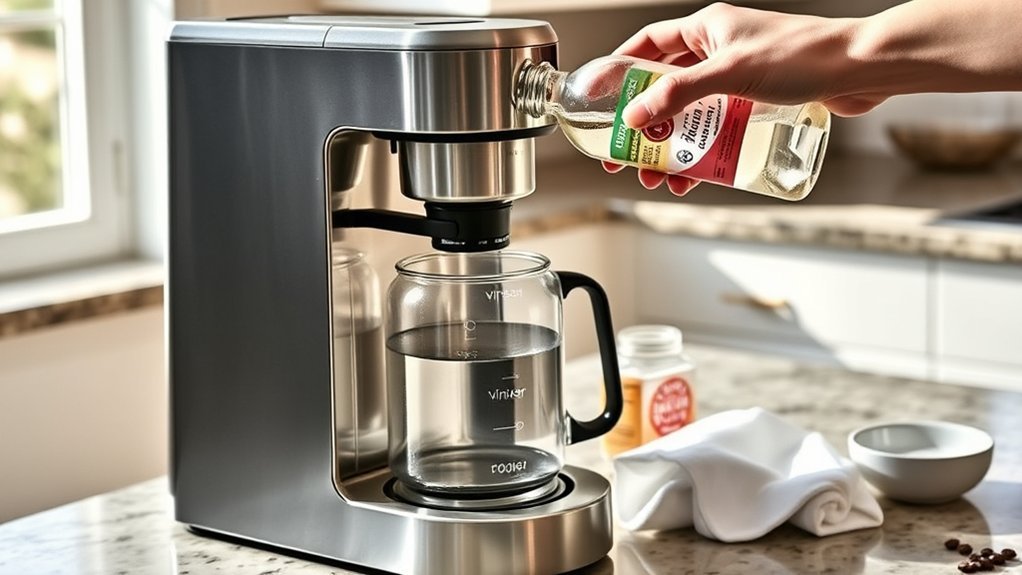
Vinegar is acceptable in some drip coffee makers, but it is not a universal solution. Check the manual before putting it in the reservoir. For example, Cuisinart’s current general cleaning guidance describes a mixture of three parts water to one part vinegar for compatible machines. Other brands and models may specify a different process or a dedicated descaling product.
Vinegar Solution Preparation
| Manual Instruction | What to Do |
|---|---|
| The manual gives a vinegar ratio | Measure and use that exact ratio. |
| The manual requires a branded descaler | Use the specified product and dosing instructions instead of vinegar. |
| The manual does not address vinegar | Use a cleaner or descaler specifically approved for the machine, or contact the manufacturer rather than guessing. |
Do not add dish soap, baking soda, bleach, or another cleaner to the vinegar solution.
Brewing Cycle Steps
- Remove all coffee grounds, filters, pods, and capsules.
- Remove the water filter if the manufacturer’s cleaning instructions tell you to do so.
- Add the approved vinegar mixture to the reservoir without exceeding its maximum fill line.
- Run the clean or brew cycle specified in the manual.
- Pause or allow the solution to sit only when the manual or cleaner instructions call for a dwell period.
For pod brewers, do not improvise a drip-machine procedure. Follow the model-specific descaling sequence and clean the pod holder, entrance needle, or exit needle only as directed by the manufacturer. Keurig’s support instructions, for example, vary by brewer.
Rinsing and Finalizing
Discard the used solution and rinse the reservoir. Fill it with fresh water and run the full rinse process stated in the manual. Some cleaning products and machines require several reservoirs or brew cycles of fresh water.
Continue rinsing until the discharged water is clear and has no vinegar, cleaner, or chemical smell. Wash the carafe and removable parts again if they contacted the solution, then allow them to dry.
Do not brew coffee simply to cover a remaining vinegar or cleaner odor. A lingering chemical smell means more freshwater rinsing is needed.
Alternative Cleaning Solutions for Persistent Odors

When the odor remains after the removable parts have been washed, identify the likely residue before selecting another product.
A descaler removes mineral scale. A coffee-equipment cleaner removes coffee oils and residue. Neither should be called a disinfectant unless its label specifically says it is one.
- For white, chalky scale: Use the manufacturer’s descaling process and an approved descaler.
- For brown or oily residue: Use a compatible coffee-equipment cleaner such as Biocaf according to its current directions.
- For an odor in a washable reservoir or carafe: Repeat washing with mild dish soap, scrub seams, rinse well, and dry completely.
- For an old water filter: Replace it at the interval specified for the model. A new filter does not remove contamination already present elsewhere in the machine.
- For an odor inside sealed tubing: Contact the manufacturer for service guidance. Replace the machine when the affected area cannot be reached or safely cleaned and the odor or visible contamination remains.
Affresh, Urnex descaling products, and Biocaf cleaners have different purposes and dosing instructions. Never combine them, and never assume that the directions for one product apply to another.
Note: A product that removes odors, coffee oils, or mineral deposits is not automatically a sanitizer or disinfectant. Follow the product label and appliance manual rather than relying on broad marketing terms.
If the Smell Comes Back After Cleaning
An odor that returns soon after a full cleaning usually means that either a contaminated area was missed or moisture is remaining somewhere between uses. Work through the machine systematically instead of immediately adding a stronger cleaner.
- Remove and smell the clean, dry reservoir, lid, carafe lid, basket, reusable filter, pod holder, and drip tray separately.
- Check seams, gaskets, lid channels, filter housings, and other places where a small amount of water can remain.
- Replace an overdue water filter according to the manufacturer’s schedule.
- If the removable parts smell clean but water coming through the brewer smells musty, follow the model-approved internal cleaning process again only if the instructions permit another cycle.
- If odor, particles, slime, or visible growth appears to come from sealed internal tubing or another inaccessible area, stop using the machine and contact the manufacturer or an authorized service provider.
Tips to Prevent Mildew Buildup in Your Coffee Maker
- Discard grounds, filters, pods, and capsules soon after brewing.
- Wash the carafe, filter basket, reusable filter, pod holder, and drip tray after use.
- Empty standing water when the machine will not be used soon and the manual permits the reservoir to be emptied.
- Dry removable parts completely before reinstalling them.
- Leave the lid or reservoir opening ajar when the design allows safe ventilation.
- Do not store the machine with wet grounds, a used pod, or liquid in the drip tray.
- Replace water filters according to the manufacturer’s schedule.
- Run the clean or descale cycle when the machine displays an alert or the manual calls for it.
- Clean sooner if brewing slows, coffee tastes unusual, or a musty odor appears.
Using filtered water may reduce scale in some locations, but the effect depends on the filter and local water. It does not replace routine washing or drying.
Storage and Long Periods Without Use
If the coffee maker will not be used for several days or longer, empty and dry removable reservoirs and trays when the manual permits it. Some brewers also have model-specific draining or storage procedures for internal water. Follow those instructions rather than trying to force water out through valves or taking the machine apart.
Before using a stored machine again, inspect it for standing water, residue, odor, or visible growth. Wash removable parts and perform any rinse or cleaning process the manufacturer recommends after storage.
How Often Should You Clean Your Coffee Maker?
There is no single schedule for every coffee maker. Use the model manual as the final authority, particularly for internal cleaning, descaling, water-filter replacement, and storage.
| Timing | Maintenance |
|---|---|
| After each use | Discard grounds or pods, rinse or wash removable brewing parts, and empty the drip tray as needed. |
| Weekly or as needed | Wash the removable reservoir, lid, reusable filter, carafe lid, and other frequently damp components. |
| When directed by the manual or indicator | Run the internal cleaning or descaling cycle with the approved solution. |
| Immediately | Clean the machine when you notice a musty odor, visible film, standing water, slow flow, unusual taste, or residue. |
Some manufacturers recommend scheduled deep cleaning for particular machines, while others base maintenance on a clean light, brew count, water hardness, or another indicator. Cleaner manufacturers may also suggest their own product-use interval. Those recommendations should not override the appliance manual.
Recognizing Mold and Mildew in Your Coffee Maker
Inspect the coffee maker under bright light before deciding how to clean it. A musty smell is a warning that the machine needs attention, but odor alone cannot identify the exact organism or residue present.
- Possible mold or microbial film: Fuzzy, slimy, spotted, or colored growth; a persistent musty odor; or residue that returns quickly after ordinary washing.
- Coffee oil: Brown, amber, or black sticky residue around the basket, carafe lid, pod holder, reusable filter, or dispensing path.
- Mineral scale: White, gray, or chalky deposits near water lines, heating areas, valves, or spray openings.
- Stale water: An odor from water left in the reservoir or carafe without obvious visible growth.
- Old filter contamination: Odor or discoloration around a water-filter cartridge that is overdue for replacement.
Quick Odor-Source Test
After washing and drying every removable component, smell them one at a time. If one part still smells musty, clean or replace that part as appropriate. If all removable parts smell clean but the odor appears only after fresh water travels through the machine, the source may be in the internal water path.
Do not disassemble the powered base or sealed hydraulic system just to locate an odor. Use the manufacturer’s internal cleaning instructions or seek service instead.
Warning: Stop using the coffee maker if visible growth remains inside sealed tubing, behind a fixed reservoir wall, or in another area you cannot reach. Do not take apart electrical or pressurized components unless the manufacturer’s service instructions authorize it.
A machine may be beyond practical cleaning when the odor returns immediately, rinse water repeatedly contains particles, internal parts remain visibly contaminated, plastic is cracked or badly damaged, or the manufacturer cannot provide a safe cleaning method for the affected area.
Final Maintenance Tips for a Fresh Coffee Maker
Good maintenance focuses on removing residue and preventing standing moisture. After brewing, discard wet grounds or pods, wash the parts that contacted coffee, empty the drip tray, and let washed pieces dry completely.
Keep the reservoir clean, but do not assume that filtered water, a new cartridge, or a hot brew cycle can replace hand-washing. Follow clean or descale alerts, use only compatible products, and perform extra maintenance whenever odor, buildup, or slow brewing appears.
Store the machine in a dry, ventilated location. If it will not be used for an extended period, empty, drain, and dry it only according to the manufacturer’s storage instructions.
Frequently Asked Questions
Can Using Flavored Coffee Contribute to Mildew Smells?
Flavored coffee may leave aromatic or oily residue in the basket, reusable filter, pod holder, or carafe. However, flavoring alone does not cause mildew. Persistent moisture, old grounds, stagnant water, and residue that is not washed away are the main concerns.
Is It Safe to Use Bleach for Cleaning My Coffee Maker?
Do not put bleach into the reservoir or internal water path unless the manufacturer gives explicit model-specific instructions. Never mix bleach with vinegar, ammonia, descaler, or another cleaner because dangerous vapors can be released.
How Can I Tell if My Coffee Maker Is Beyond Cleaning?
Consider service or replacement when visible contamination remains in inaccessible tubing, the musty odor returns immediately, rinse water repeatedly contains debris, important plastic parts are cracked, or the manufacturer cannot provide a safe way to clean the affected area.
What Type of Coffee Maker Is Most Prone to Mildew?
Any machine that holds water or wet coffee residue can develop odors. Large reservoirs, enclosed pod holders, reusable filters, complicated lids, drip trays, and parts that are difficult to remove or dry may need closer attention.
Can I Prevent Mildew Without Regular Cleaning?
No. Emptying water, discarding wet grounds, and allowing parts to dry can reduce moisture, but residue still needs to be removed through regular washing and model-directed internal cleaning.
Is Vinegar Safe for Every Coffee Maker?
No. Some manufacturers permit vinegar, some specify a particular dilution, and others require a branded cleaning or descaling solution. Check the exact model manual before adding vinegar to the reservoir.
Can I Run Baking Soda Through the Coffee Maker?
Do not put baking soda into the internal water path unless the manufacturer specifically allows it. Baking-soda paste may be suitable for some detached, washable parts such as a stained carafe, followed by thorough rinsing.
What Is the Difference Between Cleaning and Descaling?
Cleaning removes coffee oils, grounds, stains, and other residue. Descaling dissolves mineral deposits left by water. A machine may need both processes, but the products are not interchangeable and should never be mixed.
Will Running Hot Water Alone Remove a Mildew Smell?
Do not rely on a hot brew cycle alone. Physical residue can remain on the reservoir, lid, basket, reusable filter, pod holder, carafe, or drip tray. Wash accessible parts and use the model-approved internal cleaning process when needed.
Why Does the Musty Smell Return After Cleaning?
A returning odor may come from a missed lid channel, reusable filter, old water filter, drip tray, seal, standing water, or an inaccessible internal area. Clean and dry removable components separately first. If the odor appears only after water passes through the machine, follow the manufacturer’s internal-cleaning or service guidance.
Conclusion
To remove a mildew-like smell from a coffee maker, begin with the parts you can safely reach. Unplug the machine, wash every removable component, rinse it well, and let it dry completely. Then clean the internal water path with the vinegar ratio, cleaner, or descaler approved for the exact model.
Do not rely on filtered water, brewing heat, or a stronger chemical mixture to compensate for poor cleaning. Never mix cleaning products, and stop using the appliance when visible contamination or a persistent odor remains in inaccessible internal parts. Regular washing, moisture control, complete drying, and model-specific maintenance are the most reliable ways to keep a coffee maker fresh.
Sources
- Cuisinart: How to Clean Your Coffee Maker — manufacturer guidance on cleaning cycles, vinegar dilution for compatible machines, carafe cleaning, and filter maintenance.
- Keurig Support — model-specific cleaning, descaling, needle-cleaning, storage, and brewer-care guidance.
- U.S. Environmental Protection Agency: A Brief Guide to Mold, Moisture and Your Home — moisture control, hard-surface cleaning, and complete drying principles.
- Centers for Disease Control and Prevention: Cleaning and Disinfecting With Bleach — chemical-mixing and ventilation safety.
- NSF: Consumer Product Testing and Certification FAQs — context for NSF’s 2011 household germ study involving coffee-maker reservoirs.
- Urnex: Biocaf Coffee Equipment Cleaning Powder — current household product purpose, dosing, cleaning, and rinse instructions.