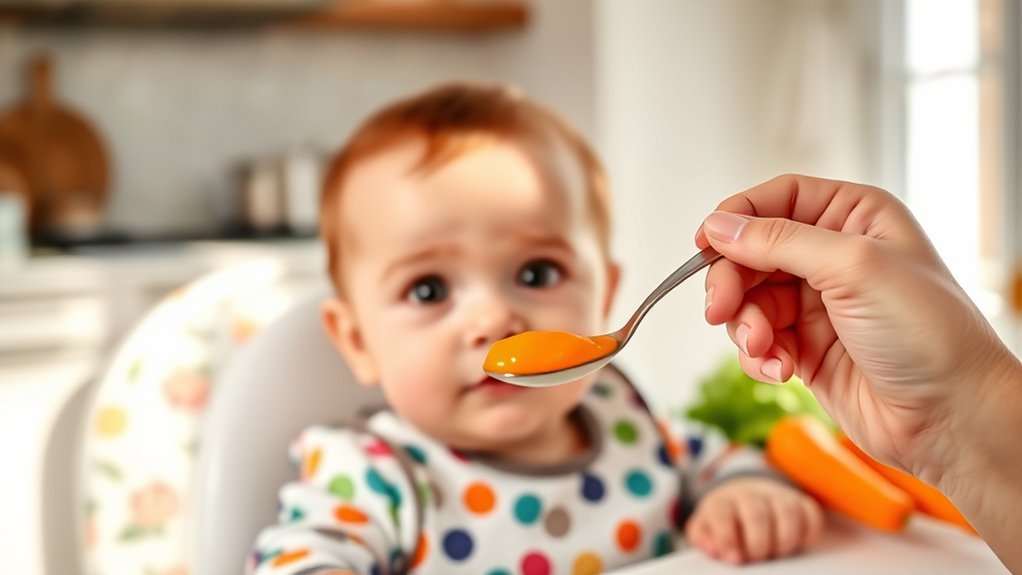
Recognizing baby food allergy symptoms means watching for changes in your baby’s skin, breathing, digestion, circulation, and behavior after a new food. Most immediate reactions begin within minutes to two hours, but delayed conditions such as FPIES can cause repetitive vomiting one to four hours later. Knowing the emergency signs helps you act without delay.
Quick Answer
Baby food allergy symptoms may include hives, swelling, coughing, wheezing, vomiting, diarrhea, unusual drooling, pallor, limpness, or sudden sleepiness. Give prescribed epinephrine immediately and call 911 for suspected anaphylaxis. Do not wait for hives, and do not use an antihistamine instead of epinephrine.
Medical note: This article provides general education and cannot diagnose a food allergy. Contact your baby’s pediatrician or allergist for personal advice. Do not remove major foods, change formula, retry a suspected trigger, or perform a home food challenge without medical guidance.
Key Takeaways
- Watch closely for at least two hours after a new allergenic food and remain alert for delayed vomiting or lethargy over the next several hours.
- Immediate symptoms can affect the skin, mouth, breathing, stomach, circulation, or behavior.
- Anaphylaxis can happen without hives or a visible rash.
- For suspected anaphylaxis, give prescribed epinephrine immediately and call 911. Antihistamines do not replace epinephrine.
- A flat red rash only where food touched the skin is often irritation, but a spreading, raised, itchy rash is more concerning.
- Babies with severe eczema, an existing egg allergy, or a previous food reaction should have a clinician-guided introduction plan.
- Record the food, amount, time eaten, symptoms, and timing so your healthcare provider can evaluate the reaction.
At a Glance
| Time Required | At least two hours of close observation, with continued awareness for delayed symptoms during the next several hours |
| Difficulty | Moderate; symptoms in babies can be subtle and may change quickly |
| Tools Needed | Phone, food-and-symptom log, pediatrician’s contact information, and prescribed epinephrine plus a written action plan when applicable |
| Cost | No cost for observation; medical assessment, testing, prescriptions, and emergency care vary |
Warning: Give prescribed epinephrine immediately and call 911 if your baby has trouble breathing, persistent coughing or wheezing, tongue or throat swelling, sudden limpness, blue or very pale skin, faintness, rapid worsening, or symptoms affecting more than one body system. Do not wait for a rash, and do not delay epinephrine while trying an antihistamine.
What Are Baby Food Allergies and How Common Are They?

A food allergy occurs when the immune system reacts to a food protein that is normally harmless. Reactions can range from a few hives to life-threatening anaphylaxis.
According to the National Institute of Allergy and Infectious Diseases, food allergy affects about 8% of children in the United States. Estimates vary because studies use different ages, definitions, and diagnostic methods.
The nine major food allergens recognized in the United States are:
- Milk
- Eggs
- Peanuts
- Tree nuts
- Soybeans
- Wheat
- Fish
- Crustacean shellfish
- Sesame
These foods cause many serious reactions, but any food can potentially trigger an allergy.
About 8% of U.S. children have a food allergy, and a baby’s symptoms can involve the skin, breathing, digestion, circulation, or behavior.
Some childhood allergies, especially milk, egg, soy, or wheat allergy, may resolve with age. Peanut, tree-nut, fish, and shellfish allergies are more likely to continue, although every child is different. An allergist should decide when testing or a supervised food challenge is appropriate.

Power your essentials anywhere with a 999Wh pure sine wave power station delivering up to 1000W continuous with 2000W surge. It supports fast charging via USB-C PD 60W and USB-A QC 18W, plus simultaneous output for multiple devices through AC, USB, wireless, and car/DC ports. Recharge using AC, car, or solar with a built-in MPPT controller and dual cooling fans, while the upgraded battery management system protects against surges, short circuits, and overheating.

Clinically Tested & Mom-Approved: National Eczema Association Approved, Dermatologically Tested, and Pediatrician Recommended. This 100% USDA Organic baby eczema and cradle cap ointment provides instant relief, faster recovery, and long-term skin support you can trust - backed by our Satisfaction Guarantee!

Signs of an Immediate Allergic Reaction in Babies
Immediate, or IgE-mediated, food-allergy symptoms usually begin within minutes to two hours after eating. A baby may have one symptom or several symptoms at the same time.
Skin and Mouth Symptoms
- Raised, itchy hives
- Red or flushed skin
- Swelling of the lips, eyelids, face, tongue, or throat
- Itching or rubbing at the mouth
- Sudden drooling or difficulty swallowing
Breathing Symptoms
- Persistent coughing
- Wheezing or noisy breathing
- Hoarse crying or voice
- Labored, fast, or difficult breathing
- Pulling in of the skin around the ribs or neck
- Blue coloring around the lips
Digestive Symptoms
- Sudden vomiting
- Diarrhea
- Stomach pain, drawing the knees toward the chest, or intense crying
Circulation and Behavior Symptoms
- Very pale or gray skin
- Sudden limpness or weakness
- Unusual sleepiness or difficulty waking
- Fainting or collapse
- Extreme fussiness that begins suddenly after eating
Note: A baby can have anaphylaxis without hives. Breathing trouble, circulation changes, sudden limpness, or rapidly worsening symptoms require emergency action even when the skin looks normal.
Differentiating Allergic Reactions From Eczema Flare-Ups

Eczema and food allergy can occur in the same baby, but an eczema flare by itself does not prove that a food caused the problem.
An immediate food-allergy reaction is more likely when symptoms begin soon after eating and include raised hives, facial swelling, vomiting, coughing, wheezing, or symptoms in more than one body system.
An eczema flare is usually drier, rougher, and longer-lasting. It may worsen because of heat, saliva, soap, dry air, infection, scratching, or many other triggers. Food may be considered when there is a clear, repeatable pattern, but timing alone is not enough to diagnose an allergy.
- Do not remove milk, egg, peanut, wheat, or other major foods solely because eczema worsened.
- Do not rely on a positive skin or blood test without a clinician interpreting the result in context.
- Ask your pediatrician or allergist before starting a broad elimination diet.
- Seek urgent help if eczema is accompanied by hives, swelling, vomiting, breathing trouble, or sudden behavioral changes.
Unnecessary food restriction can make it harder for a baby to receive enough calories, protein, fat, iron, and other nutrients.
Delayed Symptoms: Understanding FPIES in Infants
Food protein-induced enterocolitis syndrome, or FPIES, is a delayed food allergy that mainly affects the digestive system. Unlike many immediate allergies, FPIES usually does not cause hives or wheezing.
Acute FPIES commonly causes forceful, repetitive vomiting about one to four hours after a trigger food. Other signs may include:
- Marked pallor or gray-looking skin
- Severe tiredness, limpness, or lethargy
- Diarrhea several hours later
- Dehydration
- Low blood pressure or shock in a severe episode
Common triggers include cow’s milk, soy, rice, and oats, but many other foods can cause FPIES. A baby may tolerate a food once or more before a reaction becomes obvious.
Warning: Repetitive vomiting with pallor, limpness, unusual sleepiness, or signs of dehydration needs urgent medical evaluation. Do not retry a suspected FPIES trigger at home unless your child’s specialist has provided a specific plan.
Many children outgrow FPIES during early childhood, but the timing depends on the trigger and the child. Diagnosis and reintroduction should be managed by an allergist or another clinician experienced with FPIES. A supervised oral food challenge may be recommended later to determine whether the allergy has resolved.
How to Distinguish Between Rashes From Acidic Foods and Allergic Reactions

Tomato, citrus fruit, berries, and other acidic foods can irritate sensitive skin. Saliva, rubbing, and food left on the face can make the redness worse.
Contact Rashes vs. Allergic Reactions
A contact irritation is more likely when the redness:
- Appears only where the food or saliva touched the skin
- Looks flat rather than raised
- Is not very itchy
- Improves after gentle washing and skin care
- Occurs without vomiting, swelling, coughing, wheezing, or behavior changes
An allergic reaction is more concerning when the rash:
- Forms raised, itchy hives
- Spreads beyond the area that touched the food
- Returns after the same food is eaten
- Occurs with facial swelling, vomiting, breathing symptoms, pallor, or unusual sleepiness
Rash size alone cannot tell you how serious a reaction is. A small rash can occur before other symptoms, while severe anaphylaxis may happen without any rash.
Monitoring Rash Development Essentials
Stop feeding the new food and note when the rash began. Take clear photos in good light if doing so will not delay emergency care.
For a mild, flat contact rash, gently wash the face with water, pat it dry, and follow your pediatrician’s usual skin-care plan. Do not rub the food on your baby’s skin again to “test” it. Skin contact can irritate eczema and does not show whether the food is safe to eat.
Contact your healthcare provider if the rash is raised, itchy, widespread, persistent, repeatedly linked to the same food, or accompanied by another symptom.
Allergenic Foods to Introduce Carefully
Common allergenic foods should generally be introduced when your baby is developmentally ready for solids, usually around six months and not before four months. Delaying them for many months does not prevent food allergy and may increase risk for some foods.
Your baby may be ready for solids when they can sit with support, control their head and neck, bring objects to their mouth, and swallow food rather than push it out with the tongue. Confirm readiness with your pediatrician, especially after premature birth or when feeding or swallowing problems are present.
Offer allergens in an age-appropriate form:
- Peanut: Smooth peanut butter thinned well with warm water, breast milk, formula, or a tolerated puree; never a thick spoonful or whole peanuts.
- Egg: Fully cooked egg mashed to a soft texture.
- Milk: Plain yogurt or another age-appropriate dairy food; cow’s milk should not replace breast milk or formula as the main drink before 12 months.
- Tree nuts: Smooth nut butter or finely ground nut powder mixed into a tolerated food; never whole nuts.
- Wheat: Soft wheat cereal, well-cooked pasta, or soft bread prepared to reduce choking risk.
- Soy: Soft tofu or another smooth, age-appropriate soy food.
- Sesame: Tahini thinned and mixed into a tolerated puree.
- Fish and shellfish: Thoroughly cooked, finely flaked, and carefully checked for bones or hard pieces.
Note: Babies with severe eczema or an existing egg allergy should speak with a pediatrician or allergist before peanut introduction. Under NIAID peanut-prevention guidance, some high-risk infants may be evaluated and introduced to peanut-containing food as early as four to six months.
Monitoring Your Baby After Introducing New Foods
Offer a new allergenic food at home when your baby is healthy, awake, and easy to observe. Morning or early afternoon is often more practical than bedtime.
Signs of Allergic Reactions
Stop feeding the food if you notice a possible reaction. Watch for:
- Hives, flushing, itching, or swelling
- Coughing, wheezing, hoarseness, drooling, or breathing trouble
- Vomiting, diarrhea, or severe abdominal discomfort
- Pallor, limpness, faintness, or unusual sleepiness
- Symptoms affecting more than one body system
Timing of Symptoms
Most immediate allergic reactions begin within minutes to two hours. Observe your baby closely during that period.
Remain alert for delayed symptoms afterward. FPIES can cause repetitive vomiting one to four hours after eating, and diarrhea may appear later.
Record:
- The food and all ingredients
- The amount offered and amount eaten
- The time your baby ate it
- When each symptom began
- Photos of skin symptoms, when safe to take
- Medicine given and the time it was given
- Whether emergency care was needed
Emergency Response Steps
- Stop feeding the food.
- If your baby has signs of anaphylaxis and prescribed epinephrine is available, give it immediately according to the child’s emergency plan.
- Call 911 after giving epinephrine. If no prescribed epinephrine is available, call 911 immediately.
- Do not wait to see whether hives appear or whether symptoms improve on their own.
- Do not substitute an antihistamine for epinephrine or let an antihistamine delay emergency treatment.
- Follow the dispatcher’s instructions and take any additional epinephrine doses with you.
- Your baby still needs emergency evaluation even if symptoms improve after epinephrine.
What to Do If Your Baby Has an Allergic Reaction
The correct response depends on the symptoms, not on whether the baby’s previous reaction was mild.
For suspected anaphylaxis: Give prescribed epinephrine immediately and call 911. Warning signs include breathing trouble, tongue or throat swelling, repeated coughing, collapse, limpness, blue or very pale skin, rapidly worsening symptoms, or symptoms involving more than one body system.
For one isolated mild symptom: Stop the food and contact your pediatrician for instructions. Give an antihistamine only if your baby’s clinician has previously recommended the correct medicine and dose for that specific situation. Continue watching closely because symptoms can progress.
For repetitive vomiting one to four hours after eating: Seek urgent medical advice, especially if your baby is pale, sleepy, limp, unable to keep fluids down, or producing fewer wet diapers. These signs may fit FPIES or another urgent illness.
After any suspected reaction, do not offer the food again until your healthcare provider tells you whether and how it should be evaluated.
Pro Tip: Ask your pediatrician or allergist for a written allergy and anaphylaxis action plan. Make sure every caregiver knows where prescribed epinephrine is stored and how to use it before an emergency happens.
Tips for Safely Introducing Allergenic Foods
- Confirm that your baby is ready for solids. Most babies are ready at about six months, but readiness matters more than a single calendar date.
- Ask about high-risk conditions. Get medical advice before peanut introduction if your baby has severe eczema, egg allergy, or a previous reaction.
- Choose one new single-ingredient food. This makes a reaction easier to trace.
- Start with a small taste. Wait several minutes, then gradually offer more if no symptoms appear.
- Use a choking-safe texture. Avoid whole nuts, thick spoonfuls of nut butter, hard pieces, and poorly flaked fish.
- Observe closely. Watch for immediate symptoms for at least two hours and delayed vomiting or lethargy afterward.
- Space new foods for clear tracking. Some families wait one day, while a more cautious three- to five-day interval may be useful when first introducing foods. Do not delay all allergens for months solely to extend the schedule.
- Continue foods that are tolerated. Keep them in your baby’s regular diet in age-appropriate portions rather than offering them once and then stopping for a long period.
Current American Academy of Pediatrics guidance on starting solids recommends soft, safe textures and introducing new single-ingredient foods in a way that allows caregivers to watch for reactions.
When to Consult a Healthcare Provider About Allergies
Call 911 for breathing trouble, throat or tongue swelling, collapse, sudden limpness, blue coloring, severe pallor, or rapidly worsening symptoms. Give prescribed epinephrine first when your baby’s emergency plan calls for it.
Contact your pediatrician promptly when your baby has:
- Hives, swelling, vomiting, or diarrhea after a food
- A repeatable rash after the same food
- Repetitive delayed vomiting
- Blood or persistent mucus in the stool
- Poor weight gain or ongoing feeding problems
- Severe or difficult-to-control eczema
- A suspected reaction to peanut, egg, milk, or another major allergen
- A need to avoid several foods
An allergist can help determine whether the reaction fits an immediate allergy, FPIES, another non-IgE food allergy, contact irritation, intolerance, infection, reflux, or another condition.
How Food Allergies Are Diagnosed
Food allergy diagnosis begins with a detailed history. Your clinician will ask what food was eaten, how much was eaten, how quickly symptoms began, whether the reaction has happened more than once, and which body systems were affected.
Testing may include:
- Skin-prick testing: Looks for sensitization to a food.
- Blood-specific IgE testing: Measures antibodies associated with an immediate allergy.
- Supervised oral food challenge: Gives measured amounts of food in a medical setting and is often the best way to confirm whether a food is tolerated.
A positive skin or blood test does not always prove that a baby will react when eating the food. Testing broad panels without a matching history can lead to unnecessary food avoidance.
Never perform an oral food challenge at home after a suspected serious reaction unless an allergist has specifically directed you to do so.
Food Allergy vs. Food Intolerance
A food allergy involves the immune system. It can cause hives, swelling, breathing symptoms, vomiting, circulation changes, or other systemic symptoms after even a small amount of food.
A food intolerance does not usually involve the same allergic immune pathway. It more often causes digestive discomfort, gas, bloating, or loose stools and is not treated with epinephrine.
For example, cow’s-milk protein allergy is different from lactose intolerance. Lactose intolerance is uncommon in young infants, while milk-protein reactions can occur through immediate or delayed immune mechanisms.
Because symptoms can overlap, do not diagnose an intolerance or switch formula without speaking with your baby’s healthcare provider.
Frequently Asked Questions
Can Food Allergies Develop Later in Childhood?
Yes. A child can develop an allergy after previously eating a food without an obvious reaction. Contact a healthcare professional when a new, repeatable pattern of symptoms follows a specific food.
Are Some Babies More Prone to Food Allergies?
Yes. Risk is higher in babies with severe eczema, an existing food allergy, or a close family history of allergic disease. Risk factors do not prove that a baby has an allergy, so testing and feeding plans should be individualized.
How Can I Prevent Food Allergies in My Baby?
No method prevents every allergy. Offering cooked egg, age-appropriate peanut products, and other common allergens when your baby is ready for solids may lower risk, especially when tolerated foods remain in the regular diet. High-risk infants need clinician-guided advice.
What Is the Role of Genetics in Food Allergies?
Genes can affect allergy risk, but family history is only one factor. Skin-barrier health, eczema, immune development, environmental exposure, and the timing of food introduction may also play a role.
Can Allergies Be Outgrown as Children Age?
Yes. Milk, egg, soy, and wheat allergies are often more likely to resolve than peanut, tree-nut, fish, or shellfish allergies. Never test whether an allergy is gone by feeding the food at home after a serious reaction. An allergist can plan safe reassessment.
Can a Baby Have Anaphylaxis Without Hives?
Yes. A baby may have breathing trouble, persistent coughing, tongue or throat swelling, vomiting, pallor, limpness, or collapse without a visible rash. Give prescribed epinephrine and call 911 when anaphylaxis is suspected.
Should I Give My Baby an Antihistamine for a Food Reaction?
Only follow a clinician’s instructions for an isolated mild symptom and the correct infant dose. Antihistamines do not treat anaphylaxis and must never replace or delay prescribed epinephrine and emergency care.
Should I Introduce a Food Again After a Mild Reaction?
Not until you have spoken with your baby’s healthcare provider. A previous mild reaction does not guarantee that the next reaction will also be mild. Your clinician may recommend testing, avoidance, or a supervised food challenge.
Conclusion
Recognizing baby food allergy symptoms depends on watching the whole baby, not only the skin. Hives and swelling matter, but coughing, breathing changes, vomiting, pallor, limpness, and unusual sleepiness may be equally important.
Introduce allergenic foods in safe textures when your baby is ready, keep tolerated foods in the regular diet, and document any suspected reaction. For signs of anaphylaxis, give prescribed epinephrine immediately and call 911. After any suspected food reaction, contact your pediatrician or allergist before offering the food again.
Sources
- National Institute of Allergy and Infectious Diseases: Food Allergy — definition, prevalence, mechanisms, and general food-allergy guidance
- American Academy of Pediatrics: Anaphylaxis in Infants and Children — infant warning signs, epinephrine, and emergency response
- American Academy of Pediatrics: Introducing Common Food Allergens — timing and safe allergen introduction
- NIAID Addendum Guidelines for Peanut Allergy Prevention — risk-based peanut introduction for infants
- U.S. Food and Drug Administration: Food Allergies — nine major food allergens and reaction symptoms
- Food Protein-Induced Enterocolitis Syndrome Review — FPIES timing, symptoms, diagnosis, and management