A chalky, bitter, sour, stale, or chemical taste from a coffee maker can have several causes. Mineral scale may change water flow and heating, but old coffee oils, stale reservoir water, source-water minerals, or leftover cleaner can create similar off-flavors. Start by identifying the likely cause, then use only the descaling method approved for your machine.
Quick Answer
To remove limescale taste from a coffee maker, empty the machine, remove the water filter if your model requires it, and run the manufacturer-approved descaling cycle. Use the labeled descaler dilution, complete every required fresh-water rinse, and wash removable coffee-contact parts separately to remove old oils and residue.
Key Takeaways
- Confirm that scale is the likely problem before running repeated acid or descaling cycles.
- Check the owner’s manual before using vinegar, citric acid, or a commercial descaler; some machines prohibit household acids.
- Use the exact dilution and cycle instructions for the product and coffee maker instead of a universal homemade ratio.
- Complete all required fresh-water rinse cycles and do not taste rinse water while checking for cleaner residue.
- Wash removable coffee-contact parts separately with mild dish soap to remove oils that descaler does not target.
- Base descaling frequency on the machine’s alert, owner’s manual, usage, and local water hardness.
At a Glance
| Time Required | About 20–90 minutes, depending on the machine, descale program, and required rinse cycles |
| Difficulty | Easy for routine maintenance |
| Tools Needed | Approved descaler, fresh water, measuring container, mild dish soap, soft cloth, and a collection container if required |
| Cost | Usually a few dollars per descaling cycle; branded kits and machine-specific products may cost more |
Warning: Unplug the coffee maker before removing or hand-washing parts. Follow all descaler label precautions for skin and eye contact, keep cleaning products away from children, wipe spills promptly, and never swallow descaling solution. Do not immerse the appliance, mix cleaning chemicals, put soap into nonremovable internal plumbing, or use vinegar or citric acid when the manufacturer prohibits it.
How to Remove Limescale Taste From Your Coffee Maker
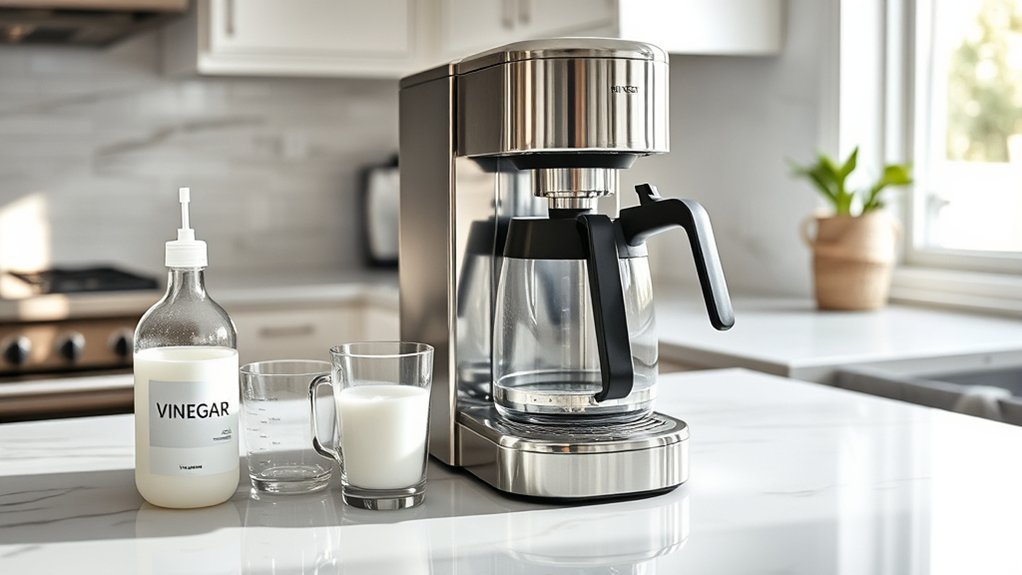
Descaling removes mineral deposits from the water path and heating system. Cleaning removes coffee oils, grounds, and food residue. If coffee tastes bitter, sour, stale, metallic, or chemical, you may need one job, both jobs, or a water-quality fix.
1. Check the Manual and Machine Type
Find the care or maintenance section in the owner’s manual or on the manufacturer’s support site. Confirm which descaler is allowed, whether the machine has a dedicated descale mode, whether its water filter should be removed, and how the rinse sequence works.
Automatic drip brewers may permit a normal brew cycle with descaling solution. Capsule, pod, espresso, and bean-to-cup machines can require button sequences, programmed pauses, valve changes, or branded products. Do not apply a generic drip-brewer procedure to a pressure-based or automatic espresso machine.
2. Empty and Prepare the Coffee Maker
- Remove coffee grounds, pods, paper filters, and capsules.
- Empty and rinse the carafe or drip tray.
- Remove the charcoal, mineral, or other water filter only when the machine instructions call for it.
- Make sure the brew basket, portafilter area, or capsule chamber is empty.
- Place a sufficiently large container under the outlet when the machine does not dispense into a carafe.
3. Mix an Approved Descaling Solution
The safest choice is a descaler approved for your coffee maker type. Follow the product label and machine instructions exactly. Do not estimate the concentration by spoonful unless the product specifically gives that measurement.
For example, Urnex Coffee and Espresso Machine Descaling Powder directs approved drip-coffee users to dissolve one 28-gram household packet in 32 ounces (1 liter) of lukewarm water. Espresso-machine owners are directed to use their machine’s own descaling procedure.
4. Run the Descaling Cycle
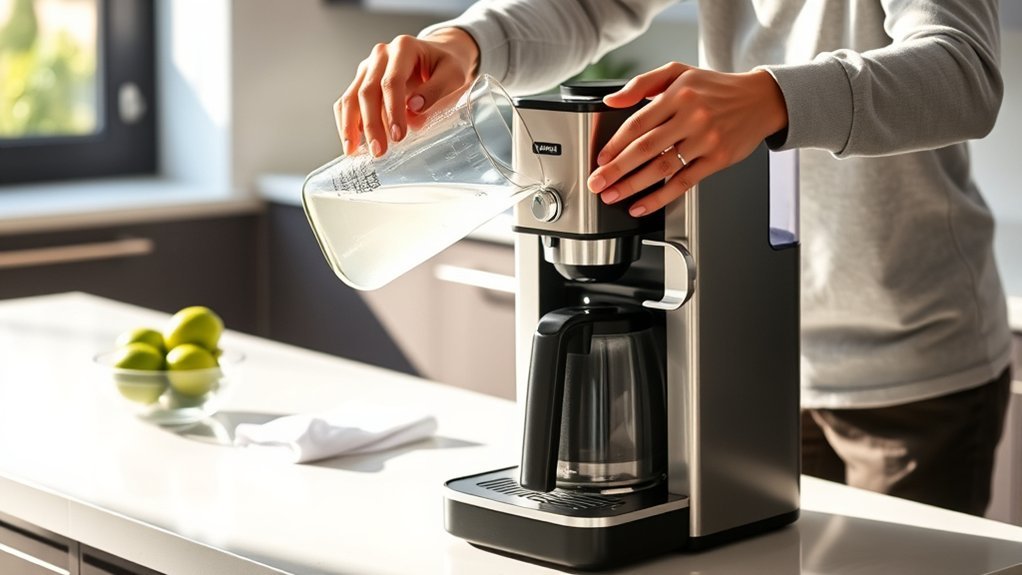
Pour the prepared solution into the reservoir and start the dedicated descale program or approved brew cycle. Do not add coffee. If the instructions call for a programmed soak, pause, or sequence of outlets, follow that procedure instead of stopping the cycle at random.
When the cycle finishes, discard the used solution. Do not reuse it or leave it in the machine longer than the descaler or coffee-maker instructions permit.
5. Rinse the Machine Completely
Refill the reservoir with fresh water and run every rinse cycle required by the machine or descaler. Urnex’s household powder instructions call for three complete fresh-water brews after the descaling tank. Other machines may require fewer or more rinses.
Do not taste rinse water while checking for cleaning residue. After completing the required rinse procedure, allow a small amount of dispensed water to cool and check for an acidic, chemical, or cleaner-like odor. If any remains, run another full fresh-water cycle before making coffee.
6. Wash the Removable Parts
Unplug the machine and let hot components cool. Wash the carafe, reusable filter, brew basket, drip tray, removable reservoir, and other washable components according to the owner’s manual. Mild dish soap removes coffee oils, but it does not replace descaling inside the water path.
7. Reinstall the Filter and Run a Test Brew
Reinstall or replace the water filter if the machine uses one and its instructions call for it after descaling. Reassemble the dry removable parts, fill the reservoir with fresh water, and run any final rinse required by the machine.
Then brew a small test batch of coffee. If water flow has returned to normal but the coffee still tastes stale, smoky, oily, or rancid, clean the coffee-contact parts and grinder path instead of immediately repeating another acid cycle.
Pro Tip: Change one thing at a time. If descaling restores normal water flow but the flavor problem remains, inspect the carafe, basket, reusable filter, grinder chute, source water, and old coffee before running another descaling cycle.
Is the Bad Taste Really From Limescale?
Limescale is only one possible cause of bad coffee. Before repeating a descaling cycle, match the flavor and symptoms to the most likely source.
- White or chalky deposits plus slow flow: Mineral scale is more likely.
- Sour or chemical flavor immediately after descaling: Cleaner residue or incomplete rinsing is more likely.
- Rancid, smoky, or stale bitterness: Old coffee oils on the carafe, basket, reusable filter, grinder, or brew chamber are more likely.
- Bad flavor in plain tap or filtered water: Treat the source-water problem rather than repeatedly cleaning the machine.
- Musty odor, slimy film, or fuzzy growth: Treat this as a sanitation problem rather than limescale. Clean accessible washable parts only as the manufacturer directs.
- Burning smell, electrical odor, overheating, or leaking: Stop using the machine and investigate a mechanical or electrical fault.
Choose the Right Descaling Method for Your Machine Type
Automatic Drip Coffee Makers
Many drip brewers can circulate a labeled descaler through a normal brew or clean cycle. Remove coffee and paper filters first, and follow the brewer’s required soak and rinse procedure. A household vinegar method is appropriate only when the manufacturer specifically allows it.
Pod and Capsule Machines
Pod and capsule brewers often use dedicated descale modes and multiple water outlets or needles. Some manufacturers require a particular descaling product. Nespresso, for example, instructs owners not to use vinegar because it can damage the machine.
Espresso and Bean-to-Cup Machines
Automatic espresso and bean-to-cup machines may route descaler through brew groups, hot-water circuits, or steam systems according to a programmed sequence. Do not improvise with a drip-coffee procedure. Some commercial or serviceable espresso equipment should be descaled by a technician rather than by circulating a stronger homemade acid solution.
Why Limescale Affects Coffee Flavor and Machine Performance
Limescale forms when hardness minerals in water are heated and deposits collect on hot surfaces or inside water passages. The U.S. Geological Survey explains that water hardness is caused mainly by calcium and magnesium compounds.
Impact on Coffee Flavor
Scale does not create one universal “limescale taste.” Instead, buildup may change water flow, heating, and contact time, which can alter extraction. Coffee may become weak, harsh, flat, or inconsistent. The chemistry of the source water also matters because dissolved minerals and alkalinity influence extraction and flavor.
A sour or chemical flavor immediately after descaling often suggests incomplete rinsing rather than remaining scale. Rancid, stale, or smoky bitterness more often points to coffee oils and residue on brewing parts.
Machine Efficiency and Longevity
Mineral deposits can narrow water passages, coat heating surfaces, increase noise, slow brewing, and reduce delivered water volume. Routine descaling can help restore normal flow when mineral buildup is the cause, but it cannot repair a failed pump, damaged heater, cracked seal, corroded component, or physical blockage that needs service.
- More consistent water flow and brew time
- Better chance of reaching the brewer’s intended temperature
- Lower risk of scale-related restrictions and blockages
- Fewer under-filled or weak cups caused by restricted water flow
How to Identify Limescale Buildup
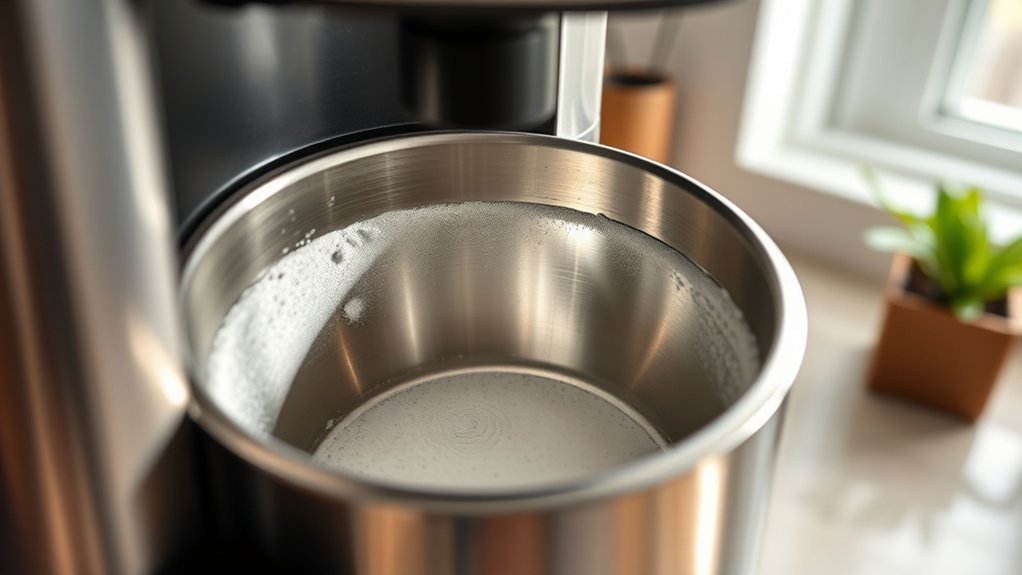
One symptom alone does not prove that scale is the problem. Look for a combination of mineral residue, reduced flow, longer brew cycles, unusual sounds, or a descale warning.
- Visible white or chalky residue: Deposits around the reservoir, showerhead, hot-water outlet, or other water-contact surfaces can indicate mineral buildup.
- Slower brewing or smaller output: Scale can restrict the water path, although a clogged needle, valve, filter, or pump can produce similar symptoms.
- More noise or sputtering: Water may move less smoothly through a restricted system.
- Descale or clean alert: Follow the model’s maintenance procedure; some alerts are based on brew count rather than a direct scale sensor.
- Recurring residue: Deposits that return quickly can indicate hard source water or a filter that improves taste without substantially reducing hardness.
Note: Brown film, oily rainbow residue, coffee odor, or grounds around the basket usually indicate coffee soil rather than limescale. Slimy or fuzzy residue is also not normal mineral scale and should be handled as a sanitation issue according to the machine’s cleaning instructions.
Step-by-Step Guide to Using Urnex Descaling Powder
Urnex sells a household Coffee and Espresso Machine Descaling Powder in single-use packets, and it also sells larger commercial Dezcal powder formats with different concentrations and instructions. Do not transfer a commercial dosage to a household packet or assume that similarly named products use the same dilution.
- Read both sets of directions. Check the coffee maker’s maintenance instructions and the exact Urnex package you have.
- For an approved drip brewer using the household packet, dissolve one 28-gram packet in 32 ounces (1 liter) of lukewarm water.
- Pour the solution into the reservoir and brew the full tank without coffee.
- Discard the used solution.
- Run three full tanks of fresh water according to the household product instructions.
- For espresso machines, use the model-specific descaling program rather than copying the drip-brewer cycle.
Urnex currently recommends its household descaling powder every three months for best results. Treat that as a product recommendation rather than a rule for every coffee maker. Hard water, heavy use, and the brewer’s own maintenance schedule can change the appropriate interval.
Natural Descaling Alternatives for Coffee Makers
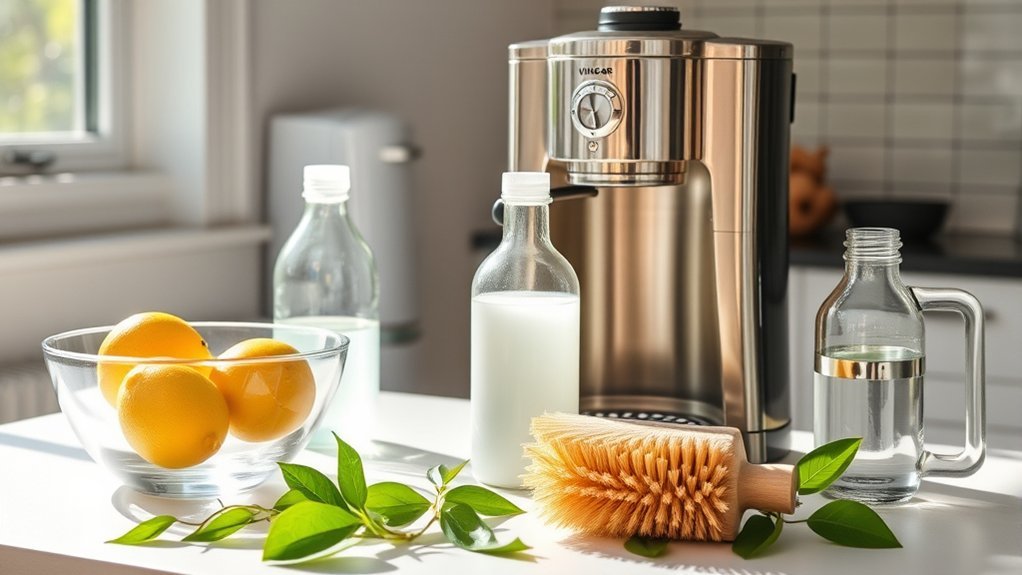
Household acids can dissolve mineral scale, but “natural” does not mean compatible with every machine. Seals, coatings, sensors, heating systems, tubing, and rinse programs differ by manufacturer.
White Vinegar
Use vinegar only when the coffee-maker manufacturer allows it. Cuisinart publishes vinegar-based cleaning guidance for some drip brewers, but its current general cleaning page presents different dilution examples for different parts of the guidance. That is a good reason to use the instructions for your exact model rather than copying a universal vinegar ratio.
Other manufacturers prohibit vinegar entirely. Nespresso’s descaling guidance instructs owners not to use vinegar because it can damage the machine.
Citric Acid
Citric acid can dissolve mineral deposits and is used in some descaling products, but concentration and exposure time still matter. Use a coffee-equipment product with labeled instructions or a citric-acid recipe supplied by your machine manufacturer. A homemade “one spoon per cup” formula is too model-independent to recommend across all coffee makers.
Baking Soda
Baking soda can help deodorize or gently scrub a stained carafe or removable basket when the material permits it. It is alkaline rather than acidic, so it is not a direct limescale remover. Do not circulate baking soda through internal plumbing unless the coffee-maker manufacturer specifically approves that procedure.
How Often Should You Clean and Descale a Coffee Maker?
Cleaning and descaling solve different problems and therefore follow different schedules. Use the routine below as a general maintenance framework, then defer to the requirements for your specific machine.
- After each use: Discard grounds or pods and rinse the carafe, basket, reusable filter, and drip tray as appropriate for your brewer.
- Daily or every few uses: Wash removable coffee-contact components with warm, soapy water when their care instructions permit it, then dry them thoroughly.
- Weekly: Wipe the exterior, lid, showerhead area, and accessible brewing surfaces. Clean a removable reservoir if the manufacturer permits washing it.
- When a maintenance alert appears or flow slows: Run the approved descaling procedure after ruling out simple clogs.
- About every three months: This is a common descaler recommendation but not a universal schedule. Hard water and frequent use can require earlier maintenance.
- Water filters: Replace them according to the brewer or filter manufacturer’s schedule because filter life and hardness-reduction ability vary.
The U.S. Geological Survey classifies water with more than 180 mg/L of hardness as calcium carbonate as “very hard.” Greater calcium and magnesium hardness generally gives a heated appliance more scale-forming material to manage.
Maintenance Tips to Prevent Limescale
Follow the Alert, Usage, and Water Hardness
A fixed “every 100 brews” rule does not fit every coffee maker. Some descaling products recommend a calendar interval, while certain machines track brew count. For example, the Keurig K-Supreme lists a maintenance alert that reminds the user to descale after every 250 brews. That number applies to that brewer, not to coffee makers in general.
Use Water Treatment That Actually Addresses Your Need
Filtered water can improve flavor, but not every filter removes hardness minerals. NSF’s water-treatment standards overview explains that NSF/ANSI 42 filtration can address aesthetic issues such as chlorine, taste, and odor, while NSF/ANSI 44 covers cation-exchange water softeners designed to reduce calcium- and magnesium-based hardness.
If scale returns quickly, check your utility water-quality report or measure the water’s hardness. Choose treatment with a verified hardness-reduction claim that is suitable for the coffee maker. Do not assume that a basic carbon pitcher automatically softens water, and avoid completely demineralized water when the machine manufacturer advises against it.
Clean Coffee Oils Separately
Descaler targets mineral deposits. Mild dish soap and warm water target coffee oils on washable parts. Keeping those jobs separate prevents unnecessary repeat acid cycles when the real problem is an oily carafe, reusable filter, grinder path, brew basket, or pod chamber.
The Connection Between Water Quality and Coffee Flavor
Water is both an ingredient and a solvent in coffee. The Specialty Coffee Association’s discussion of water and coffee flavor explains that mineral content and alkalinity can influence extraction and the sensory result. Water with very high hardness can also create more scale inside heated equipment.
The practical goal is not simply to use “the most filtered” water. Use clean, pleasant-tasting water that falls within the range recommended by the coffee-maker manufacturer and your preferred brewing guidance. If the source water already tastes strongly of chlorine, sulfur, metal, or earth, address the water problem as well as the machine.
What to Do if the Bad Taste Persists
- Run another fresh-water rinse if needed. A sharp, sour, or chemical odor after descaling can indicate that more flushing is required.
- Do not taste water that may still contain cleaner. Complete the manufacturer’s rinse procedure before preparing anything for consumption.
- Wash removable parts. Clean the carafe, filter basket, reusable filter, lid, drip tray, and accessible coffee-contact areas.
- Replace an overdue water filter. Use the filter schedule specified for the brewer.
- Check the source water. If fresh water already smells or tastes unpleasant, machine cleaning will not correct the underlying water problem.
- Repeat descaling only when approved. Heavy scale can sometimes require another labeled cycle, but increasing acid strength or repeatedly running unapproved treatments can damage components.
- Check for another blockage. Clean pod needles, showerheads, outlets, or removable valves only as the manufacturer instructs.
- Check for sanitation problems. Slimy, fuzzy, or musty residue is not ordinary mineral scale and requires appropriate cleaning of washable parts.
- Request service when symptoms continue. Stop using a machine that leaks internally, overheats, trips a breaker, smells burned, or still produces very low flow after approved maintenance.
Frequently Asked Questions
Can I use vinegar instead of a commercial descaling solution?
Only when the coffee-maker manufacturer permits it. Some drip brewers have vinegar-based maintenance procedures, while manufacturers such as Nespresso warn against vinegar. Use your model’s instructions rather than a universal vinegar-to-water ratio.
How can I tell if my coffee maker needs descaling?
Common clues include visible white deposits, slower brewing, reduced output, unusual gurgling, or a descale alert. Similar symptoms can come from clogged needles, valves, filters, or pumps, so check simple blockages and the brewer’s troubleshooting instructions too.
Is descaling safe for every coffee maker?
Descaling is routine maintenance for many coffee makers, but the product, dilution, and cycle vary. Drip, capsule, espresso, and bean-to-cup machines can require very different procedures, so use only a method approved for the exact machine.
Will descaling change the taste of my coffee?
It can improve consistency when scale has changed water flow or heating. A persistent chemical or acidic flavor after maintenance is not the intended result and can indicate incomplete rinsing or another source of bad flavor.
What should I do if limescale remains after one cycle?
Check whether the descaler and coffee-maker instructions permit a second cycle. If flow remains poor after approved descaling and rinsing, inspect accessible outlets as directed and contact the manufacturer rather than increasing the acid concentration yourself.
Can baking soda remove limescale?
Baking soda is useful for odor control and gentle cleaning on some removable surfaces, but it is not an acidic limescale remover. Do not circulate it through internal plumbing unless the coffee-maker manufacturer specifically approves that procedure.
How many rinse cycles should I run after descaling?
Use the number specified by the machine or descaler. Urnex’s household powder calls for three complete fresh-water tanks after its descaling tank. Run additional fresh-water cycles if cleaner odor remains after the required procedure.
Should I taste rinse water to check whether the descaler is gone?
No. Do not taste water while you are checking for possible cleaning-product residue. Complete all required fresh-water rinses, let dispensed water cool, check for cleaner odor, and rinse again if any remains.
Does a pitcher filter prevent coffee maker scale?
Not necessarily. Many filters primarily reduce chlorine, taste, or odor and can leave substantial hardness minerals in the water. Look for a verified hardness-reduction claim and make sure the treated water is suitable for the coffee maker.
Conclusion
Removing limescale taste safely is not about using the strongest homemade acid. First confirm that scale is actually the problem. Then match the descaler to the coffee maker, use the correct dilution, complete every required rinse, and clean coffee oils from washable parts separately. Correct water hardness and routine maintenance can reduce repeat buildup without risking seals, coatings, sensors, or internal plumbing.
Sources
- Urnex Coffee and Espresso Machine Descaling Powder — household packet dosage, three-rinse procedure, and product maintenance recommendation.
- Cuisinart: How to Clean a Coffee Maker — removable-part cleaning and manufacturer-specific vinegar guidance.
- U.S. Geological Survey: Hardness of Water — calcium, magnesium, scale formation, and water-hardness classifications.
- NSF Standards for Water Treatment Systems — distinction between aesthetic filtration and hardness-reducing water softeners.
- Nespresso: Descaling Your Machine — machine-specific descaling guidance and the warning against vinegar.
- Specialty Coffee Association: Water and the Taste of Coffee — discussion of mineral content, alkalinity, extraction, and coffee flavor.