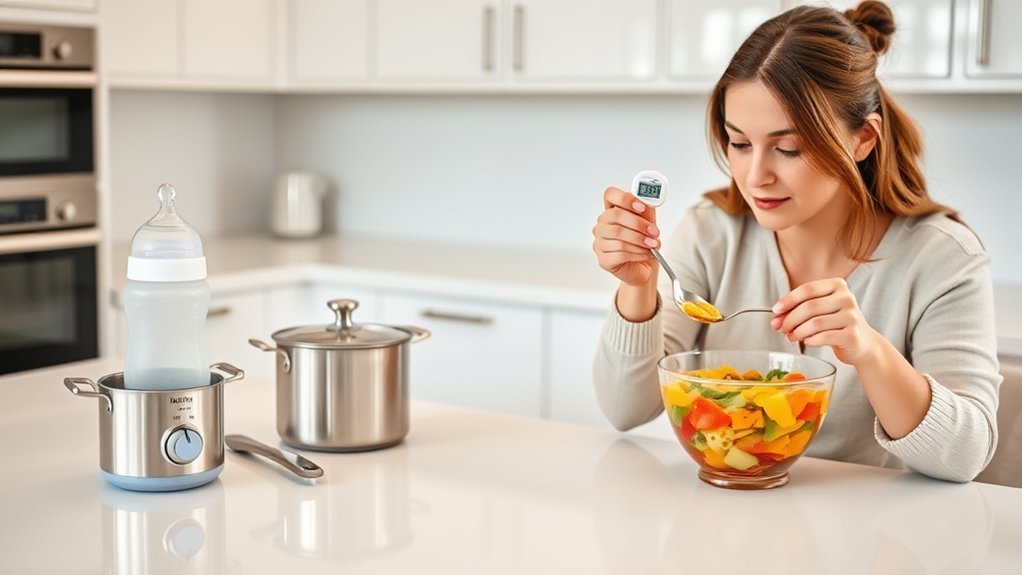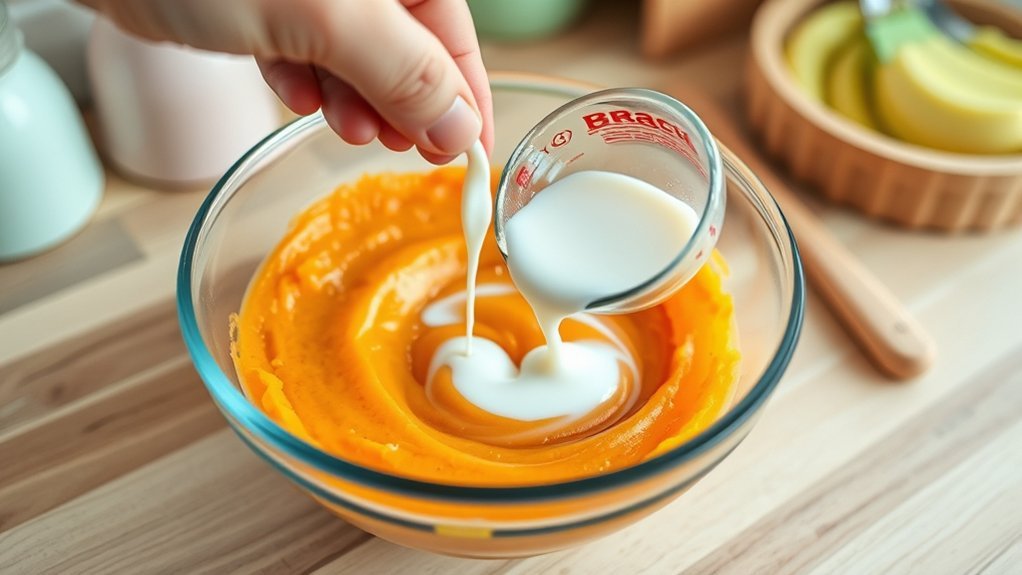
Thinning baby food puree can help a baby who is just learning to manage food from a spoon, but there is no single ratio that works for every puree or every child. Use a clean bowl and spoon, add breast milk, properly prepared infant formula, or a little water in small amounts, and stop when the texture matches your baby’s current feeding skills.
Quick Answer
Place one serving of puree in a clean bowl. Stir in breast milk, prepared formula, or water about 1 teaspoon at a time until the puree is smooth and easy to scoop. Serve it cold, room temperature, or lukewarm—not hot—and discard anything left in the serving bowl after feeding.
Key Takeaways
- Start with about 1 teaspoon of liquid, mix well, and add more only as needed.
- Prepare powdered or concentrated formula exactly as the label directs before adding it to food; never mix formula powder directly into puree.
- Cold, room-temperature, and lukewarm purees can all be acceptable. Test warmed food and avoid hot spots.
- Mix only the portion you plan to serve, then discard leftovers that have touched your baby’s spoon or mouth.
- Use thinner textures only while they help. Move toward thicker, mashed, and lumpy foods as your baby’s skills develop.
At a Glance
| Time Required | 2–5 minutes |
| Difficulty | Easy |
| Tools Needed | Clean bowl, infant spoon, measuring teaspoon, and fork, whisk, or blender if needed |
| Cost | Usually no extra cost |
Note: This guide is for healthy babies who are developmentally ready for complementary foods. Ask your pediatrician or feeding specialist for individual advice if your baby was born prematurely, has poor growth, coughs or chokes during meals, has a swallowing disorder, or needs a medically prescribed texture.
Why Thinning Baby Food Puree Matters
A thinner puree can be useful at the start of spoon-feeding because it may be easier for some babies to move from the front of the mouth to the back. Breast milk or formula can also provide a familiar taste. However, thinning is not required for every baby, and a runnier puree is not automatically safer.
Choking prevention depends on the food’s shape, size, softness, and texture, as well as upright seating and close supervision. The CDC recommends preparing food for a child’s developmental abilities, feeding small portions, and watching the child throughout the meal.
As feeding skills improve, offer thicker mashed, lumpy, finely chopped, and other age-appropriate textures. Staying with very thin purees longer than needed can limit practice with chewing and moving food around the mouth.

Power your essentials anywhere with a 999Wh pure sine wave power station delivering up to 1000W continuous with 2000W surge. It supports fast charging via USB-C PD 60W and USB-A QC 18W, plus simultaneous output for multiple devices through AC, USB, wireless, and car/DC ports. Recharge using AC, car, or solar with a built-in MPPT controller and dual cooling fans, while the upgraded battery management system protects against surges, short circuits, and overheating.

Make fresh, delicious food with wholesome ingredients. You control exactly what goes in - no hidden stabilizers, preservatives, or flavor enhancers necessary.

𝗦𝘁𝗲𝗮𝗺𝗶𝗻𝗴 𝗮𝗻𝗱 𝗕𝗹𝗲𝗻𝗱𝗶𝗻𝗴 𝗶𝗻 𝗢𝗻𝗲: The height of the blender container is 4.13 inches, and the outer diameter is 4.17 inches.This GROWNSY baby food maker thoughtfully designed for babies 6 months+ during the weaning stage.It seamlessly combines steaming and blending in a single device, simplifying meal prep and eliminating the need for extra kitchen tools. The built-in sterilizer mode saves time and effort, giving you more precious moments with your baby.
When to Start Thinning Baby Food
Most babies begin complementary foods at about 6 months, but age alone is not enough. Your baby should be able to sit alone or with support, control the head and neck, open the mouth for food, and swallow food instead of pushing it back out.
Do not introduce solids before 4 months. When your baby is ready, begin with a small amount of smooth food and adjust the texture based on how well they manage it. Breast milk or infant formula should remain the main source of nutrition from 6 to 12 months.
- Signs the texture may be too thick: your baby repeatedly cannot move it off the spoon, pushes it out after several calm attempts, or becomes frustrated before swallowing.
- Normal learning behaviors: mild gagging, coughing, or spitting food out can happen while babies learn new textures.
- Get medical help: repeated coughing during swallowing, wet or gurgly breathing, color change, breathing difficulty, or poor weight gain needs prompt professional evaluation.
What to Do When Your Baby Food Is Too Thick
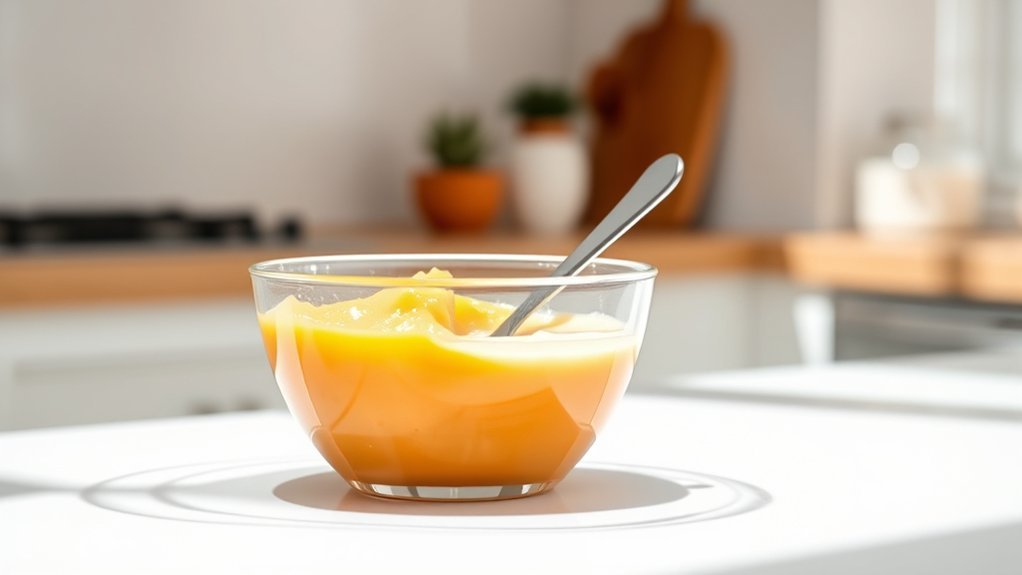
- Portion the food first. Put only the amount you expect your baby to eat into a clean bowl. Keep the untouched puree separate.
- Choose a suitable liquid. Use fresh or safely thawed breast milk, properly prepared formula, plain water, or unsalted cooking water from the food.
- Add 1 teaspoon. Stir, mash, whisk, or blend until the liquid is fully mixed.
- Check the spoon. The puree should sit on the spoon but slide off with a gentle tilt. It should not be watery or separate into liquid and solids.
- Repeat only if needed. Add another teaspoon, mix, and check again.
- Serve safely. Offer small spoonfuls while your baby is seated upright and supervised.
Pro Tip: A teaspoon gives you more control than a tablespoon. Purees vary in thickness, so use texture—not a fixed liquid-to-food ratio—as your guide.
Step-by-Step: How to Thin Baby Food With Breast Milk
Breast milk can make a puree smoother while adding a familiar taste. It may be used fresh, refrigerated, or properly thawed. The key is to follow safe milk-handling times and avoid contaminating the stored supply.
Benefits of Thinning Purees
Adding a small amount of breast milk can loosen a dense puree without introducing a new flavor. This may help during the first stage of complementary feeding, especially when a baby is still learning to take food from a spoon.
It is not necessary to warm breast milk before mixing. According to the CDC’s breast milk storage and preparation guidance, expressed milk may be served cold, at room temperature, or warm.
Techniques for Adding Breast Milk
- Wash your hands and use a clean bowl and utensil.
- Place one serving of puree in the bowl.
- Add 1 teaspoon of breast milk.
- Stir or mash until smooth. Use a blender only when the food needs more processing.
- Add another teaspoon only if the puree is still too thick for your baby’s current skills.
- Serve immediately or refrigerate the untouched mixture promptly.
If you warm the puree, warm the food gently before adding breast milk when practical. Never microwave breast milk itself. Microwaves can create hot spots and may reduce some milk components.
Storage Tips for Purees Thinned With Breast Milk
- Fresh milk: freshly expressed breast milk can be stored for up to 4 hours at 77°F (25°C) or colder, up to 4 days in the refrigerator, and about 6 months in the freezer for best quality. A mixed puree may have a shorter limit, so follow the shortest limit for any ingredient.
- Thawed milk: use refrigerated thawed breast milk within 24 hours after it is completely thawed. Once warmed or brought to room temperature, use it within 2 hours.
- Refreezing: never refreeze breast milk after it has fully thawed, including breast milk mixed into puree.
- After feeding: discard puree that has touched the feeding spoon or your baby’s mouth. Do not return it to the refrigerator.
Step-by-Step: How to Thin Baby Food With Formula
Formula can be used to thin puree, but it must first be prepared exactly as directed on the container. Do not add extra water to prepared formula, and do not sprinkle powdered formula directly into baby food. Incorrect proportions can provide too little nutrition or place extra strain on a baby’s kidneys and digestive system.
- Wash your hands and clean the preparation surface.
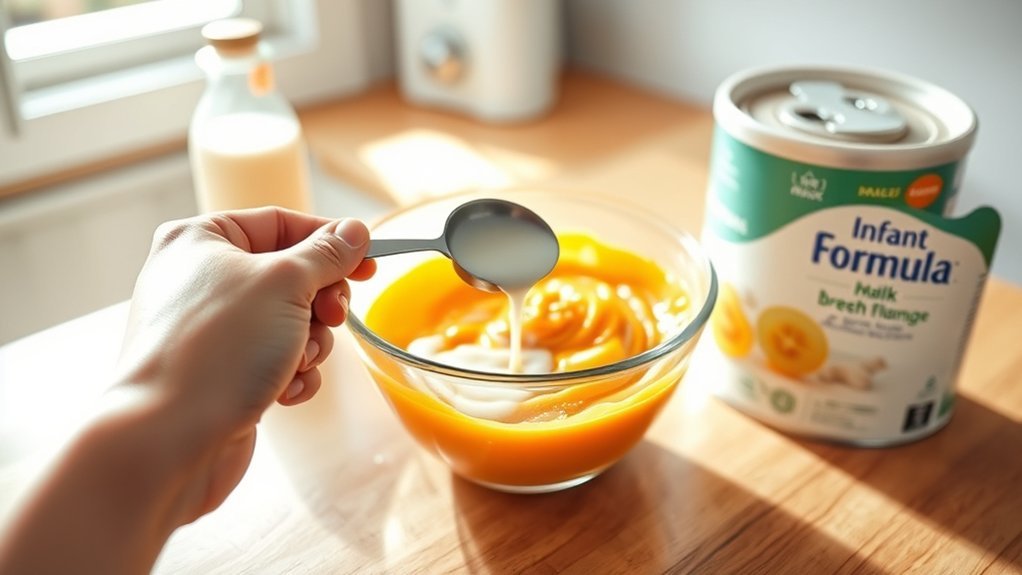
- Prepare powdered or concentrated formula according to the manufacturer’s label. Measure the water first, then add the exact amount of formula.
- Place one serving of puree in a clean bowl.
- Add 1 teaspoon of prepared formula and stir thoroughly.
- Add more prepared formula in teaspoon amounts until the texture is suitable.
- Serve cold, room temperature, or lukewarm. Formula does not need to be warmed.
Use prepared formula within 2 hours of preparation and within 1 hour after feeding begins. Refrigerate it immediately if feeding has not started, and use it within 24 hours.
Warning: Discard formula-thinned puree left in the serving bowl after feeding. Saliva can introduce bacteria. Do not freeze puree mixed with prepared formula because freezing formula is not recommended and may cause its components to separate.
What Not to Do When Thinning Baby Purees
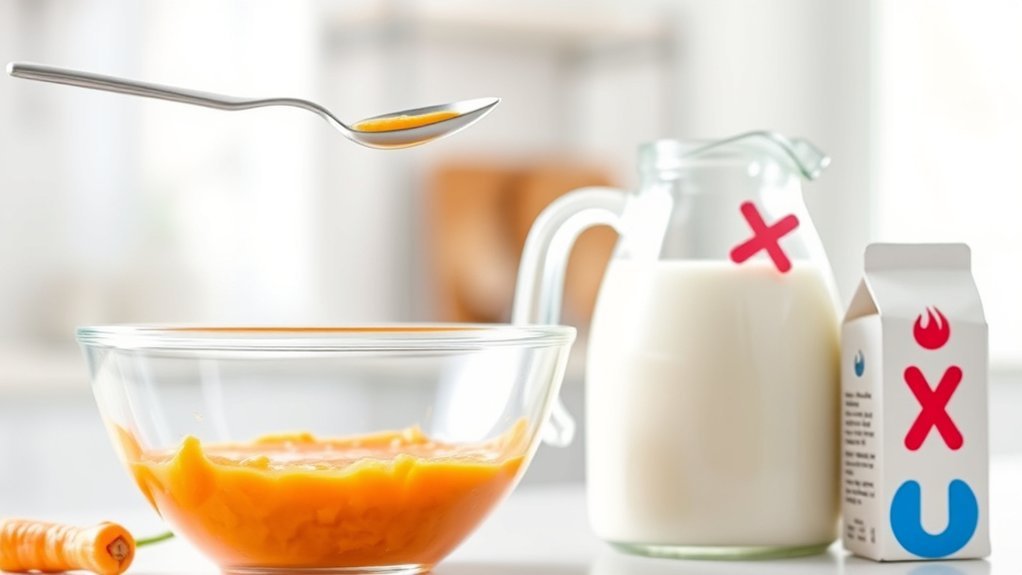
- Do not use a fixed tablespoon rule. Start with a teaspoon so the puree does not become watery.
- Do not alter the formula ratio. Prepare formula according to its label before adding it to food.
- Do not assume previously frozen breast milk is unsafe. Properly thawed milk may be used, but it must be used within the recommended time and never refrozen after thawing.
- Do not serve food hot. Stir warmed puree, let it stand, and test it before feeding. Never microwave breast milk or formula.
- Do not save food from the feeding bowl. Saliva can contaminate leftovers.
- Do not add honey for a baby younger than 12 months. Honey can cause infant botulism.
- Do not use juice as a routine thinner. The CDC says children younger than 12 months should not drink fruit or vegetable juice. Plain water, breast milk, formula, or unsalted cooking water are better choices.
- Do not use salty broth. Many commercial broths contain more sodium than a baby needs.
Flavor-Boosting Tips for Thinned Baby Purees
A baby does not need juice, sugar, syrup, or honey to make puree appealing. The food’s natural flavor is enough. When you want variety, combine foods your baby has already tolerated and keep the texture appropriate for their skills.
Natural Sweetness Boosting Options
- Mashed ripe banana: adds sweetness and creaminess.
- Cooked sweet potato: adds a naturally sweet flavor and a thicker texture.
- Pureed pear or peach: blends well with plain grains or vegetables.
- A small pinch of cinnamon: may be used after the ingredients in the puree have already been tolerated.
Use fruit puree rather than juice. Whole and pureed fruit provide more fiber and help a baby learn the food’s natural taste.
Flavor Pairing Ideas
- Banana with avocado
- Carrot with pear
- Sweet potato with plain, fortified oat cereal
- Peas with potato
- Chicken with unsalted vegetable puree
When introducing a new ingredient, offer one single-ingredient food at a time first and watch for a reaction. The CDC recommends waiting 3 to 5 days between new foods during early introduction. If your baby has severe eczema or an egg allergy, ask a clinician how to introduce peanut-containing foods safely.
Nutrient-Rich Additions
- Breast milk or prepared formula: useful for thinning and a familiar flavor.
- Plain water or unsalted cooking water: useful when only a small texture adjustment is needed.
- Pureed beans, meat, egg, or lentils: can increase protein and iron when introduced in an age-appropriate form.
- Fortified oat, barley, or multigrain infant cereal: can thicken a puree that became too runny. Offer a variety rather than relying only on rice cereal.
- Plain pasteurized yogurt without added sugar: can add creaminess after dairy foods have been introduced safely.
How to Store Thinned Baby Purees Safely
Storage time depends on the puree and the liquid used. Follow the shortest safe time for any ingredient in the mixture. Refrigerate perishable puree promptly and do not leave baby food or formula at room temperature for more than 2 hours. The simplest approach is to keep the main batch plain and add breast milk or formula only to the serving you are about to offer.
- Untouched homemade puree: refrigerate promptly and use within 1 to 2 days. FoodSafety.gov lists 1 day for strained meat or egg and 1 to 2 days for meat-and-vegetable combinations.
- Puree mixed with prepared formula: use within 2 hours of preparation. If feeding has not begun, refrigerate immediately and use within 24 hours. Do not freeze.
- Puree mixed with fresh breast milk: refrigerate promptly and follow the shortest storage limit for the puree and milk. Mixing only one serving is the safest way to avoid waste and timing confusion.
- Puree mixed with thawed breast milk: use within 24 hours after the milk is completely thawed, within 2 hours after warming or reaching room temperature, and never refreeze.
- Any puree already served: discard the leftovers because the spoon can transfer saliva to the food.
Freeze untouched homemade puree in clean, covered portions, label it with the food and date, and thaw it in the refrigerator. FoodSafety.gov provides ingredient-specific refrigerator and freezer limits for baby food.
If you warm baby food in a microwave, transfer it to a microwave-safe dish, stir well, let it stand, and test the temperature. Never microwave breast milk or formula, and never heat baby food in its original jar.
What to Use If You Don’t Have Formula or Breast Milk
For a baby who is already developmentally ready for solids, plain water is the simplest alternative. Add it 1 teaspoon at a time. You can also use unsalted cooking water left from steaming or boiling the same fruit, vegetable, grain, or protein.
- Good choices: plain water, unsalted cooking water, or another previously tolerated puree.
- Avoid: fruit or vegetable juice before 12 months, salty broth, sweetened liquids, unpasteurized liquids, and honey before 12 months.
- Remember: water used to adjust texture does not replace breast milk or formula feeds during the first year.
Quick Consistency Check Before Serving
Before offering the puree, scoop a small amount and tilt the spoon. A beginner puree should be smooth and slide off slowly without large hard pieces. It should not pour like a drink or separate into a watery layer.
Seat your baby upright in a high chair or another safe feeding seat. Offer small spoonfuls and allow time to swallow. Gagging can be noisy and is common while learning; choking may be silent and can prevent breathing. Learn infant choking first aid and CPR from a qualified instructor, and seek emergency help immediately if your baby cannot breathe, cry, or cough.
Frequently Asked Questions
Can I use water instead of breast milk or formula?
Yes. For a baby who is ready for solids, add plain water about 1 teaspoon at a time. Water changes texture but does not replace the nutrition from breast milk or formula.
How do I know when the puree is thin enough?
It should be smooth, hold briefly on the spoon, and slide off with a gentle tilt. Use your baby’s feeding skills as the guide rather than aiming for one universal thickness.
Is it safe to freeze thinned baby puree?
Freeze plain homemade puree in covered portions. Do not freeze puree mixed with prepared formula, and never refreeze puree made with breast milk that was already thawed.
Can I use previously frozen breast milk?
Yes, when it was thawed safely. Use it within 24 hours after it is completely thawed in the refrigerator, use it within 2 hours after warming or bringing it to room temperature, and never refreeze it.
Can I mix different purees together?
Yes. First introduce the ingredients separately so you can spot a possible reaction. Once each food is tolerated, combining them can add variety in flavor and texture.
How long does thinned puree last in the refrigerator?
It depends on the ingredients. Prepared formula mixtures should be used within 24 hours when refrigerated before feeding. Homemade puree is generally kept 1 to 2 days, while thawed breast milk must be used within 24 hours after fully thawing. Always follow the shortest limit.
Can I microwave thinned puree?
It is safer to warm the plain puree first and add milk afterward. If you microwave food, use a separate dish, stir thoroughly, let it stand, and test it. Never microwave breast milk or formula.
Should I use apple juice or broth to thin puree?
Do not use juice for a baby younger than 12 months. Avoid regular broth because it may be high in sodium. Plain water or unsalted cooking water is a better alternative when breast milk or formula is unavailable.
Conclusion
Thinning baby food puree is a small adjustment, not a strict recipe. Portion the food first, add breast milk, prepared formula, or water by the teaspoon, and stop when the texture fits your baby’s current skills. Keep your baby upright and supervised, move toward thicker textures as feeding develops, and follow the shortest storage limit for every ingredient in the bowl.
Sources
- CDC: When, What, and How to Introduce Solid Foods — readiness signs, texture progression, allergen introduction, and choking prevention.
- CDC: Infant Formula Preparation and Storage — correct mixing, temperature, use times, and disposal after feeding.
- CDC: Breast Milk Storage and Preparation — fresh and thawed milk storage, warming, and refreezing rules.
- CDC: Foods and Drinks to Avoid or Limit — juice, honey, added sugar, sodium, and unpasteurized foods.
- FoodSafety.gov: Children Under Five — refrigerator and freezer limits for pureed foods and safe microwaving.
- FDA: Once Baby Arrives — preventing saliva contamination, safe heating, and baby-food handling.