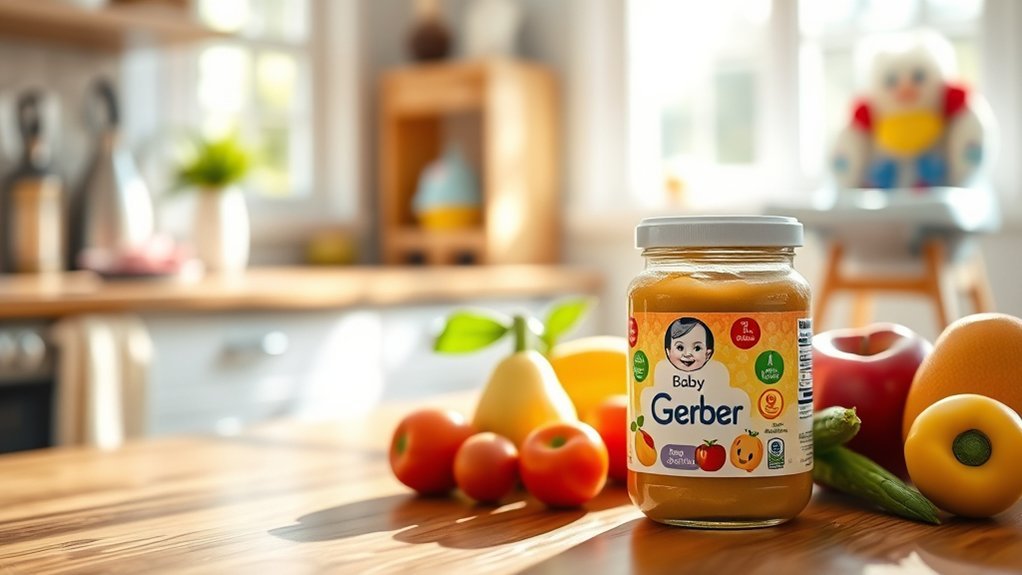
Gerber baby food, like homemade and other packaged baby foods, can contain trace amounts of arsenic, lead, cadmium, or mercury because these elements occur in soil, water, and air. The most useful safety question is not whether every Gerber product is completely metal-free, but whether a specific product is tested, meets current regulatory guidance, and forms part of a varied diet.
Quick Answer
Gerber baby food is not metal-free, and no baby food can be guaranteed free of naturally occurring arsenic, lead, cadmium, or mercury. Gerber says it tests finished products and publishes batch results, but historical government reports found concerning levels in some ingredients and cereals. Check current lot data, vary foods, and follow FDA alerts.
Key Takeaways
- Heavy metals can enter both packaged and homemade baby food through soil, water, air, and agricultural ingredients.
- Congressional reports published in 2021 documented historical concerns involving some Gerber ingredients and rice cereals, but those findings do not identify the level in a product currently on a store shelf.
- FDA currently lists category-specific lead action levels and a 100 ppb inorganic arsenic action level for infant rice cereal.
- California AB 899 now requires regular finished-product testing and public disclosure of arsenic, cadmium, lead, and mercury results for covered baby foods.
- Parents can reduce repeated exposure by rotating grains and produce, checking batch results, using safe water, and discussing suspected exposure with a pediatrician.
Warning: A product test result cannot diagnose heavy-metal exposure in a child. Contact your pediatrician if your child may have eaten a recalled or unusually contaminated product, or if you are concerned about lead exposure. A healthcare professional can decide whether blood testing or other follow-up is appropriate.
Assessing Heavy Metal Safety in Gerber Baby Food
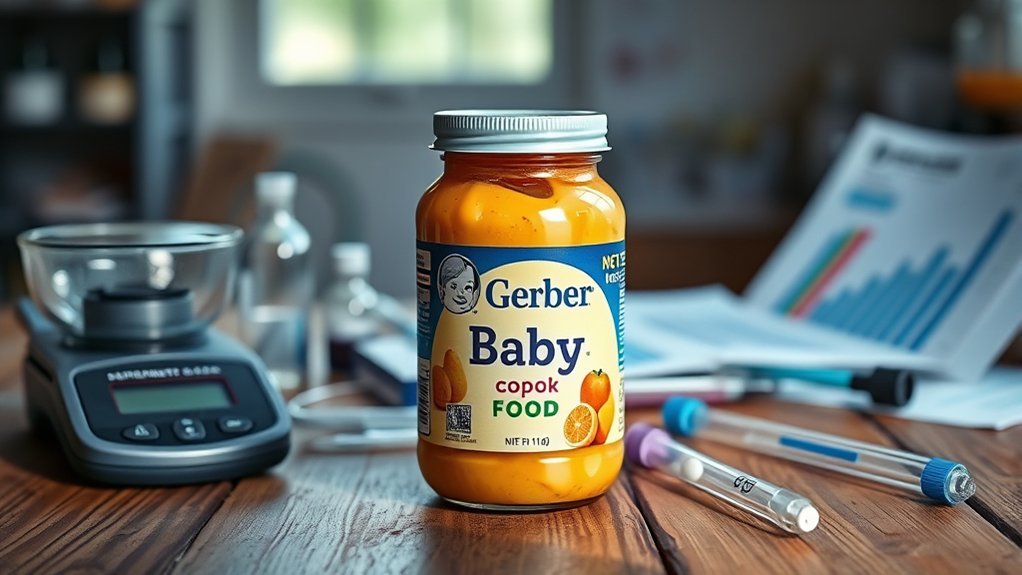
There is no honest brand-wide yes-or-no answer that applies to every Gerber jar, pouch, cereal, snack, and production lot. Heavy-metal levels differ by ingredient, crop source, food category, production date, and batch.
The U.S. Food and Drug Administration explains that arsenic, lead, cadmium, and mercury may occur in food because they are present in the environment. They cannot always be eliminated completely from fruits, vegetables, or grains, including foods grown organically or used in homemade baby food.
Gerber states that its current products are tested under a farm-to-finished-product quality program. However, two congressional reports published in 2021 documented historical concerns involving some Gerber ingredients and infant cereals. Those reports remain relevant to the history of baby-food oversight, but they should not be presented as current test results for every Gerber product.
A historical brand finding does not reveal the metal level in the package in your hand. Current safety decisions should use the product category, lot or batch result, applicable FDA guidance, and any active recall or safety alert.
Identifying Sources of Heavy Metals in Baby Food
Heavy metals can reach baby food at several points in the food supply. The main pathway is environmental: crops may absorb naturally occurring or pollution-related elements from soil and water as they grow. Ingredient selection, water quality, equipment controls, and finished-product testing can then affect the level in the final food.
Natural Environmental Presence
Arsenic, lead, cadmium, and mercury are elements found in the environment. Their presence does not automatically mean a manufacturer intentionally added them. It does mean growers and manufacturers need controls that reduce exposure as far as practical.
| Potential Source | How It Can Affect Food | Useful Control |
|---|---|---|
| Soil | Plants can absorb arsenic, cadmium, or lead while growing. | Field selection, soil testing, crop choice, and ingredient sourcing. |
| Agricultural or processing water | Contaminated water can contribute metals to crops or finished food. | Water testing and treatment. |
| Naturally higher-uptake crops | Rice tends to accumulate more inorganic arsenic than many other grains, while root vegetables may have more contact with lead-containing soil. | Lower-level sources, varied ingredients, washing, peeling where appropriate, and final-product testing. |
| Ingredient combinations | Several ingredients can contribute to the measured level in a finished product. | Test ingredients and representative samples of the finished food. |
Agricultural Practices Impacting Levels
Growing practices can lower metal uptake, but no farming label guarantees a metal-free crop. Organic standards address how food is grown; they do not remove arsenic, lead, cadmium, or mercury already present in soil and water.
Gerber says its growers use measures such as soil testing, crop rotation, field selection, and harvest controls. These practices may help reduce contamination, but the most useful evidence for a finished baby food is still a representative final-product test.
Note: “Organic,” “natural,” or “homemade” does not mean “free of heavy metals.” Compare transparent testing practices and current product results rather than relying on a front-label claim alone.
Food Processing and Final-Product Testing
It is inaccurate to assume that ordinary processing automatically adds every heavy metal to food. However, processing can combine ingredients from several sources, and the concentration measured in a finished product may differ from estimates based only on individual ingredients.
This is why testing finished baby food matters. A strong program should assess incoming ingredients, water, processing controls, and representative samples of the final product rather than relying on supplier documents alone.
| Production Stage | What Should Be Checked | Why It Matters |
|---|---|---|
| Crop and supplier selection | Soil, water, location, and ingredient history | Reduces contamination before ingredients reach the factory. |
| Incoming ingredients | Metal levels in higher-risk grains, produce, spices, and mineral premixes | Helps reject or limit higher-level ingredients. |
| Manufacturing | Water, equipment, sanitation, traceability, and formulation | Controls avoidable contamination and allows investigation of a problem. |
| Finished product | Representative samples tied to a production aggregate or batch | Shows the level in the food that will actually be sold. |
What Testing Protocols Are in Place for Heavy Metals?
According to Gerber’s published quality information, the company tests crops, water, ingredients, and final products. Gerber says it regularly tests for more than 500 toxins and contaminants and requires its baby foods to pass more than 100 individual quality checks before sale.
Gerber also states that its testing is conducted by ISO-accredited laboratories and that it works with additional outside laboratories to improve analytical methods. ISO accreditation supports laboratory competence and reliable procedures, but it does not by itself prove that every product contains zero heavy metals or that every result is below every possible health benchmark.
The company further reports that selected foods have earned Clean Label Project certifications. Certification can add another layer of testing, but it applies only to the certified product or program and should not be treated as a blanket guarantee for every Gerber item or production lot.
Pro Tip: When comparing baby-food brands, look for finished-product testing, lot-level results, clear units, dates, and easy access to the data. A general statement that a brand “tests rigorously” is less useful than a result tied to the package you are considering.
Current FDA Action Levels for Baby Food
The FDA uses action levels to identify contaminant concentrations at which it may consider enforcement, along with other evidence. These levels are industry guidance and are not a promise that exposure below the number carries no risk.
| Element | Covered Food Category | FDA Action Level or Status |
|---|---|---|
| Lead | Processed fruits, non-root vegetables, mixtures, yogurts, custards or puddings, and single-ingredient meats intended for children under 2 | 10 ppb |
| Lead | Single-ingredient root vegetables intended for children under 2 | 20 ppb |
| Lead | Dry infant cereals | 20 ppb |
| Inorganic arsenic | Rice cereals for infants | 100 ppb |
| Cadmium | Broad processed baby-food categories | FDA’s Closer to Zero work remains ongoing; no single broad final baby-food action level is listed in the current guidance. |
| Mercury | Broad processed baby-food categories | FDA data collection and action-level work remain ongoing; no single broad final baby-food action level is listed in the current guidance. |
Note: Do not compare a result with an unrelated drinking-water, candy, juice, or workplace limit and assume the comparison proves that a baby food is safe or unsafe. Standards account for the product, serving pattern, population, and regulatory purpose.
What Are the Testing Results for Heavy Metals in Gerber Products?
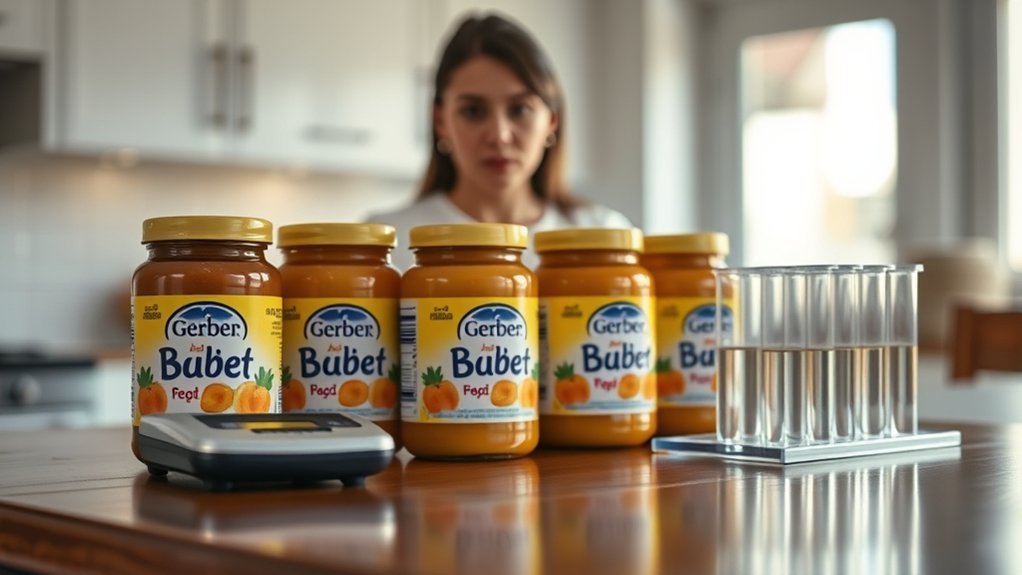
The most widely cited Gerber findings come from two U.S. House staff reports published in 2021. These reports used company documents, ingredient data, and laboratory results available at that time. They do not establish the metal level in every Gerber product sold today.
Historical Lead and Cadmium Findings
The February 2021 House report stated that Gerber had accepted tested sweet-potato ingredients containing as much as 48 ppb lead. It also reported that some tested Gerber carrot ingredients contained as much as 87 ppb cadmium and that 75% of the carrot samples provided to the investigation exceeded 5 ppb cadmium.
Those figures concerned historical ingredient records, not a claim that every Gerber sweet-potato or carrot product contained those concentrations. They also should not be combined with rice-cereal data to create a result that the report did not publish.
Historical Inorganic Arsenic Findings in Rice Cereal
A September 2021 follow-up report cited Alaska laboratory tests of Gerber rice cereals. Four samples of Gerber Organic Rice Cereal ranged from 53.9 to 76 ppb inorganic arsenic and averaged 65.6 ppb.
The average was below FDA’s 100 ppb inorganic arsenic action level for infant rice cereal. However, an action level is not the same as zero exposure, and a 2021 average cannot be used to predict the result for a cereal produced several years later.
The House report also criticized Gerber for not recalling the rice cereal associated with the findings described at that time. That statement should be limited to the historical episode; it does not mean that Gerber has never recalled any product for any reason.
How to Evaluate Current Gerber Products
Gerber states that it now publishes heavy-metal results for qualifying foods produced on or after January 1, 2025. Current results should be matched to the product name, UPC, lot or production information, and manufacture or best-by date whenever those details are provided.
- Use the QR code or testing link on the package.
- Confirm that the result matches the exact product and lot rather than a similar flavor or container size.
- Check whether a reported number is a detection, an average, a maximum, or a reporting limit.
- Compare the result with FDA guidance for the same metal and food category.
- Check the FDA recall and safety-alert pages for newer information.
California AB 899 and Public Test Results
California Assembly Bill 899 is no longer an upcoming proposal. The law was signed in October 2023. Testing duties began in 2024, while public disclosure and labeling requirements applied to covered baby food sold, manufactured, delivered, held, or offered for sale in California beginning January 1, 2025.
Under current California Department of Public Health guidance, manufacturers must test representative samples of covered final baby-food products for:
- Arsenic
- Cadmium
- Lead
- Mercury
Covered baby food generally includes foods in jars, pouches, tubs, and boxes marketed specifically for babies and children younger than 2. Infant formula is excluded from the baby-food definition used for these provisions.
How to Use a QR Code or Batch Disclosure
- Match the package. Confirm the product name, flavor, container size, UPC, and lot or best-by information.
- Check the unit. Results are often reported in parts per billion, abbreviated ppb.
- Read all four results. A page may report arsenic, cadmium, lead, and mercury separately.
- Check the food category. The applicable FDA lead action level differs for a fruit puree, root vegetable, mixture, and dry cereal.
- Look for context. Determine whether “less than” means the element was below the laboratory’s reporting limit rather than completely absent.
- Keep the packaging when reporting a concern. The lot, UPC, and best-by date help the manufacturer, FDA, and health department investigate.
One ppb means one part of a substance per billion parts of the food by weight. The unit describes concentration; it does not by itself show how much a child absorbed. Serving size, frequency, the child’s age, other exposure sources, and the chemical form of the element also matter.
Practical Tips for Reducing Heavy Metal Exposure in Baby Food
You cannot remove every trace of environmental metals from a child’s diet, but you can reduce repeated exposure from a single food or source. The goal is variety and informed selection, not unnecessary elimination of nutritious foods.
Diverse Food Options
- Rotate infant cereals. Rice cereal does not need to be the first or only cereal. Consider iron-fortified oat, barley, wheat, or multigrain cereals when age-appropriate and suitable for your child.
- Vary fruits and vegetables. Avoid relying on the same root vegetable or puree at every meal.
- Include iron- and zinc-rich foods. Age-appropriate meat, poultry, beans, seafood, and fortified cereals support development and may help protect against harmful effects from environmental contaminants.
- Use safe water. Prepare cereals and homemade foods with water from a safe source. Consider testing private-well water according to local health guidance.
- Follow age and texture guidance. Reducing metal exposure should not introduce choking, allergy, or nutritional risks.
The FDA’s healthy food choices guidance for babies recommends a varied diet and says rice cereal should not be the only grain-based infant cereal.
Consult Healthcare Professionals
Talk with your pediatrician if you believe your child consumed a recalled food, repeatedly ate a product with an unusually high result, lives in a home with possible lead paint or plumbing exposure, or has another known lead risk.
Most children with lead exposure do not show clear immediate symptoms. A blood lead test is the standard way to assess lead exposure. A food test result cannot be converted directly into a predicted blood lead level.
Do not start supplements or remove major food groups solely because of an online article. A pediatrician or registered dietitian can help maintain adequate iron, zinc, calories, and dietary variety.
Check Ingredient Labels and Product Information
- Review the ingredient list for repeated use of rice, rice flour, or the same root vegetable across several daily foods.
- Do not assume an organic product contains fewer heavy metals than a conventional one.
- Look for lot-level testing disclosures rather than relying only on brand-wide marketing.
- Confirm whether a third-party certification applies to the exact product.
- Check the package for damage, swelling, leaks, a broken seal, or an unusual odor and do not feed a questionable product.
- Review current FDA recall notices before continuing to use a product named in a safety alert.
Exploring Gerber’s Quality Assurance Practices
Gerber describes a quality system that covers growers, ingredient suppliers, water, manufacturing, final products, and outside laboratory support. The company says its agricultural teams use soil testing, field selection, crop rotation, and supplier controls to reduce metals before ingredients reach production.
Gerber also reports that qualifying products manufactured from January 2025 onward have heavy-metal test results made available to consumers in response to California AB 899. This added transparency is useful because it lets parents evaluate a specific product rather than relying only on a general brand promise.
| Gerber-Reported Practice | What It Shows | Important Limitation |
|---|---|---|
| More than 500 toxins and contaminants tested | The company reports a broad analytical program. | The claim does not replace the result for a specific lot. |
| More than 100 quality checks | Multiple controls may be used from sourcing through release. | Not all checks necessarily concern heavy metals. |
| ISO-accredited laboratories | Laboratories follow recognized competence and quality requirements. | Accreditation does not mean every measured value is zero. |
| Selected Clean Label Project certifications | Some products have undergone an additional certification process. | Certification should not be generalized to uncertified products or future lots. |
| Public batch disclosures | Consumers can obtain more product-specific information. | Results must still be matched carefully to the package and interpreted by food category. |
A balanced assessment should consider both Gerber’s current controls and the historical government findings. Neither company assurances nor an old report alone provides a complete picture of a product manufactured today.
Frequently Asked Questions
Is Gerber baby food safe?
Gerber baby food is regulated food and the company reports extensive testing, but no packaged or homemade baby food can be guaranteed free of environmental metals. Evaluate the specific product, current lot result, applicable FDA guidance, recall status, and your child’s overall dietary variety.
Does organic Gerber baby food contain fewer heavy metals?
Not necessarily. Organic farming rules do not remove arsenic, lead, cadmium, or mercury already present in soil and water. A product-specific finished-food test is more informative than the organic label alone.
Should I stop feeding my baby rice cereal?
Rice cereal does not have to be eliminated, but it should not be the only grain cereal. Rotate it with iron-fortified oat, barley, wheat, or multigrain cereals when appropriate for your child. Follow allergy and texture guidance from your pediatrician.
What does ppb mean on a heavy-metal test result?
PPB means parts per billion and describes concentration by weight. A ppb result does not directly show how much a child absorbed. Serving size, feeding frequency, age, other exposure sources, and the form of the metal also affect risk.
Is homemade baby food safer than Gerber baby food?
Homemade food is not automatically lower in heavy metals because store-bought produce and grains also grow in soil and water. Homemade preparation gives you control over ingredients, but the ingredients usually do not come with finished-food metal test results. Variety, safe water, and reliable sourcing remain important.
How can I find current Gerber heavy-metal results?
Check the QR code or testing information on the product package and match the result with the exact product, UPC, lot code, and best-by or production information. Gerber states that results for qualifying foods manufactured from January 1, 2025 onward are publicly reported.
Should my child have a blood lead test after eating baby food?
A baby-food concern does not automatically mean testing is required. Contact your pediatrician if your child ate a recalled product, had repeated exposure to a product with an unusually high result, or has other lead risk factors. The pediatrician can decide whether a blood lead test is appropriate.
How do I report a concern about Gerber baby food?
Keep the package, lot code, UPC, best-by date, receipt, and photographs. Contact Gerber and submit the concern through the FDA’s Report a Problem portal. Contact a healthcare professional promptly if a child is ill or may have been harmed.
Conclusion
Gerber’s current testing program and public batch disclosures provide more information than parents had when the 2021 congressional reports were published. Those historical findings should not be ignored, but they also should not be treated as proof that every Gerber product currently contains the same levels.
Use the result for the specific product and lot whenever it is available. Compare it with the correct FDA food category, rotate grains and produce, use safe water, and check current recalls. Speak with your pediatrician when exposure is suspected rather than trying to diagnose risk from a label or ppb number alone.
Sources
- FDA: Action Levels for Lead in Processed Food Intended for Babies and Young Children — current lead action levels and their regulatory meaning.
- FDA: Action Level for Inorganic Arsenic in Rice Cereals for Infants — the 100 ppb infant-rice-cereal action level.
- FDA: Healthy Food Choices to Help Protect Babies From Environmental Contaminants — dietary variety, grain rotation, iron, and zinc guidance.
- California Department of Public Health: AB 899 Frequently Asked Questions — current testing, disclosure, and labeling requirements.
- U.S. House Staff Report, February 2021 and September 2021 Follow-Up Report — historical Gerber ingredient and rice-cereal findings.
- Gerber Medical Hub: Answers to Questions About Heavy Metals — Gerber’s description of its current testing, quality checks, laboratory use, and public disclosures.