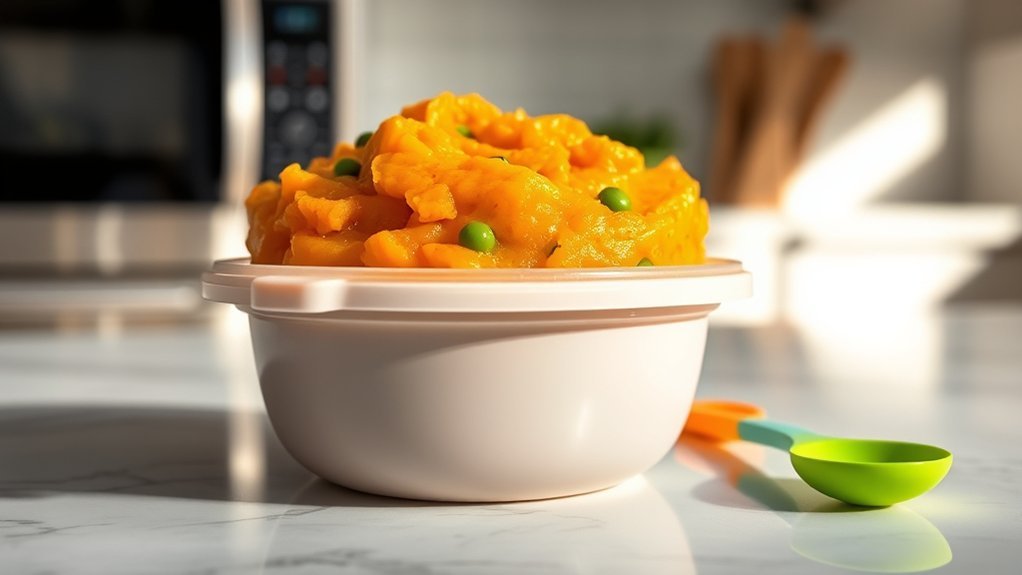
Baby food can be warmed in a microwave, but you should not place every baby food container directly inside one. The safest approach is to transfer a small serving of solid food to a microwave-safe glass or ceramic dish, heat it briefly, stir it well, let it rest, and test the temperature before feeding your baby.
Quick Answer
Do not microwave baby food in its original jar, a sealed container, or plastic that is not specifically labeled microwave-safe. Transfer solid food to a suitable dish, heat it in short bursts, stir thoroughly, let it stand for at least 30 seconds, and serve it lukewarm. Never microwave breast milk or infant formula.
Key Takeaways
- Solid baby food may be microwaved after it is transferred from the jar or package to a microwave-safe dish.
- Microwaves can create hot spots, so always stir, let the food stand, and test it before feeding.
- Never microwave breast milk or infant formula because uneven heating can burn a baby’s mouth and throat.
- A “BPA-free” label or recycling code does not prove that a plastic container is microwave-safe.
- Research has found that some heated plastics release microplastics and nanoplastics, but the health effects of typical food exposure remain uncertain.
- Discard food left in the serving dish after feeding because the baby’s saliva can introduce bacteria.
At a Glance
| Time Required | About 1–3 minutes, including standing and temperature testing |
| Difficulty | Easy |
| Tools Needed | Microwave-safe dish, spoon, and clean serving bowl |
| Cost | No added cost if you already have a suitable dish |
Can You Microwave Baby Food Containers?
You should not assume that a baby food jar, pouch, tub, or storage container can go directly into a microwave. The answer depends on the material, the manufacturer’s instructions, whether the container is sealed, and what type of food is inside.
The U.S. Food and Drug Administration advises parents not to microwave baby food in its jar. Instead, place one serving in a separate dish so you can stir the food thoroughly and test its temperature.
Microwaving the solid food itself can be acceptable when you use a suitable dish and follow safe heating steps. The main immediate risk is uneven heating. A portion may feel cool near the edge while the center is hot enough to burn a baby’s mouth.
Warning: Never microwave breast milk or infant formula. Microwaves can create hidden hot spots that may scald a baby’s mouth or throat. Warm bottles under running warm water or place them in a bowl of warm water instead.
What Research Says About Heating Plastic
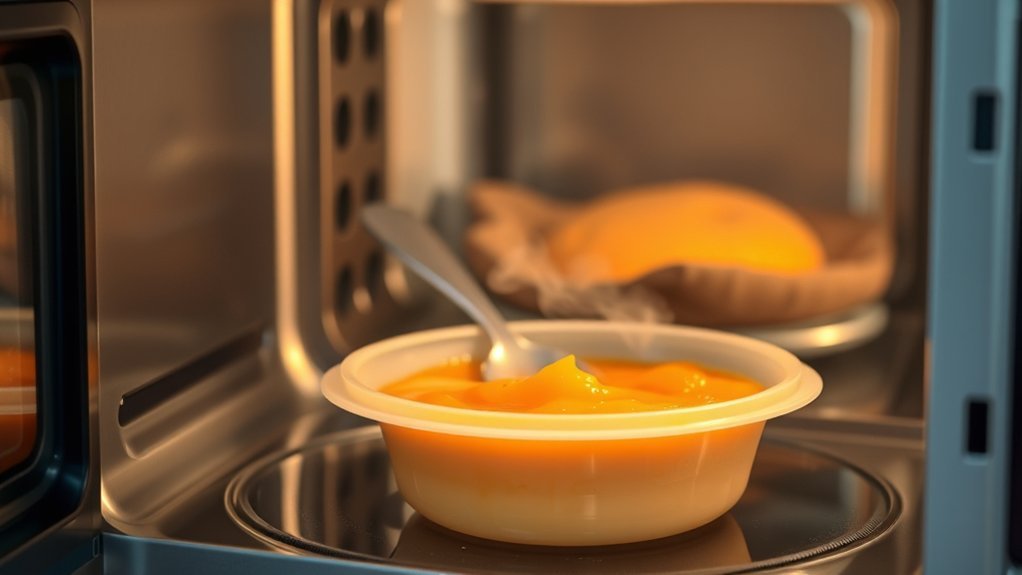
A 2023 study published in Environmental Science & Technology examined two polypropylene baby food containers and one reusable polyethylene pouch. The researchers filled them with water or an acidic food-simulating liquid and tested refrigeration, room-temperature storage, and microwave heating.
Microwave heating caused the highest particle release in the study. Under some test conditions, the researchers measured more than two billion nanoplastic particles and four million microplastic particles per square centimeter of container.
The study shows that certain plastics can shed large numbers of particles during microwave heating, but it does not prove that ordinary use causes illness in infants.
What the Cell Study Found
The researchers also exposed cultured embryonic kidney cells to particles released from the tested containers. Cell survival fell at the highest experimental concentrations.
This finding supports the need for more research, but it must be interpreted carefully. The cells were exposed directly under laboratory conditions, including particle concentrations intended to represent accumulation from multiple exposures. The experiment was not a clinical study in babies and did not measure real-world childhood disease.
What Health Agencies Say
The FDA states that current scientific evidence does not demonstrate that the levels of microplastics and nanoplastics detected in foods pose a risk to human health. It also notes that detection methods and definitions are not yet standardized.
The World Health Organization has reviewed dietary and inhalation exposure to microplastics and identified major evidence gaps. Researchers still need better information about exposure levels, absorption, particle characteristics, and long-term effects.
Note: Avoiding unnecessary heating in plastic is a reasonable precaution, but claims that food-related microplastics are proven to cause hormonal, immune, developmental, or cognitive disorders in children go beyond the available evidence.
How to Heat Baby Food Safely in the Microwave
Use the following method for puréed or solid baby food. Microwave power and food thickness vary, so use the shortest heating time that makes the food lukewarm.
- Wash your hands. Use a clean spoon, dish, and preparation surface.
- Portion the food. Transfer only the amount your baby is likely to eat to a microwave-safe glass, ceramic, or approved plastic dish.
- Remove all lids and seals. Never microwave a sealed jar, capped container, foil seal, metal lid, or metal-trimmed dish.
- Heat briefly. FDA guidance suggests about 15 seconds on high for four ounces of solid baby food. Begin with less time for a smaller serving or a powerful microwave.
- Stir thoroughly. Scrape the bottom and sides and mix the center into the cooler outer portion.
- Let it stand. Wait at least 30 seconds so heat can spread through the food.
- Stir and test again. The food should feel lukewarm, not hot. Test a small amount with a clean spoon before feeding.
Pro Tip: Heat only one serving. Leaving the rest of the food in its original container prevents the baby’s saliva from contaminating food you plan to refrigerate.
Which Containers Are Suitable?
Microwave-safe glass or ceramic is a simple choice because it does not rely on a plastic microwave-use claim. However, the dish must be free of cracks, metallic decoration, foil, and non-microwave-safe coatings.
A plastic container should be used only when it is specifically labeled for microwave heating and the instructions permit the food, temperature, and heating time you plan to use. Replace damaged, warped, heavily scratched, or discolored containers.
Why “BPA-Free” Is Not Enough
“BPA-free” means the product was made without bisphenol A. It does not tell you whether the container can withstand microwave heating, whether other additives are present, or whether the surface may shed particles as it ages.
Why Recycling Codes Are Not Safety Labels
Recycling numbers identify broad resin categories. They do not certify that a container is microwave-safe. Do not rely on codes 1, 2, 5, or any other number as a heating instruction.
Look for clear microwave-use directions on the container or packaging. When no directions are available, transfer the food to microwave-safe glass or ceramic.
What Not to Microwave
- Breast milk: Microwave heating can create hot spots and may affect some of the milk’s protective qualities.
- Infant formula: Formula does not need to be warmed. When warming is preferred, use warm water rather than a microwave.
- Baby food in its original jar: The center can become much hotter than food next to the glass.
- Sealed containers: Pressure can build and force hot food or steam outward.
- Containers without microwave instructions: Takeout tubs, disposable packaging, cold-storage containers, and reused commercial packaging may not be designed for heating.
- Containers with foil or metal: Metal can spark and damage the microwave.
- Baby-food meats, meat sticks, and eggs: FoodSafety.gov recommends stovetop heating because their fat content can contribute to splattering and overheating.
Non-Microwave Baby Food Heating Options
You do not have to warm baby food if your baby accepts it cool or at room temperature. When warming is preferred, the following methods provide more gradual heating.
Stovetop Heating Method
- Place one serving in a small saucepan.
- Warm it over low heat.
- Stir continuously to prevent sticking and hot spots.
- Remove it from the heat as soon as it is lukewarm.
- Transfer it to a clean dish and test it before feeding.
Warm Water Bath
Place the food in a closed, heat-safe container and set the container in a bowl of warm water. Keep water from entering the food. Stir the food after warming and test the temperature.
Double Boiler Technique
Place the baby food in a heat-safe bowl over a pan of gently simmering water. Stir until the food is evenly lukewarm. This method reduces direct contact with the burner, but the bowl and steam can become hot, so use oven mitts and keep your baby away from the cooking area.
Practical Ways to Reduce Plastic Contact
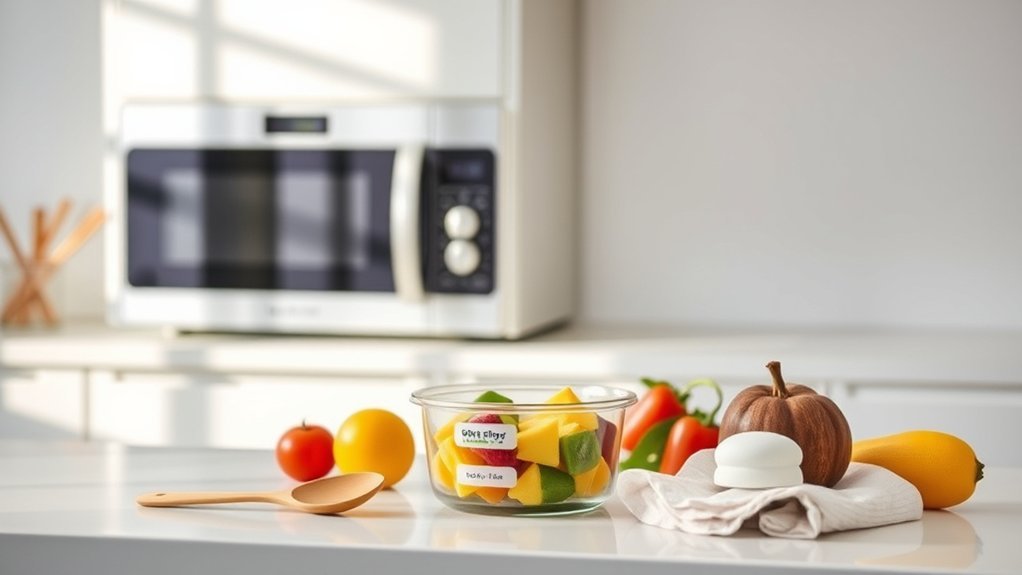
You cannot eliminate every source of microplastics, and current research does not provide a precise exposure limit for baby food. You can still reduce unnecessary plastic contact without treating every packaged food as dangerous.
- Transfer food to microwave-safe glass or ceramic before heating.
- Follow the manufacturer’s temperature and use instructions for every storage pouch or container.
- Do not heat disposable packaging unless it is specifically designed and labeled for microwave use.
- Replace plastic containers that are warped, cracked, rough, or heavily scratched.
- Avoid repeatedly heating and cooling food in the same disposable container.
- Use glass containers for refrigerated or frozen homemade portions when practical.
- Do not assume that “organic,” “natural,” “BPA-free,” or “food-grade” means microplastic-free.
Homemade baby food can help you control ingredients, texture, and serving size. Organic ingredients may reduce exposure to certain agricultural chemicals, but organic certification does not mean the food is free of microplastics.
How to Store and Reheat Baby Food Safely
Use clean, airtight containers and keep your refrigerator at 40°F (4°C) or colder. Label homemade portions with the preparation date.
| Food Type | Refrigerator | Freezer |
| Opened strained fruits and vegetables | 2–3 days | 6–8 months |
| Strained meats and eggs | 1 day | 1–2 months |
| Meat and vegetable combinations | 1–2 days | 1–2 months |
| Homemade baby food | 1–2 days | 1–3 months for best quality and conservative storage |
Storage recommendations can vary by recipe and appliance, so use the shorter period when you are unsure. Discard food that smells unusual, has changed appearance, or was left at room temperature for more than two hours.
Warning: Do not return food to the refrigerator after feeding directly from its jar or serving dish. Saliva transferred by the spoon can introduce bacteria. Portion the food before feeding and throw away anything left in the serving dish.
Frequently Asked Questions
Can I microwave baby food in a glass jar?
Do not microwave baby food in its commercial jar. Transfer one serving to a separate microwave-safe dish. Food in a jar may become much hotter in the center than it feels near the glass.
Can I microwave baby food in a plastic container?
Use plastic only when the container is specifically labeled microwave-safe and the manufacturer permits the intended heating time and food type. Microwave-safe glass or ceramic is a simpler option when the original packaging is unclear.
Does BPA-free mean a container is microwave-safe?
No. BPA-free means the product was made without bisphenol A. It does not certify that the container is suitable for microwave heating or that it will not release other substances or particles.
Which recycling codes are safe for microwaving?
A recycling code is not a microwave-safety certification. Check for explicit microwave-use instructions from the manufacturer instead of relying on the resin number.
How long should I microwave baby food?
FDA guidance suggests about 15 seconds on high for four ounces of solid food. Use less time for smaller servings, stir thoroughly, let the food stand for at least 30 seconds, and test it. Microwave wattage and food thickness can change the required time.
Can I microwave frozen baby food?
You can thaw and warm a small frozen portion in a microwave-safe dish, but use short intervals and stir repeatedly. Frozen centers and overheated edges are common. Make sure the entire serving is evenly thawed and lukewarm before feeding.
Are microplastics from heated containers proven to harm babies?
No direct evidence currently proves that ordinary dietary exposure from heated containers causes illness in babies. Laboratory studies have found particle release and cell effects under experimental conditions, but the FDA and WHO say important exposure and health questions remain unresolved.
Can I reheat baby food more than once?
It is best to heat only the serving you need. Discard food that has contacted the baby’s spoon or saliva. Repeated heating and cooling can reduce quality and create more opportunities for bacterial contamination.
Conclusion
You do not need to avoid every use of a microwave when preparing solid baby food. The safer method is to remove one serving from its original container, place it in a microwave-safe glass or ceramic dish, heat it briefly, stir it thoroughly, let it stand, and test it before feeding.
Do not microwave breast milk, formula, sealed containers, unsuitable plastic, or baby-food meats and eggs. Although research raises reasonable concerns about particle release from some heated plastics, scientists have not yet established the health effects of typical microplastic exposure from food. Using suitable containers and careful temperature checks addresses the clearest known risks without overstating the evidence.
This article provides general food-safety information. Ask your pediatrician for individual advice if your baby was born prematurely, has a weakened immune system, has feeding difficulties, or needs a medically prescribed diet.
Sources
- U.S. Food and Drug Administration: Once Baby Arrives — safe microwaving, temperature testing, storage, and leftover handling.
- FoodSafety.gov: Children Under Five — current baby food microwaving, storage, formula, and milk guidance.
- Environmental Science & Technology: Assessing the Release of Microplastics and Nanoplastics — 2023 laboratory study of particle release from tested containers and pouches.
- FDA: Microplastics and Nanoplastics in Foods — current assessment of evidence, analytical limitations, and health uncertainty.
- World Health Organization: Dietary and Inhalation Exposure to Nano- and Microplastic Particles — evidence review and research needs.
- Centers for Disease Control and Prevention: Infant Formula Preparation and Storage — warning against microwave heating of formula.