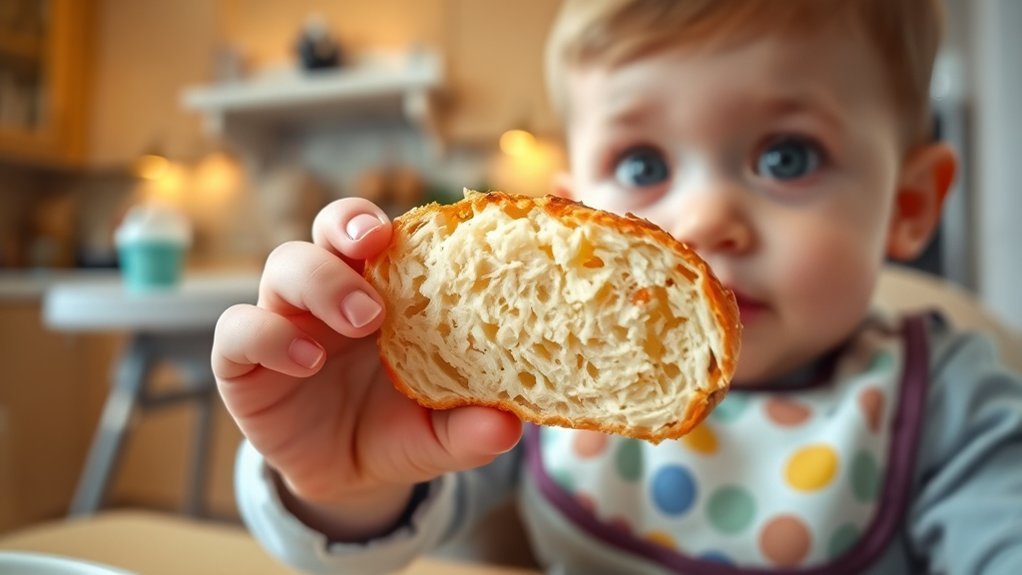
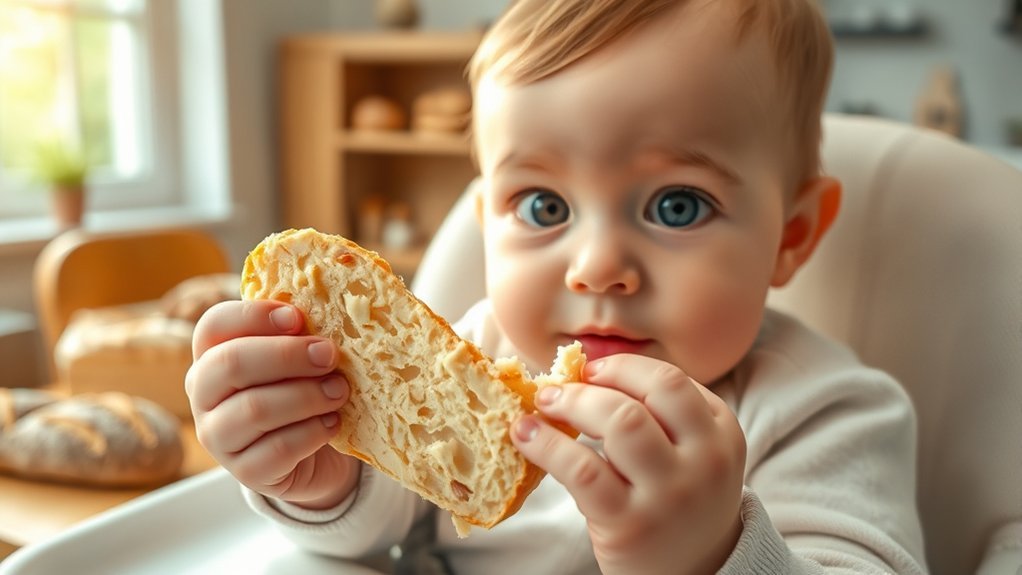
Babies can usually try bread at about 6 months, once they show the skills needed for solid foods. The safest serving method depends more on your baby’s development than on an exact birthday. Choose a simple bread, prepare it so it is not gummy or hard, and stay close while your baby eats. This guide offers general feeding information and does not replace advice from your child’s pediatrician or feeding specialist.
Quick Answer
Most babies can eat bread at about 6 months when they can sit upright with support, control their head and neck, bring food to their mouth, and swallow food. Start with a narrow strip of lightly toasted bread or another firm, manageable piece. Avoid honey before 12 months and supervise every bite.
Key Takeaways
- Offer bread at about 6 months only after your baby shows developmental readiness for solid foods.
- Lightly toast bread if it becomes sticky or forms a gummy ball in the mouth; do not make it rock-hard or brittle.
- Use narrow strips for babies who grasp with their whole hand and smaller pieces after a reliable pincer grasp develops.
- Check labels for honey, added sugars, sodium, and common allergens such as wheat, milk, egg, soy, and sesame.
- Bread should complement breast milk or infant formula and a varied diet that includes iron-rich foods, produce, and protein.
At a Glance
| Time Required | About 2 to 5 minutes to select, toast if needed, spread, and cut |
| Difficulty | Easy, with close supervision |
| Tools Needed | Knife, cutting board, optional toaster, and a secure high chair |
| Cost | Low; usually a fraction of the price of a loaf per serving |
When Can Babies Start Eating Bread?
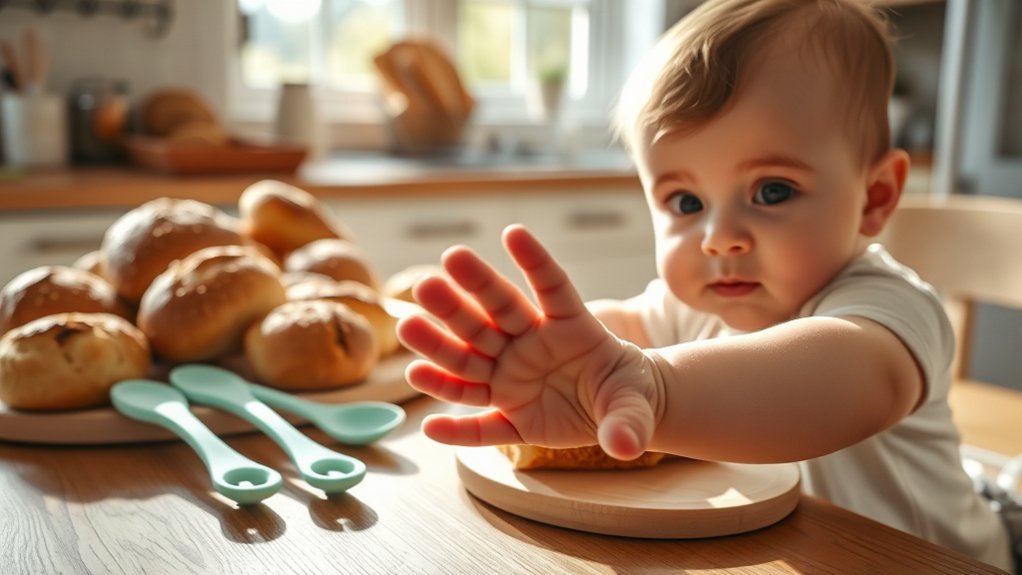
Most babies can begin eating complementary foods, including bread, at about 6 months. The Centers for Disease Control and Prevention recommends looking for readiness signs rather than relying on age alone.
- Your baby can sit upright alone or with support.
- Your baby controls their head and neck.
- Your baby opens their mouth for food and swallows instead of pushing food out.
- Your baby brings objects or food toward their mouth.
- Your baby can grasp food and move it around the mouth.
You do not need routine pediatric approval before offering bread to a healthy, developmentally ready baby. Contact your child’s clinician first if your baby was born prematurely, has swallowing or oral-motor problems, has poor growth, has severe eczema, has already reacted to a food, or has another condition that affects feeding.
Warning: Never offer bread while your baby is lying down, crawling, walking, riding in a stroller, or sitting in a moving car. Seat your baby upright in a secure high chair and watch continuously during the meal.

Power your essentials anywhere with a 999Wh pure sine wave power station delivering up to 1000W continuous with 2000W surge. It supports fast charging via USB-C PD 60W and USB-A QC 18W, plus simultaneous output for multiple devices through AC, USB, wireless, and car/DC ports. Recharge using AC, car, or solar with a built-in MPPT controller and dual cooling fans, while the upgraded battery management system protects against surges, short circuits, and overheating.

【Perfect Fit for Graco High Chairs】– Engineered for seamless compatibility, these replacement straps install effortlessly, providing a secure and reliable fit for your Graco high chair.

Convenient:Turn a regular chair into a high chair in the snap of a finger! Easy to use,the high chair cover will comfortably and safely provide the perfect safe space for baby to sit, eat, and play.You can take this portable high chair harness with you wherever you go.
How to Prepare Bread Safely for Your Baby
Bread can become sticky when mixed with saliva, especially soft white bread. The goal is to choose a piece that your baby can hold and mouth without it turning into a dense dough ball or breaking into hard, sharp fragments.
- Check the label. Avoid honey before 12 months, and look for options with little or no added sugar and less sodium compared with similar breads.
- Assess the texture. Squeeze or chew a sample yourself. If it clumps into a gummy ball, lightly toast it.
- Cut for the current skill. Use a narrow strip for a whole-hand grasp or small pieces once your baby has a reliable pincer grasp.
- Add moisture carefully. A thin layer of mashed avocado, hummus, plain full-fat yogurt, ricotta, or smooth nut butter can add nutrition. Thin sticky nut butter and never serve a spoonful by itself.
- Offer one piece at a time. This can help a baby who stuffs several pieces into the mouth.
- Stay close. Keep the meal calm and unhurried, and watch your baby’s chewing and swallowing.
Age-Appropriate Bread Types and Shapes
The ages below are practical starting points, not deadlines. Continue using a format that your baby manages well, even after a new skill appears.
| Developmental Stage | Safer Starting Format | What to Watch |
|---|---|---|
| About 6 months; whole-hand grasp | A narrow strip of lightly toasted bread about two adult fingers wide, or a firm end piece that does not splinter | Gumminess, large torn-off wads, or a crust that is too hard to soften in the mouth |
| About 9 months; reliable pincer grasp | Small torn or cut pieces of lightly toasted bread; strips may still be used | Mouth stuffing; serve only a few pieces at a time |
| About 12 months and older | Small sandwich strips or quarters with a thin, soft filling | Overfilled sandwiches, thick sticky spreads, whole nuts, and hard raw fillings |
| About 18 months and older | Larger sandwich portions as chewing and bite control improve | Continue seated supervision; toddlers can still choke |
Toasting Techniques for Safety
Light toasting can make very soft bread less doughy and easier to manage. Toast only until the surface is firm enough to hold its shape. Bread that is very dark, brittle, or cracker-hard may break into dry pieces and is not automatically safer.
Crusts do not always need to be removed. Keep a crust if it helps the strip stay together and softens easily with saliva. Remove or trim it if it is unusually tough, sharp, burnt, or difficult for your baby to manage. The NHS notes that white bread can form a dough-like ball if it is not chewed well and advises light toasting or choosing brown bread.
Pro Tip: Test the bread before serving. Take a bite, mix it with saliva, and press it against the roof of your mouth. If it quickly becomes a sticky lump, toast it lightly or choose a less gummy loaf.
Serving Size Recommendations
There is no required daily serving of bread for babies. Begin with one strip or a few small pieces and let your child’s hunger and fullness cues guide the meal. The CDC suggests starting complementary foods in small amounts and notes that breast milk or infant formula remains the main source of nutrition from 6 through 12 months.
Offer more when your baby reaches for food, opens their mouth, or remains interested. Stop when they turn away, close their mouth, push food away, or lose interest. Bread is filling, so balance it with iron-rich foods, vegetables, fruit, dairy or alternatives, and other protein foods.
Age-Appropriate Serving Ideas for 6-Month-Olds
For a baby who is just starting solids and uses a whole-hand grasp, try one narrow strip of bread at a time. Good first combinations include:
- Lightly toasted whole-wheat bread with a thin layer of mashed avocado.
- Toast with plain full-fat yogurt or ricotta spread thinly.
- Toast with mashed beans or lentils for iron and protein.
- Toast with a very thin layer of smooth peanut or tree-nut butter, thinned with water, breast milk, formula, or yogurt when introducing that allergen safely.
- A firm strip of sourdough or another simple loaf that softens in the mouth without splintering.
Do not force your baby to finish the strip. Early meals are for learning tastes, textures, hand-to-mouth coordination, chewing, and swallowing as much as they are for calories.
Best Practices for Serving Bread to 9-Month-Olds
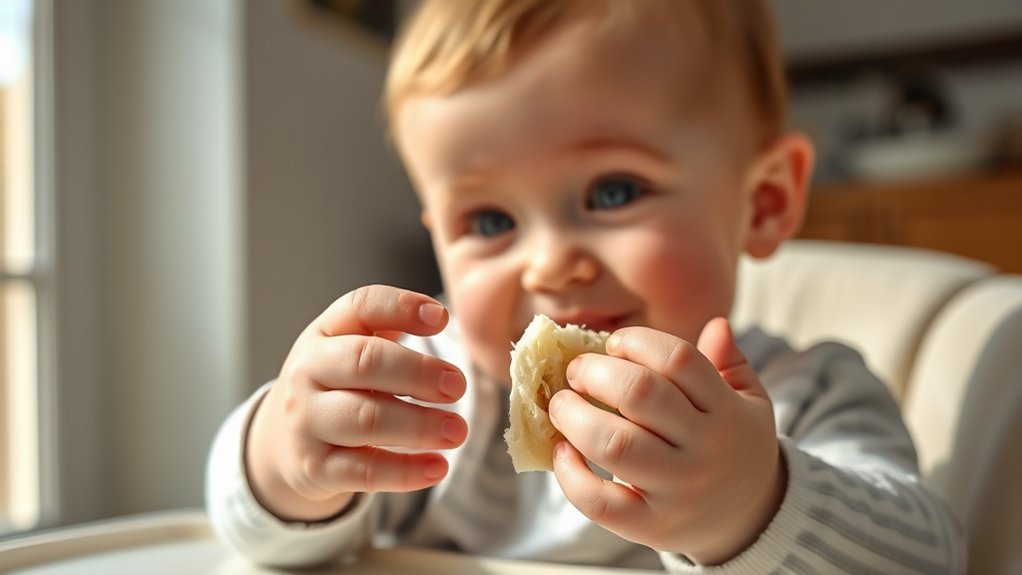
Many babies develop a pincer grasp around this stage, allowing them to pick up small pieces between the thumb and forefinger. Development varies, so use small pieces only when your baby can pick them up and manage them reliably.
Appropriate Bread Types
Whole-grain, whole-wheat, enriched wheat, sourdough, and sprouted-grain breads can all fit, provided the texture is manageable and the ingredient list suits your child. Whole-grain bread can add fiber and minerals, while enriched bread may provide iron and folic acid. A very dense, high-fiber loaf can be filling, so variety is more useful than treating one bread as the only healthy choice.
Avoid loaves with whole nuts, large hard seeds, large pieces of dried fruit, or a thick sugar crust. Small baked-in seeds are not automatically unsafe, but the finished bread should not contain hard pieces that can separate and become difficult to chew.
Safe Serving Techniques
- Lightly toast gummy bread, then cut or tear it into small manageable pieces.
- Continue offering strips if your baby handles strips better than small pieces.
- Spread toppings thinly so the bread stays moist without becoming overloaded or slippery.
- Place only a few pieces on the tray at once if your baby stuffs food into the mouth.
- Keep your baby upright, alert, and closely supervised.
Nutritional Benefits of Bread for Babies and Toddlers
Bread mainly provides carbohydrate, which supplies energy. Depending on the flour and recipe, it may also contribute fiber, iron, folate, B vitamins, selenium, and magnesium. Check the Nutrition Facts and ingredient labels because nutrient content varies widely among products.
Bread can also carry nutrient-dense toppings. Pairing it with mashed beans, egg, fish paste without excess salt, yogurt, ricotta, avocado, or a thin smooth nut-butter spread can make the meal more balanced. For babies younger than 12 months, bread and toppings are complementary foods; breast milk or infant formula still supplies most nutrition.
Bread is best treated as one part of a varied meal—not as the meal itself—especially during the first year.
Common Allergens in Bread to Watch For
Wheat is one of the nine major food allergens recognized by the U.S. Food and Drug Administration. Bread may also contain milk, egg, soy, sesame, peanuts, or tree nuts, depending on the recipe and bakery.
Read both the ingredient list and any “Contains” statement every time you buy bread, because recipes can change. Bakery bread sold without a package may not have the same on-label allergen information, so ask staff about ingredients and cross-contact when an allergy is known.
When introducing wheat for the first time, offer a small amount earlier in the day when your baby is healthy and you can observe them. The CDC advises introducing potential allergens along with other complementary foods rather than delaying them. If your baby has severe eczema, a known food allergy, or a previous reaction, ask their clinician for an individual introduction plan.
Wheat Allergy, Celiac Disease, and Gluten Sensitivity
These terms are not interchangeable. A wheat allergy is an allergic immune reaction that can cause hives, swelling, vomiting, breathing trouble, or anaphylaxis. Celiac disease is a chronic immune disorder in which gluten damages the small intestine. Gluten sensitivity may cause symptoms but does not cause the same intestinal damage.
Gluten-free bread is not automatically healthier for a baby. Use it when a clinician recommends avoiding gluten or wheat, and choose a product with a safe texture and a balanced nutrient profile. Do not start a gluten-free diet before celiac testing if celiac disease is suspected, because avoiding gluten can affect test accuracy.
Warning: Stop feeding and seek emergency help for trouble breathing, swelling of the tongue or throat, widespread hives with other symptoms, sudden limpness, or signs of shock. Mild symptoms such as a limited rash or vomiting still warrant prompt medical advice.
Is Bread a Choking Hazard for Babies?
Any food can become a choking hazard if its shape, size, or texture does not match a child’s skills. Bread deserves special care because soft bread can compress into a sticky lump. Lightly toasting a gummy loaf and cutting it into narrow strips can reduce that problem, but no preparation removes all choking risk.
Follow the CDC’s choking-prevention guidance: prepare food for your child’s development, avoid hard or sticky pieces, seat your child upright, keep meals calm, and watch at all times.
Gagging Versus Choking
Gagging is a normal protective reflex while babies learn to manage food. It is usually noisy and may involve coughing, retching, watery eyes, or pushing the tongue forward. Choking blocks the airway and may be quiet; a child may be unable to cough, cry, or breathe effectively.
Caregivers should learn age-appropriate choking first aid before starting finger foods. If your child cannot breathe properly, treat it as an emergency and call 911 while beginning the first-aid steps you have been trained to perform.
Best Types of Bread for Babies and Toddlers
There is no single best loaf for every child. Use this label-and-texture checklist:
- No honey before age 1: Honey can cause infant botulism, and baking does not make honey-containing bread appropriate for a baby younger than 12 months.
- Little or no added sugar: The CDC advises avoiding added sugars for infants and young children.
- Lower sodium: Compare similar loaves and choose the one with less sodium rather than relying on a universal per-slice cutoff.
- Simple texture: Avoid large hard nuts, tough dried-fruit pieces, and crusts that are extremely hard or sharp.
- Useful nutrients: Whole-grain breads can provide fiber and minerals; enriched breads may provide iron and folic acid.
- Allergen fit: Check wheat, milk, egg, soy, sesame, peanut, and tree-nut ingredients as needed.
Note: “Multigrain,” “wheat,” and brown coloring do not necessarily mean a bread is 100% whole grain. Check whether whole-wheat flour or another whole grain appears first in the ingredient list.
Safe and Nutritious Bread Toppings
Thin spreads can soften bread and add nutrients. Suitable options include:
- Mashed avocado.
- Hummus with modest sodium.
- Mashed beans or lentils.
- Plain full-fat yogurt, ricotta, or cottage cheese with a texture your baby can manage.
- Mashed cooked egg.
- Flaked fish mixed into yogurt or avocado, with all bones removed.
- Smooth peanut or tree-nut butter spread very thinly or thinned before serving.
- Unsweetened fruit puree in a thin layer.
Avoid thick spoonfuls of nut butter, large cheese cubes, raw hard vegetables, whole nuts, and oversized sandwich fillings. Do not add honey for a baby younger than 12 months.
How Much Bread Can Babies and Toddlers Have Daily?
There is no fixed daily bread requirement. Start with a small serving, such as one strip or a few pieces, and respond to your child’s appetite. Some days they may eat more and other days less.
From 6 to 12 months, keep offering breast milk or infant formula as the main source of nutrition. Use bread alongside iron-rich foods and a range of fruits, vegetables, proteins, dairy foods, or suitable alternatives. For toddlers, bread can be part of meals and snacks, but it should not crowd out other food groups.
Frequently Asked Questions
Can I give my baby homemade bread?
Yes. Homemade bread can be suitable once your baby is ready for solids. Do not use honey before 12 months, limit added salt and sugar, avoid hard nuts or large seeds, and prepare the bread so it is not gummy, brittle, or difficult to chew.
What types of bread should I avoid for babies?
Avoid bread made with honey for babies younger than 12 months, very hard or brittle bread, bread that forms a sticky dough ball, and loaves with whole nuts or large hard pieces. Also limit products high in added sugar or sodium and avoid any ingredient your child is allergic to.
How can I tell if my baby is allergic to bread?
Bread can contain wheat and other allergens. Watch for hives, swelling, vomiting, coughing, wheezing, breathing trouble, or sudden lethargy after eating. Stop feeding and contact a clinician for suspected reactions; call 911 for breathing trouble, throat or tongue swelling, or other signs of anaphylaxis.
Should I toast all types of bread for my baby?
No. Lightly toast bread when it is very soft or gummy. A firm loaf that holds together and softens easily may not need toasting. Avoid making bread extremely hard, dry, dark, or brittle.
Can bread be served as a meal replacement for babies?
Bread alone is not a balanced meal. Pair it with an iron-rich or protein food and fruit or vegetables. During the first year, continue breast milk or infant formula as the main source of nutrition.
Can a baby eat bread without teeth?
Yes. Babies can mash many soft foods with their gums and jaws. Teeth are not the main readiness test; head control, upright sitting, swallowing skills, and the ability to bring food to the mouth matter more.
Is gluten-free bread better for babies?
Not automatically. Gluten-free bread is useful when a child has a diagnosed condition or a clinician recommends it. Otherwise, it may offer no health advantage and can vary in fiber, iron, sugar, fat, and texture.
Can babies have bread every day?
Bread can appear regularly as part of a varied diet, but it should not replace iron-rich foods, produce, protein, or breast milk or formula during the first year. Rotate grains and toppings to provide different nutrients and textures.
Conclusion
Babies can usually begin eating bread at about 6 months when they are developmentally ready for solid foods. Choose a manageable texture, lightly toast bread that becomes gummy, cut it for your child’s current grasp, and supervise every bite. Avoid honey before the first birthday, check labels for allergens and excess added sugar or sodium, and serve bread as one part of a varied, nutrient-rich diet.
Sources
- CDC: When, What, and How to Introduce Solid Foods — readiness signs, timing, allergen introduction, and safe texture guidance.
- CDC: Choking Hazards — preparation, upright seating, calm meals, and continuous supervision.
- CDC: Foods and Drinks to Avoid or Limit — honey, added sugars, and high-sodium foods.
- CDC: How Much and How Often to Feed — small starting portions and the role of breast milk or formula.
- FDA: Food Allergies — major allergens, labeling, and reaction severity.
- NIDDK: Definition and Facts for Celiac Disease — differences among celiac disease, wheat allergy, and gluten sensitivity.