Eggs can be a nutritious early food, but timing, texture, cooking, and allergy awareness all matter. Most babies can try well-cooked egg at about 6 months once they are developmentally ready for solid foods. Start with a small serving, keep the texture soft and moist, and know what to do if a reaction occurs.
Quick Answer
Most babies can try well-cooked whole egg at about 6 months, once they show readiness for solid foods. Start with a small amount of soft scrambled or mashed egg, serve it as the only new allergen, and watch for a reaction. Babies with severe eczema or a previous food reaction should get medical guidance first.
Key Takeaways
- Introduce well-cooked egg at about 6 months when your baby can sit with support, control their head and neck, and swallow food.
- Offer a small first taste when your baby is healthy and you can remain nearby for the next several hours.
- Serve whole egg, including the yolk and white, in a soft, moist texture suited to your baby’s eating skills.
- After egg is tolerated, keep offering it routinely in developmentally appropriate portions.
- Stop feeding egg and contact your pediatrician for possible mild allergy symptoms. Call 911 for breathing trouble, tongue or throat swelling, faintness, blue coloring, or other signs of anaphylaxis.
- Refrigerate eggs at 40°F or below and cook them until the white and yolk are firm.
At a Glance
| Time Required | About 10–15 minutes to cook and prepare, plus close observation during and after the first serving |
| Difficulty | Easy for most babies; medical guidance may be needed for babies at higher allergy risk |
| Tools Needed | Skillet or saucepan, fork or spoon, bowl, and an upright high chair |
| Cost | Low; one egg can provide several small starter portions |
Medical note: This guide provides general feeding information and does not replace advice from your child’s pediatrician or allergist. Ask for individualized guidance if your baby was born prematurely, has trouble swallowing, has severe eczema, has a diagnosed food allergy, or has previously reacted to food.
When Can Babies Start Eating Eggs?
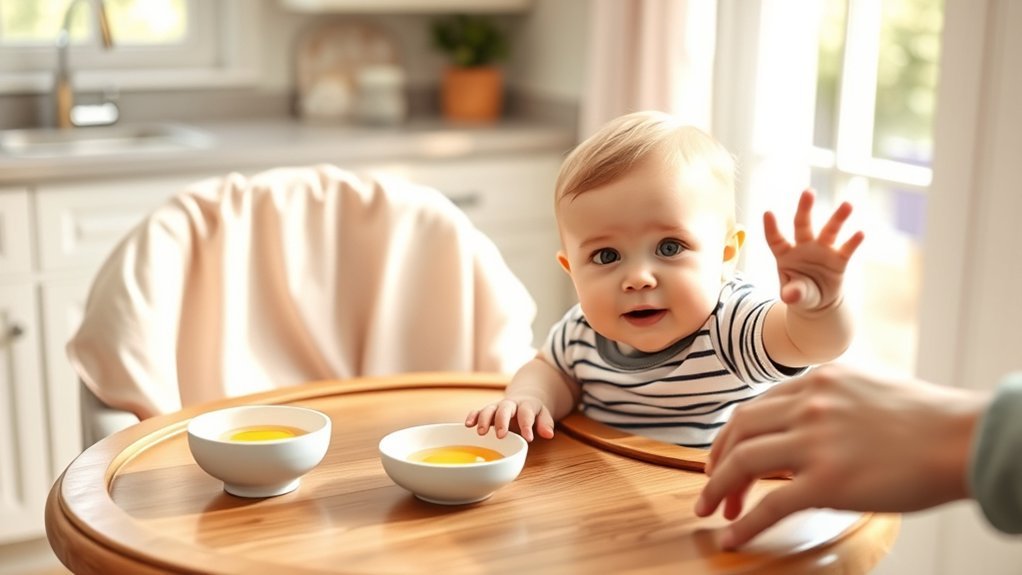
Most babies can start eating egg at about 6 months, when they are ready for complementary foods. The Centers for Disease Control and Prevention advises against starting solid food before 4 months and recommends using developmental readiness, not age alone, to decide when to begin.
The Dietary Guidelines for Americans, 2025–2030 specifically include eggs among the potentially allergenic foods that can be introduced with other complementary foods at about 6 months.
There is no benefit to delaying egg until the first birthday for most babies. Current guidance suggests that offering cooked egg after a baby is ready for solids may help reduce the chance of developing an egg allergy, although it cannot guarantee prevention.
Once a baby is ready for solids, delaying well-cooked egg does not prevent food allergy. A small first taste followed by routine, age-appropriate servings is the current approach for most infants.

Power your essentials anywhere with a 999Wh pure sine wave power station delivering up to 1000W continuous with 2000W surge. It supports fast charging via USB-C PD 60W and USB-A QC 18W, plus simultaneous output for multiple devices through AC, USB, wireless, and car/DC ports. Recharge using AC, car, or solar with a built-in MPPT controller and dual cooling fans, while the upgraded battery management system protects against surges, short circuits, and overheating.

100% Baby Safe Silicone: The baby spoons are made from 100% premium food-grade silicone. Safe for babies with no BPA, no PVC, no phthalates or anything harmful or toxic. It has no potential compositional-danger to children even chewed by teeth. Mummy can use them to feed baby with ease. And silicone material has better heat resistance than metal or plastic, babies would love to use it.

Quality Material: The baby spoon is made of food grade silicone, BPA free, soft and durable.
Signs Your Baby Is Ready for Eggs
Your baby may be ready to try egg when they can:
- Sit upright alone or with support.
- Control their head and neck.
- Open their mouth when food is offered.
- Bring objects or food toward their mouth.
- Move food from the front to the back of the tongue.
- Swallow food instead of consistently pushing it back out.
Breast milk or iron-fortified infant formula should remain the main source of nutrition through the first year while your baby gradually learns to eat solid foods.
How to Safely Introduce Eggs to Your Baby
Choose a day when your baby is healthy, awake, and not dealing with a fever, stomach illness, or a flare of unexplained symptoms. Offer egg earlier in the day rather than immediately before bedtime so you have time to watch for a reaction.
- Cook the egg thoroughly: Scramble, boil, bake, or poach it until both the white and yolk are firm. Do not serve raw batter, runny egg, or partly cooked egg.
- Make the texture soft: Mash the egg with a little water, breast milk, prepared formula, plain yogurt, or another familiar soft food. Do not mix prepared formula directly into food unless it is prepared according to its label first.
- Start with a small taste: Offer a small spoon-tip amount. If no symptoms appear, gradually offer more during the same meal.
- Use familiar foods: Egg should be the only new allergenic food at that meal. Familiar foods can be served alongside it.
- Watch closely: Stay with your baby while they eat and remain alert for symptoms over the next several hours.
- Continue after tolerance: Once your baby has eaten egg without a reaction, include it routinely in age-appropriate portions. The American Academy of Pediatrics gives about one-third of a well-cooked egg as an example of a routine infant portion.
Note: Guidance on spacing new foods varies. The CDC suggests waiting 3–5 days between new single-ingredient foods when solids are first introduced, while current AAP parent guidance says to wait at least one day. The purpose is to make a possible trigger easier to identify, not because every baby requires an exact waiting period.
Pro Tip: Write down the date, approximate amount, preparation method, and any symptoms after the first few egg servings. This gives your pediatrician useful details if a reaction or feeding problem develops.
Best Egg Preparations by Age

Age ranges are only a guide. Choose a preparation based on your baby’s ability to sit, grasp food, move it around the mouth, chew, and swallow. Eggs should be fully cooked and moist enough to mash easily between your fingers.
Preparing Eggs for Infants
At about 6–8 months, smooth or finely mashed preparations are often easiest to manage. Suitable options include:
- Soft scrambled egg mashed with a fork.
- Hard-boiled egg mashed with water, prepared formula, breast milk, avocado, or plain full-fat yogurt.
- A fully cooked egg puree blended with a familiar vegetable puree.
- A small amount of finely crumbled omelet softened with a familiar puree.
Avoid dry, crumbly egg pieces that are difficult to gather and swallow. Thin the mixture as needed, but do not make it so watery that it runs quickly to the back of the throat.
Ideal Egg Serving Methods
At around 9 months, many babies begin using a pincer grasp and can manage small, soft pieces. Depending on your baby’s skills, you can offer:
- Moist scrambled-egg curds in small pieces.
- Soft omelet strips that are easy to hold and mash with the gums.
- Thin pieces of fully cooked egg mixed into mashed vegetables or beans.
- Mashed hard-boiled egg served on a loaded spoon.
Hard-boiled egg can become dry and rubbery. Mash it or combine it with a moist familiar food rather than serving large, firm chunks.
Age-Appropriate Egg Dishes
By about 12 months, toddlers with established chewing skills can enjoy a wider range of fully cooked dishes, including:
- Scrambled eggs with finely chopped, soft vegetables.
- Omelets cut into manageable strips or small pieces.
- Mini frittatas or egg muffins cooked through in the center.
- Egg salad made with plain yogurt or avocado.
- Small portions of fully cooked quiche with a soft crust removed if it is hard or chewy.
Keep dishes low in added salt and avoid added sugar. Do not use honey in food for a child younger than 12 months.
How to Keep an Eye Out for Egg Allergies
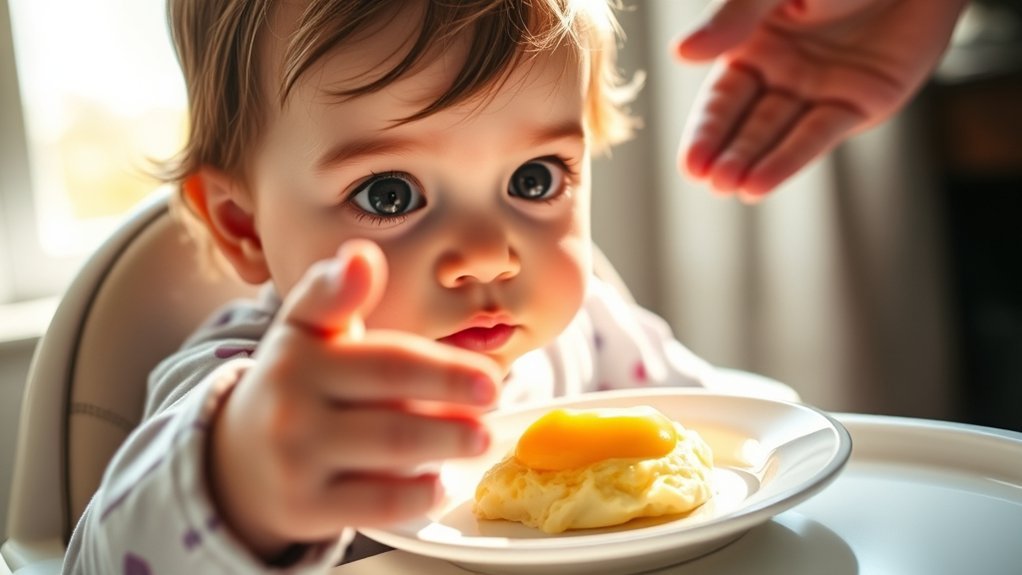
An egg-allergy reaction may begin within minutes or several hours after eating. A baby can react even if a previous serving caused no obvious problem, so continue watching for symptoms during later exposures.
Common Allergy Symptoms
Possible symptoms include:
- Hives, redness, itching, or a spreading rash.
- Swelling around the eyes, face, lips, or tongue.
- Vomiting, diarrhea, stomach pain, or repeated gagging unrelated to texture.
- Coughing, wheezing, hoarseness, or trouble breathing.
- Sudden drooling or trouble swallowing.
- Unusual sleepiness, limpness, confusion, faintness, or pale or bluish skin.
A small area of redness where food touched the skin does not always prove an allergy, but you should stop the feeding and contact your pediatrician if you are unsure.
Warning: Trouble breathing or swallowing, swelling of the tongue or throat, weak or floppy behavior, faintness, blue or very pale coloring, or symptoms involving more than one body system may signal anaphylaxis. Use prescribed epinephrine immediately if available and call 911. Do not wait for an antihistamine to work or drive the child to care yourself when emergency services are available.
Risk Factors Overview
Speak with your baby’s pediatrician before introducing egg at home if your baby:
- Has severe or persistent eczema.
- Has a diagnosed food allergy.
- Previously developed hives, swelling, repeated vomiting, wheezing, or another immediate symptom after food.
- Has a swallowing disorder or another condition that changes feeding safety.
A family history of food allergy may be worth discussing, but it does not automatically mean egg should be delayed. Most babies can introduce cooked egg at home after they are ready for solids.
Testing and Diagnosis
Most babies do not need routine allergy testing before trying egg. Testing is more useful when a clinician identifies a specific risk or when a reaction has already occurred.
Skin-prick and blood tests can support a diagnosis, but a positive test does not always prove that eating egg will cause symptoms. An allergist may recommend a medically supervised oral food challenge when the history and test results are unclear.
Do not attempt a home “test,” increase the serving after a reaction, or reintroduce egg without medical advice.
What to Do if Your Baby Reacts to Egg
- For a possible mild reaction: Stop feeding egg, keep your baby with you, record the symptoms, and call your pediatrician for advice.
- For rapidly worsening or severe symptoms: Follow your child’s allergy action plan, give prescribed epinephrine immediately, and call 911.
- After any suspected reaction: Avoid another egg exposure until a qualified clinician tells you how to proceed.
The AAP’s anaphylaxis guidance for infants and children explains that epinephrine is the recommended emergency treatment and should be followed by a 911 call.
Are Eggs a Choking Hazard for Babies?
Egg is soft when prepared correctly, but any food can become a choking risk if its shape, size, or texture does not match a baby’s eating skills. Dry hard-boiled pieces, thick rubbery omelet chunks, or an overcooked mass of scrambled egg may be difficult to manage.
Follow these precautions:
- Seat your baby upright in a secure high chair.
- Keep meals calm and free from toys, screens, and rushing.
- Supervise every bite and remain within arm’s reach.
- Mash egg for newer eaters or serve soft, moist pieces for babies who can self-feed.
- Avoid feeding in a moving car, stroller, or while the baby is lying down, crawling, or walking.
- Learn infant choking first aid from a qualified pediatric or first-aid course.
The CDC’s choking-prevention guidance stresses upright seating, suitable textures, calm mealtimes, and continuous supervision.
Warning: Never place food in a baby’s mouth with your fingers to make them swallow. If your baby cannot breathe, cry, cough, or make a sound, begin the age-appropriate choking response you have been trained to use and call 911.
Is Daily Egg Consumption Safe for Toddlers?
Most healthy toddlers who tolerate egg can eat it regularly. An egg may fit into the diet on many days, and some children may eat one daily, but there is no requirement or special need to serve egg every day.
Use eggs as one part of a varied diet that also includes vegetables, fruits, grains, dairy or suitable alternatives, beans, meat, fish, poultry, tofu, and other age-appropriate foods. Variety provides nutrients that eggs contain only in small amounts, including fiber and vitamin C.
Ask your pediatrician or registered dietitian for individualized guidance if your child has an egg allergy, restricted diet, growth concern, metabolic condition, or another medical need.
Creative Ways to Serve Eggs to Babies and Toddlers
Once your baby has tolerated plain egg, you can combine it with familiar ingredients and introduce new flavors gradually.
- Mashed egg and avocado: Combine fully cooked egg with ripe avocado for a soft, moist texture.
- Vegetable scrambled egg: Add finely chopped, well-cooked spinach, tomato, zucchini, or bell pepper.
- Omelet fingers: Cook a thin omelet fully and cut it into strips suited to your baby’s grasp.
- Mini egg muffins: Bake egg with soft vegetables in a mini muffin pan until the center is fully set.
- Egg and bean mash: Mix mashed egg with soft beans for additional texture and variety.
- Yogurt egg salad: Use plain full-fat yogurt instead of a heavily salted dressing.
- Egg shapes for toddlers: Cut a fully cooked omelet into simple shapes to make the meal visually interesting without turning eating into a distracting game.
Introduce cheese, vegetables, herbs, or other ingredients only after checking that the texture is safe and that any major allergen in the recipe has already been introduced appropriately.
Nutritional Benefits of Eggs for Babies
Eggs are nutrient-dense and can contribute to a balanced complementary diet. Their main benefits include:
- Complete protein: Egg protein supplies all essential amino acids and supports normal growth and tissue maintenance.
- Choline: Eggs are a notable source of choline, a nutrient involved in brain, nervous-system, and cell function. The National Institutes of Health choline fact sheet lists eggs among the major food sources.
- Fat: Whole egg contains fat that contributes energy to an infant’s diet. Omega-3 content varies, and eggs labeled as omega-3 enriched generally contain more than standard eggs.
- Vitamins and minerals: Eggs provide vitamin B12, riboflavin, selenium, vitamin A, and smaller amounts of vitamin D, iron, and zinc.
Egg should not be your baby’s only protein or iron-containing food. Continue offering a range of nutrient-dense foods, including meat, poultry, seafood, beans, lentils, fortified infant cereal, vegetables, fruits, dairy foods, and whole grains in safe forms.
Eggs add protein, choline, fat, and several vitamins and minerals, but the strongest infant diet is built from a wide variety of foods rather than one “superfood.”
Egg Cooking and Storage Safety
Fresh shell eggs can contain Salmonella even when the shells look clean. Follow the FDA’s egg-safety recommendations:
- Buy eggs only from a refrigerated case.
- Choose clean eggs without cracked shells.
- Refrigerate eggs promptly at 40°F or below.
- Keep raw eggs in their original carton rather than the refrigerator door.
- Use shell eggs within about three weeks for best quality.
- Use refrigerated hard-cooked eggs within one week.
- Cook eggs until the yolk and white are firm and egg dishes are thoroughly cooked.
- Wash hands, utensils, bowls, counters, and cutting surfaces after contact with raw egg.
- Refrigerate cooked egg within two hours, or within one hour if the surrounding temperature is above 90°F.
- Discard egg dishes that have remained at room temperature beyond those limits.
For recipes that are not cooked thoroughly, FDA guidance recommends pasteurized shell eggs or pasteurized egg products. For babies, the simplest option is still to serve egg fully cooked.
Frequently Asked Questions
Can babies eat egg yolks and whites together?
Yes. Most babies can be introduced to fully cooked whole egg, including the yolk and white, at the same time. There is no need to introduce the two parts separately unless your child’s allergist has given a specific plan.
What are the signs of an egg allergy in infants?
Possible symptoms include hives, facial swelling, vomiting, diarrhea, coughing, wheezing, trouble swallowing, unusual limpness, or pale or bluish skin. Stop feeding egg and contact your pediatrician for possible mild symptoms. Use prescribed epinephrine and call 911 for breathing trouble, tongue or throat swelling, faintness, or other signs of anaphylaxis.
How should eggs be stored for infants?
Keep raw eggs in their original carton in a refrigerator at 40°F or below. Choose uncracked eggs and use them within about three weeks for best quality. Refrigerated hard-cooked eggs should be used within one week, and cooked egg dishes should not remain at room temperature for more than two hours.
Can babies eat raw or undercooked eggs?
Babies should be served fully cooked egg because raw and undercooked egg can contain Salmonella. Cook until both the white and yolk are firm, and avoid raw batter, runny egg, homemade mayonnaise made with untreated shell egg, and other uncooked egg mixtures.
Are organic eggs better for babies than conventional eggs?
Organic and conventional eggs can both be used for babies. The USDA organic label describes how the hens and eggs were produced; it does not guarantee that an egg is more nutritious or free from Salmonella. Refrigeration, intact shells, clean handling, and thorough cooking are the main immediate safety factors.
How much egg should I give my baby the first time?
Begin with a small spoon-tip taste of soft, fully cooked egg. If no symptoms appear, gradually offer more during the meal. After egg is tolerated, about one-third of a well-cooked egg is one example of a routine infant portion, although appetite and eating skills vary.
Should I introduce egg at home if my baby has eczema?
A baby with mild eczema may still be able to try egg at home, but severe or persistent eczema increases food-allergy risk. Ask your pediatrician or allergist for an individualized plan before introduction if the eczema is severe, if your baby has another food allergy, or if a previous food caused an immediate reaction.
Conclusion
Most babies can begin eating well-cooked whole egg at about 6 months once they are ready for solid foods. Start with a small amount, use a soft and moist texture, supervise every bite, and continue offering egg routinely after it is tolerated. Speak with your pediatrician before home introduction if your baby has severe eczema, a diagnosed food allergy, or a previous immediate reaction. Knowing the signs of anaphylaxis and practicing safe cooking and storage make egg introduction safer and less stressful.
Sources
- Dietary Guidelines for Americans, 2025–2030 — timing of complementary foods, allergen introduction, dietary variety, and infant nutrition.
- CDC: When, What, and How to Introduce Solid Foods — developmental readiness, timing, new-food intervals, and safe textures.
- American Academy of Pediatrics: Introducing Egg and Other Common Allergens — early allergen introduction, starter servings, higher-risk infants, and routine exposure.
- FDA: What You Need to Know About Egg Safety — Salmonella prevention, cooking, refrigeration, storage, and leftover safety.
- CDC: Choking Hazards — safe food preparation, upright seating, supervision, and mealtime practices.
- NIH Office of Dietary Supplements: Choline — the role of choline and eggs as a dietary source.