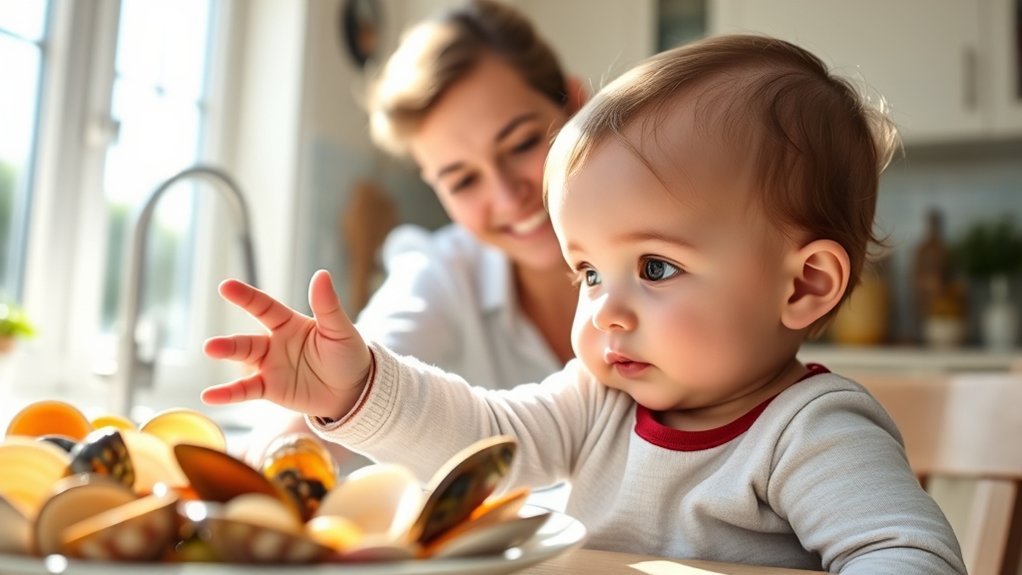
Shellfish can be a nutritious early food, but it needs careful preparation because firm pieces may be a choking hazard and shellfish can cause allergic reactions. Most babies can try fully cooked shellfish at about 6 months, once they show signs of readiness for solid foods. Begin with a small amount in a soft texture and supervise the entire meal.
Quick Answer
Babies can usually eat fully cooked shellfish from around 6 months, when they can sit upright with support, control their head, and swallow soft food. Finely mince or puree the shellfish, mix it with an already familiar food, offer a small first taste, and watch closely for allergy symptoms.
Key Takeaways
- Introduce shellfish at about 6 months only after your baby is developmentally ready for complementary foods.
- Shellfish must be fully cooked, removed from its shell, inspected for hard fragments, and prepared in a soft, moist texture.
- Use an already tolerated food when mixing the first serving so shellfish is the only new allergen.
- Stop feeding shellfish if symptoms develop. Call 911 for breathing difficulty, throat or tongue swelling, collapse, or loss of consciousness.
- If shellfish is tolerated, keep it in your child’s diet routinely in small, developmentally appropriate servings.
At a Glance
| Time Required | About 10–15 minutes to cook and prepare, plus time to observe your baby during and after the meal |
| Difficulty | Easy, with close attention to texture, choking prevention, and allergy symptoms |
| Tools Needed | Saucepan or steamer, clean cutting board, knife, fork, bowl, and optional food thermometer |
| Cost | Varies by the type of shellfish; an infant serving requires only a small amount |
Note: This article provides general feeding and safety information. Ask your pediatrician or pediatric allergist for personalized guidance if your baby has severe or persistent eczema, an existing food allergy, swallowing difficulties, or a previous immediate reaction to food.
When Can Babies Eat Shellfish?
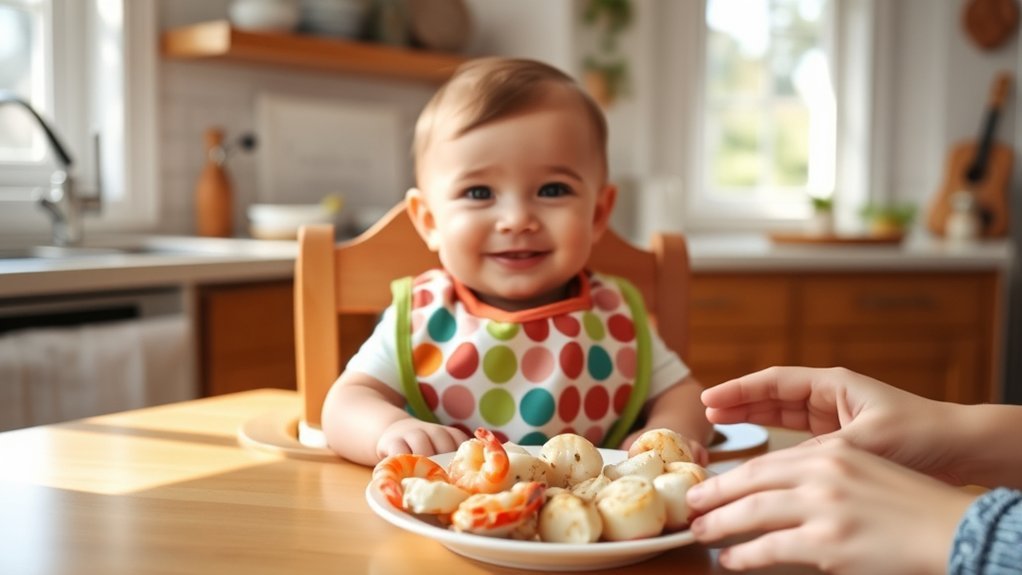
Most babies can try shellfish at about 6 months, when they are ready to begin solid foods. According to the Centers for Disease Control and Prevention, signs of readiness include being able to sit upright alone or with support, having good head and neck control, opening the mouth for food, and swallowing food instead of pushing it back out.
Shellfish is a potentially allergenic food, but it does not normally need to be delayed after a baby begins complementary foods. Current guidance from the American Academy of Pediatrics recommends introducing common allergens in infant-safe forms rather than avoiding them without a medical reason.
However, the evidence should not be overstated. Research strongly supports early introduction for preventing certain allergies, especially peanut and egg allergy. There is not equally strong proof that introducing shellfish early will prevent a future shellfish allergy.
Most healthy babies do not require a pediatric appointment before their first taste. Speak with a medical professional first if your baby has severe eczema, a diagnosed food allergy, a previous immediate reaction to food, or a condition that affects safe swallowing.
How to Introduce Shellfish to a Baby
- Choose one plain shellfish. Start with one type, such as shrimp, crab, lobster, scallop, clam, mussel, or oyster. Avoid breading, sauces, seasoning blends, and added salt.
- Cook it completely. Never offer raw, lightly cooked, ceviche-style, or partially cooked shellfish to a baby.
- Remove every hard part. Take off shells, tails, and claws. Check crab, lobster, clams, mussels, and oysters carefully for small shell fragments.
- Prepare a soft texture. Mince, shred, mash, or puree the cooked meat according to your baby’s eating skills.
- Mix it with a familiar food. Stir a small amount into an already tolerated puree, mashed vegetable, yogurt, beans, or soft grain. Do not combine it with another new allergen.
- Begin with a small taste. Offer a small spoonful, pause, and watch your baby before gradually offering more.
- Observe closely. Choose a time when your baby is healthy, awake, and can be watched during and after the meal.
- Keep serving it if tolerated. Include shellfish routinely in small, suitable portions. There is no proven shellfish-specific rule that it must be served exactly once per week.
The CDC advises introducing one single-ingredient food at a time and waiting three to five days before another new food. This makes it easier to identify the cause if symptoms occur.
Pro Tip: Freeze small portions of freshly cooked, finely minced shellfish in a clean covered tray. Thaw only the amount needed and combine it with a familiar food immediately before serving.
How to Prepare Shellfish by Age and Eating Skill
Age can offer a rough guide, but your child’s chewing, swallowing, and hand skills matter more than a birthday. Some babies need finely minced food longer than others.
| Stage | Safer Preparation |
|---|---|
| New eater, usually around 6 months | Puree or mince fully cooked shellfish very finely. Mix a small amount into a smooth or mashed food your baby already eats. |
| Developing pincer grasp, often around 9 months | Offer finely shredded or minced shellfish in a moist food. Avoid whole shrimp, thick rounds, rubbery chunks, and loose shell fragments. |
| More confident chewer, often 12–18 months or later | Try thin lengthwise strips or small, soft pieces. Continue shredding or mincing if your child stuffs food, struggles with firm textures, or has limited chewing skills. |
| Older toddler with reliable chewing skills | Gradually increase the size while continuing to remove shells and tails and supervise every meal. Do not serve whole firm shrimp simply because the child has reached a certain age. |
Use a practical softness check before serving. The shellfish should break apart easily with a fork and should not feel tough or rubbery. Minced shellfish mixed into a moist food is generally easier for a new eater to manage than a separate piece.
Texture and shape matter more than the calendar: keep shellfish soft, moist, and easy for your child to manage.
Is Shellfish a Choking Hazard for Babies?
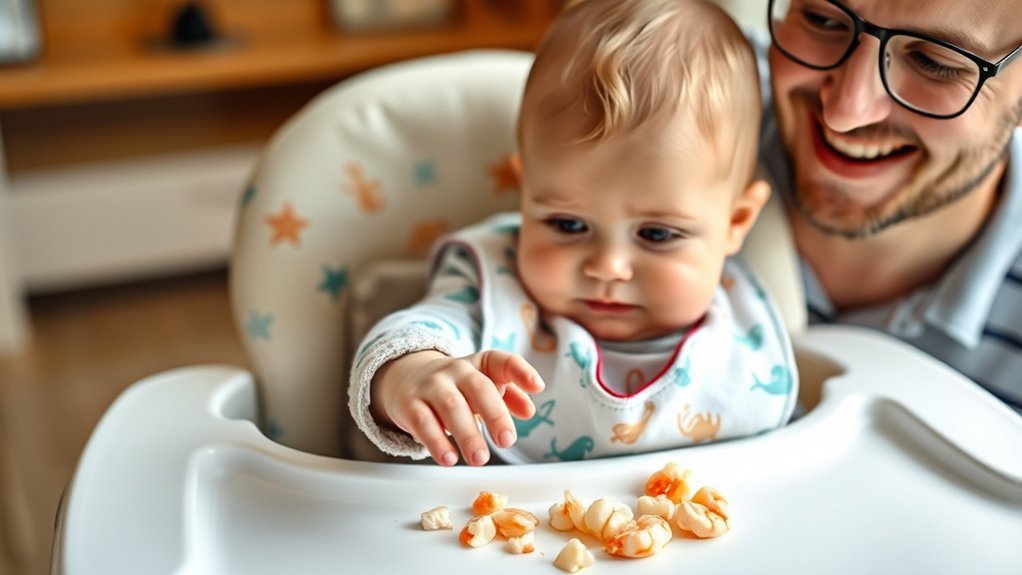
Shellfish can become a choking hazard when it is served whole, firm, rubbery, or in thick cylindrical pieces. Whole shrimp and round crosswise slices are particularly concerning because their shape can fit into a young child’s airway.
The CDC’s choking-prevention guidance recommends preparing food in a shape, size, and texture that matches the child’s development.
- Do not serve whole shrimp or large, tough chunks of crab, lobster, or scallop.
- Remove all shells, tails, claws, bones, and hard cartilage.
- Keep the food moist rather than dry or rubbery.
- Seat your baby upright in a high chair or another safe eating seat.
- Do not let a baby eat while lying down, crawling, walking, riding in a stroller, or sitting in a moving car.
- Keep meals calm and watch your child continuously.
Gagging Versus Choking
Gagging is a normal protective reflex when babies learn to manage new textures. A gagging baby may cough, make noise, or push food forward with the tongue. Choking may be quiet because the airway is blocked. A choking child may be unable to cough, cry, or breathe.
Warning: If your baby cannot breathe, cry, or cough effectively, call 911 and begin age-appropriate choking first aid. Do not leave the child unattended and do not perform a blind finger sweep inside the mouth.
Shellfish Allergy Signs and What to Do
Crustacean shellfish, including shrimp, crab, and lobster, is one of the major food allergens recognized in the United States. A reaction may begin within minutes or several hours after eating.
According to the U.S. Food and Drug Administration, possible food-allergy symptoms include:
- Hives, flushed skin, or an itchy rash
- Swelling of the lips, face, tongue, or throat
- Vomiting, diarrhea, or abdominal discomfort
- Coughing, wheezing, or difficulty breathing
- Sudden dizziness, weakness, limpness, or loss of consciousness
If any possible allergic symptom develops, stop feeding the shellfish and contact your child’s healthcare provider. Do not offer the food again until you have received medical advice. A mild first reaction does not guarantee that a future reaction will also be mild.
Warning: Call 911 immediately for difficulty breathing, wheezing, throat or tongue swelling, blue or very pale skin, sudden limpness, collapse, or loss of consciousness. If your child has prescribed epinephrine, use it immediately according to the child’s emergency plan and then call 911.
Which Shellfish Is Best for Babies?
No shellfish is completely “safe” from an allergy standpoint. A child may react to shrimp, crab, lobster, scallops, clams, mussels, oysters, or another variety. Tolerating one type does not prove that every other shellfish will be tolerated.
For preparation, the easiest first options are usually plain shellfish that can be fully cooked and minced without leaving hard fragments. Examples include:
- Shrimp: Remove the shell and tail, cook until opaque, and mince very finely.
- Crab or lobster: Check the meat carefully for shell pieces before shredding or mincing.
- Scallops: Cook until opaque and mince because the texture can become firm or rubbery.
- Clams, mussels, or oysters: Cook completely, remove the meat from the shell, inspect it carefully, and mince it into a familiar food.
Avoid heavily salted shellfish, fried shellfish, restaurant sauces, smoked seafood, and processed products during the first introduction. These foods can contain excess sodium or additional allergens that make a reaction harder to identify.
Many common shellfish—including shrimp, crab, crawfish, clams, oysters, scallops, squid, and lobster—appear among the lower-mercury choices in the FDA and EPA seafood guidance. Infant portions should remain small and appropriate for the child’s appetite and feeding skills.
Nutritional Benefits of Shellfish for Babies
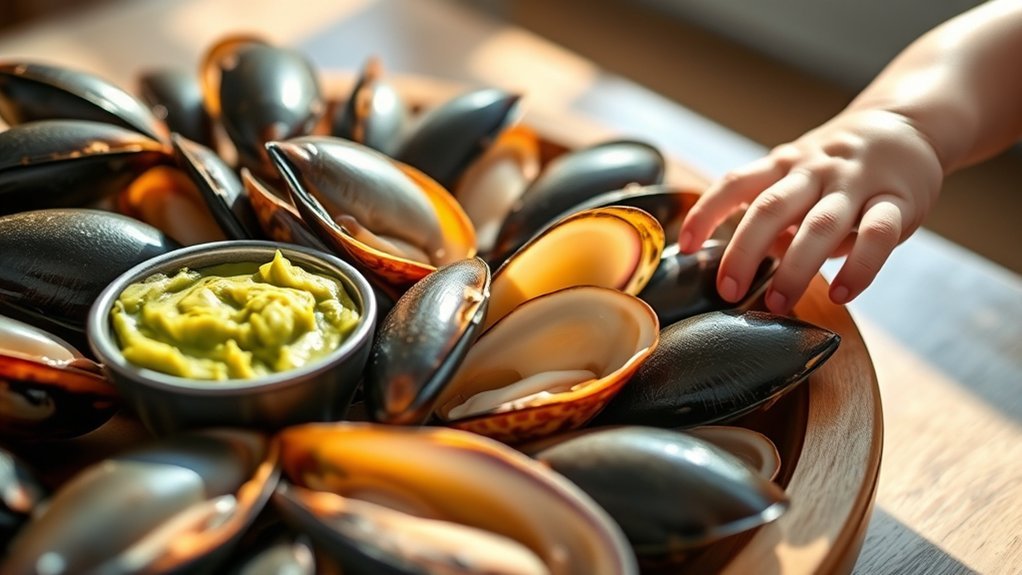
Shellfish can contribute useful nutrients to a varied diet. The exact nutrient content differs by species, so shellfish should complement—not replace—breast milk, infant formula, and other iron- and zinc-rich complementary foods.
| Nutrient | Role in the Diet | Possible Sources |
|---|---|---|
| Complete protein | Provides amino acids needed for normal growth and tissue development | Shrimp, crab, lobster, scallops, clams, and mussels |
| Zinc and iron | Support normal growth, immune function, and healthy blood-cell production | Oysters, crab, clams, and mussels |
| Vitamin B12 and selenium | Help support the nervous system, blood cells, and normal antioxidant functions | Clams, mussels, crab, lobster, and shrimp |
| Omega-3 fats | Contribute to a balanced eating pattern that supports brain and eye development | Amounts vary among oysters, mussels, crab, shrimp, and other shellfish |
Shellfish nutrient levels vary considerably. It is more accurate to say that different shellfish may provide protein, zinc, iron, vitamin B12, selenium, iodine, vitamin D, or omega-3 fats than to claim every type is rich in all of them.
Shellfish Cooking, Storage, and Reheating Safety
Babies should never be served raw or lightly cooked shellfish. Raw oysters, clams, mussels, and other shellfish can contain harmful bacteria, viruses, or marine toxins.
Follow the current FoodSafety.gov cooking guidance:
- Cook shrimp, lobster, crab, and scallops until the flesh is pearly or white and opaque.
- Cook clams, mussels, and oysters until their shells open. Discard any that remain closed, then remove the cooked meat from its shell before preparing it for your baby.
- Avoid cross-contamination by keeping raw shellfish and its juices away from cooked food, utensils, and preparation surfaces.
- Refrigerate cooked shellfish within two hours, or within one hour when the surrounding temperature is above 90°F.
- Store leftovers in a covered container at 40°F or below and use or freeze them within three to four days.
- Reheat leftovers to 165°F, then let the food cool to a safe temperature before serving.
- Discard shellfish if its storage time or temperature is uncertain. Smell alone cannot confirm that food is safe.
Frequently Asked Questions
Can I introduce shellfish if my baby has eczema?
A baby with mild eczema may still be able to try shellfish when ready for solids. Ask your pediatrician or pediatric allergist for a personalized introduction plan if the eczema is severe or persistent, or if your child has an existing food allergy or previous immediate food reaction.
What types of shellfish are safest for babies?
No shellfish is allergy-proof. Choose a plain type that can be cooked completely, checked for shell fragments, and minced easily. Shrimp, crab, scallop, lobster, clam, mussel, or oyster can be used when prepared in a developmentally appropriate texture.
How should I store leftover shellfish for my baby?
Refrigerate cooked shellfish within two hours in a covered container at 40°F or below. Use or freeze it within three to four days. Reheat leftovers to 165°F and cool them before serving. Discard food if its storage time or temperature is uncertain.
Can shellfish cause digestive issues in babies?
Shellfish may be followed by vomiting, diarrhea, or stomach discomfort due to an allergic reaction, foodborne illness, or another digestive problem. Stop serving the food and contact your pediatrician if symptoms occur, especially when digestive symptoms appear with hives, swelling, coughing, or wheezing.
Is it safe to serve raw shellfish to babies?
No. Babies should not eat raw, lightly cooked, or ceviche-style shellfish. Fully cooking shellfish reduces the risk from harmful bacteria and viruses, although cooking does not prevent an allergic reaction.
Do I need to ask a pediatrician before the first serving?
Most healthy, developmentally ready babies do not need medical approval before trying shellfish. Seek personalized advice first if your baby has severe eczema, a diagnosed food allergy, a previous immediate reaction, swallowing problems, or another condition that affects feeding safety.
How often should I serve shellfish after a successful introduction?
If your baby tolerates shellfish, include it routinely as part of a varied diet in small, developmentally appropriate portions. There is no established shellfish-specific schedule that requires an exact number of weekly servings.
Conclusion
Most babies can try fully cooked shellfish at about 6 months when they are developmentally ready for solid foods. Start with a small amount, use a soft and moist texture, introduce only one new allergen at a time, and supervise closely. Continue offering shellfish routinely if it is tolerated, but seek medical advice after any suspected reaction and call 911 for signs of anaphylaxis.
Sources
- CDC: When, What, and How to Introduce Solid Foods — readiness signs, allergen introduction, texture, and supervision guidance
- American Academy of Pediatrics: Introducing Common Food Allergens — allergen timing, high-risk infants, and routine exposure after tolerance
- CDC: Choking Hazards — safe food shapes, textures, seating, and meal supervision
- FDA: Food Allergies—What You Need to Know — allergy symptoms and anaphylaxis risks
- FoodSafety.gov: Safe Minimum Internal Temperatures — cooking and reheating guidance for seafood
- EPA and FDA: Advice About Eating Fish and Shellfish — lower-mercury seafood choices and nutritional benefits