
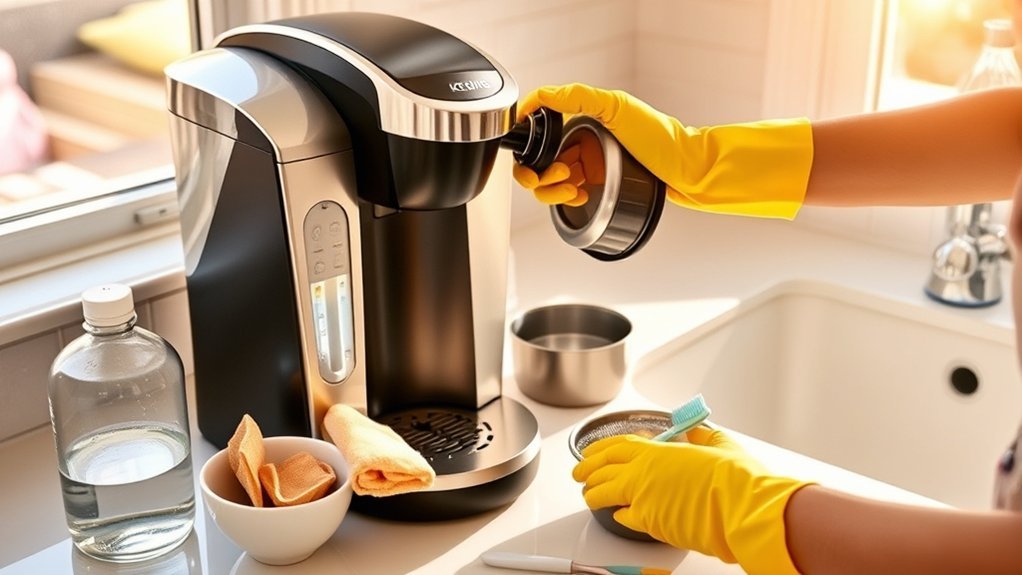
Cleaning a Keurig involves two different jobs: washing the removable parts that collect coffee residue and descaling the internal water system to remove mineral deposits. Because cleaning parts, dishwasher guidance, Descale Mode controls, and descaling times vary by brewer, identify your exact Keurig model before starting.
Quick Answer
To clean a Keurig, unplug and cool the brewer, remove the parts allowed by your model, and wash them with warm, soapy water. Clear clogged needle openings carefully, run a water-only cleansing brew, and descale about every three months or when indicated, following the exact procedure for your model.
Key Takeaways
- Turn off, unplug, and cool the Keurig before washing parts or working near the pod-puncturing needles.
- Hand-wash removable parts periodically or whenever residue is visible unless your exact model guide gives different care instructions.
- Use a straightened paper clip to clear the entrance or exit needle only when grounds or restricted flow suggest a clog.
- Descale using the procedure for your exact brewer rather than following one universal vinegar recipe or button sequence.
- For compatible Keurig water-filter cartridges, replace the cartridge about every two months or 60 tank refills.
At a Glance
| Time Required | About 15–20 minutes for routine cleaning; roughly 10–90 minutes for descaling depending on the exact brewer and procedure |
| Difficulty | Easy |
| Tools Needed | Soft lint-free cloth, mild dish soap, nonabrasive sponge, large ceramic mug, sink, and a straightened paper clip if a needle is clogged |
| Cost | Routine cleaning uses common household supplies; descaling-solution and replacement-filter costs vary by product and retailer |
Warning: Turn off and unplug the brewer before removing or washing parts. Let hot surfaces and water cool, keep your fingers away from the sharp pod-puncturing needles, and never immerse the brewer, cord, or plug in water or pour cleaner over the electrical housing.
Check Your Keurig Model Before Cleaning
Keurig cleaning and descaling steps are not identical across all brewers. A K-Mini, K-Express, K-Classic, K-Elite, K-Supreme, K-Duo, and newer Keurig model can have different reservoirs, removable parts, cleaning instructions, and descaling controls.
Some current brewers use a programmed Descale Mode. For example, current K-Duo Gen 2 instructions activate Descale Mode by holding the CUPS and OZ buttons together, while other models use different controls. Older brewers may use an entirely different descaling sequence.
Find the model name on the brewer, base or rear label, original packaging, or product documentation. Then use the Keurig Support center to locate the instructions for that exact brewer.
Note: Do not treat an online vinegar recipe, button combination, waiting period, or dishwasher recommendation as universal. Keurig has used several different care procedures across its brewer families.
How to Clean Your Keurig Coffee Maker Effectively
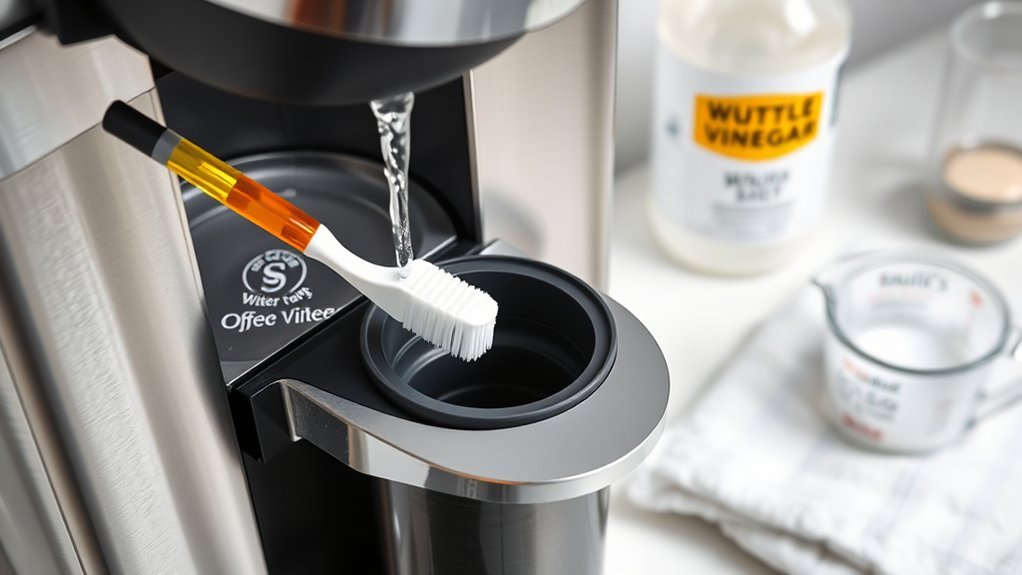
Routine cleaning removes coffee grounds, oils, splashes, and beverage residue from the parts you can reach. It does not remove mineral scale from the internal heater and water lines. That requires the brewer’s descaling procedure.
Supplies You Will Need
- Warm water
- Mild dish soap
- A soft, nonabrasive sponge
- A clean, lint-free cloth
- A large ceramic mug
- A straightened paper clip for a suspected needle clog
- Keurig Descaling Solution or the alternative specifically approved in your model guide
- A replacement water-filter cartridge if your brewer uses a compatible filter
For normal removable-part cleaning, stick to mild dish soap and water. For the brewer’s internal water path, use Keurig Descaling Solution or another method specifically allowed by the model’s care guide. Do not improvise with bleach, abrasive cleaners, baking soda, lemon juice, or mixed cleaning chemicals inside the brewer.
Step-by-Step Keurig Cleaning Process
- Turn off, unplug, and cool the brewer. Remove any used K-Cup pod. If the machine has a carafe heating plate, wait until the plate has cooled completely.
- Remove the water filter if fitted. Lift the filter holder and cartridge out of the reservoir before washing the tank or descaling.
- Empty the reservoir and drip tray. Keep the drip tray level as you pull it forward so collected liquid does not spill.
- Remove the parts allowed by your model. Common removable parts include the reservoir, reservoir lid, drip tray, drip-tray plate, K-Cup pod holder, and funnel.
- Wash removable parts. Hand-wash approved components with warm water and mild dish soap, then rinse them thoroughly.
- Check before using a dishwasher. Dishwasher safety varies. Some older Keurig manuals permit selected components in the dishwasher, while many current guides state that their removable parts are not dishwasher-safe.
- Air-dry the reservoir. Do not dry the inside of the water reservoir with a shedding towel because lint can remain in the tank.
- Wipe the brewer exterior. Use a damp, mildly soapy, lint-free, nonabrasive cloth, followed by a clean damp cloth. Never spray cleaner directly into buttons, vents, seams, or electrical openings.
- Reassemble the brewer. Make sure the funnel is attached correctly to the pod holder and that the reservoir is seated securely.
- Run a cleansing brew. Fill the reservoir with fresh water, place a suitable ceramic mug on the drip tray, leave the pod holder empty, and run a water-only brew. After needle cleaning, Keurig care instructions for many brewers call for two water-only brews.
Pro Tip: After brewing hot cocoa, cider, or another sweetened pod, remove the pod and run a water-only cleansing brew or use a compatible Keurig Rinse Pod. This helps reduce flavor carryover and residue around the pod holder and needles.
How to Clean the Keurig Needles Safely
The exit needle is associated with the K-Cup pod holder, while the entrance needle is under the brewer head. Clean the needle openings when the brewer produces a partial cup, dispenses slowly, puts grounds in the mug, or shows other signs of a clog. There is no need to push a paper clip into the needles after every cup.
- Turn off and unplug the brewer.
- Remove the pod-holder assembly according to your model guide and separate its funnel if the design allows it.
- Locate the exit-needle opening in the pod-holder assembly.
- Insert a straightened paper clip gently into the opening and move it carefully to loosen trapped grounds. Do not force it farther than it moves easily.
- Rinse the pod holder and funnel, then reconnect them.
- Raise the brewer handle and locate the entrance needle beneath the lid.
- Keeping your fingers away from the sharp needle, gently insert the paper clip into each visible opening to loosen trapped grounds.
- Reassemble the brewer and run two water-only cleansing brews without a pod.
This method is consistent with Keurig’s current needle-care instructions for models such as the K-Duo Gen 2, although the way the pod holder is removed can vary by brewer.
How to Clean a K-Duo or Other Keurig Carafe Model
If your Keurig also brews a carafe, the carafe side has additional parts that need routine care. Follow the exact guide for your version because K-Duo generations differ.
- Carafe and lid: Clean them after use as directed by the model guide. Current K-Duo Gen 2 instructions call for a damp, soapy, lint-free, nonabrasive cloth and thorough rinsing.
- Filter basket and holder: Remove coffee grounds and the paper filter, then wash the basket and holder in warm, soapy water and rinse thoroughly.
- Heating plate: Let it cool completely before wiping it gently with a clean damp cloth.
- Avoid abrasives: Rough scrubbers and abrasive cleaners can damage the carafe or heating-plate surfaces.
Current K-Duo Gen 2 care instructions also state that its parts are not dishwasher-safe, which is another reason to check the manual instead of assuming all Keurig components can go in a dishwasher.
Deep Cleaning and Descaling Your Keurig
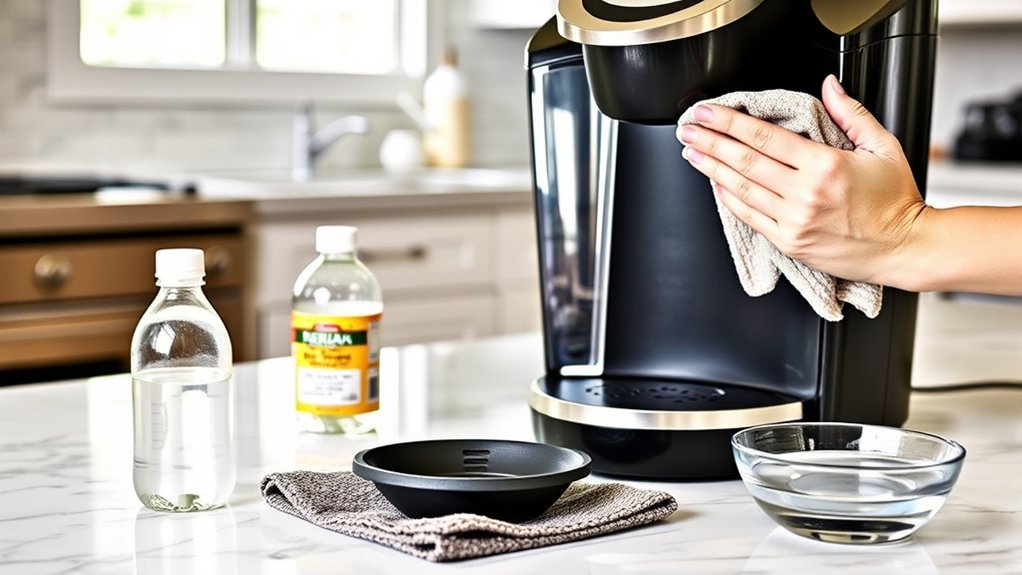
Descaling removes calcium and other mineral deposits from the brewer’s internal water path. Descale when the brewer’s indicator tells you to, at the interval in the model guide, or when symptoms such as slower brewing or reduced cup volume suggest scale buildup.
Keurig’s current maintenance guidance commonly recommends descaling about every three months or when the brewer’s descale notification appears. Mineral-rich water or heavy use can make earlier descaling necessary.
How to Descale a Current Keurig Model
- Open the exact brewer instructions. Use Keurig’s current descaling support and the Use & Care Guide for your model.
- Prepare the brewer. Remove any K-Cup pod and water filter. Empty the drip tray and reservoir as directed.
- Add the approved descaler. Add Keurig Descaling Solution and the amount of water required by the model instructions. Do not guess at the dilution.
- Use a ceramic mug or carafe as directed. Do not use a paper cup for hot descaling liquid.
- Enter Descale Mode if your brewer requires it. Button combinations are model-specific. For example, current K-Duo Gen 2 instructions use CUPS and OZ together, while other brewers use different controls.
- Complete every programmed or instructed cycle. Do not insert a beverage pod or ground coffee unless the model instructions specifically tell you to.
- Discard the hot liquid safely. Empty the mug or carafe into the sink after each required cycle.
- Rinse the reservoir thoroughly. Remove remaining descaling solution before refilling it with fresh water.
- Complete the full fresh-water rinse. Continue until the programmed procedure finishes or the manual’s required rinse volume has passed through the machine.
- Check for remaining cleaner odor or taste. Run additional water-only brews if necessary.
- Reinstall or replace the water filter. Prepare the cartridge according to its package directions before returning it to the reservoir.
Note: Descaling time varies widely. Keurig documentation lists roughly 10–15 minutes for some compact models and about 20 minutes for some other current brewers, while certain larger or older procedures take much longer. Use your brewer’s instructions rather than a universal timer.
Can You Descale a Keurig With Vinegar?
Use vinegar only when the care instructions for your exact brewer permit it. Keurig’s legacy instructions for certain brewers used undiluted white vinegar, but the amount, waiting period, and rinse procedure varied significantly.
For example, Keurig’s older MINI Plus B31 instructions used a 30-minute rest during the vinegar procedure. Older Elite B40, Classic B44, Special Edition B60, Platinum B70, and similar reservoir-brewer instructions called for at least a four-hour rest.
That variation is why a generic 50/50 vinegar-and-water recipe should not be treated as correct for every Keurig. The legacy Keurig vinegar instructions should only be used for the older models they specifically identify. For a current brewer, use its current guide.
Warning: Never mix vinegar, descaling solution, bleach, or another cleaner together. Rinse the reservoir before changing products, and keep your face and hands away from hot liquid released during descaling.
Maintaining Your Keurig Between Cleanings
A simple maintenance routine helps prevent coffee residue, flavor carryover, clogged needles, and mineral buildup. Exact intervals still depend on the model, water quality, and frequency of use.
| Frequency | Maintenance Task |
| After each use | Remove the used pod, wipe visible splashes, and empty the drip tray when needed. |
| After a sweetened or strongly flavored pod | Run a water-only cleansing brew or use a compatible Keurig Rinse Pod to reduce flavor carryover. |
| Periodically or when visibly dirty | Hand-wash the reservoir, lid, drip tray, pod-holder components, and other removable parts allowed by the model guide. Clean more often with heavy use or visible residue. |
| Every two months or 60 tank refills | Replace a compatible Keurig water-filter cartridge. |
| Every three months or when indicated | Descale using the complete procedure for the exact brewer. |
| After storage or several unused days | Refill with fresh water and run a cleansing brew before preparing a beverage. |
Keurig states that compatible current water-filter cartridges should generally be replaced every two months or after 60 tank refills. Check the Keurig water-filter cartridge guidance and confirm that the filter fits your brewer before buying or installing it.
Troubleshooting Your Keurig After Cleaning
The Keurig Will Not Brew
Confirm that the reservoir contains enough water, is not filled beyond its maximum line, and is seated correctly. Make sure the handle is fully lowered and all parts removed during cleaning have been reinstalled properly. If the brewer still will not operate, check its model-specific troubleshooting guide rather than repeatedly forcing brew cycles.
The Keurig Brews a Partial or Slow Cup
Make sure enough water is available for the selected brew size. Clean the entrance and exit needle openings if grounds are present or the flow appears restricted. If the needles are clear, complete the correct descaling procedure. Persistent partial cups after descaling can require Keurig support or service.
Coffee Grounds Appear in the Mug
Remove and rinse the pod holder and funnel, then carefully clear the relevant needle openings with a straightened paper clip. Reassemble the brewer and run two water-only brews before inserting another pod.
The “Add Water” Light Stays On
Remove the reservoir, refill it without passing the maximum line, and seat it securely. Make sure no filter part, residue, or misplaced component is interfering with the reservoir connection. If the light remains on, follow the troubleshooting instructions for the exact model.
The Descale Light Will Not Turn Off
Many current brewers clear the descale alert only after the complete programmed Descale Mode and fresh-water rinse sequence has finished. A normal brew or simple power cycle may not clear the indicator. Reopen the instructions for your model and confirm that you entered and completed its full descaling procedure.
The Coffee Tastes Like Vinegar, Descaler, or Soap
Remove and rinse the reservoir thoroughly. Refill it with fresh water and run additional water-only brews until no cleaning-product odor or taste remains. Do not prepare coffee while cleaner residue is still detectable.
The Keurig Leaks After Cleaning
Check that the reservoir, lid, drip tray, funnel, pod holder, carafe components, and any other removed pieces are seated correctly. Inspect removable parts for visible cracks or damage and make sure the reservoir is not overfilled. Stop using the brewer if water reaches the cord, plug, controls, or another electrical area.
The Keurig Has No Power
Confirm that the brewer is connected to a working grounded outlet. Keurig manuals for several models recommend operating the brewer on an appropriate circuit rather than an overloaded circuit shared with other high-power appliances. If the machine remains dead or repeatedly shuts off outside its normal automatic-off behavior, contact Keurig Support.
Frequently Asked Questions
How often should I clean my Keurig coffee maker?
Remove used pods and wipe spills as needed after brewing. Hand-wash removable parts periodically or when residue is visible. Descale about every three months, when the descale indicator appears, or at the interval stated in your brewer’s exact care guide.
Can I use vinegar to descale a Keurig?
Use vinegar only if the instructions for your exact brewer permit it. Keurig’s older vinegar procedures used different amounts and waiting times for different models. Many current brewers instead use Keurig Descaling Solution and a model-specific Descale Mode.
Can I use lemon juice or baking soda instead of descaling solution?
Do not substitute improvised cleaners for the model’s specified descaling method. Use Keurig Descaling Solution or a vinegar procedure only when the manufacturer instructions for your exact brewer permit it.
Is it safe to clean a Keurig with bleach?
Bleach is not part of Keurig’s standard brewer-care or descaling procedure. Use mild dish soap on approved removable parts and the manufacturer-specified descaling method for the internal water system.
Can Keurig parts go in the dishwasher?
It depends on the brewer and component. Some older Keurig manuals permit selected parts in the dishwasher, while current guides for other models state that their parts are not dishwasher-safe. Hand-wash by default unless the guide for your exact brewer says otherwise.
How often should I replace the Keurig water filter?
For compatible Keurig filter cartridges, the manufacturer generally recommends replacement every two months or 60 tank refills. Not every Keurig uses the same filter system, so confirm compatibility with your brewer.
Why is the descale light still on after cleaning?
Washing removable parts does not complete a descale cycle. Many current brewers require you to enter Descale Mode and finish every descaling and fresh-water rinse step before the indicator turns off.
How do I know my Keurig needs cleaning or descaling?
Visible residue, grounds, flavor carryover, or a dirty drip tray point to routine cleaning. Slower brewing, reduced cup volume, restricted flow, or an illuminated descale indicator can point to scale buildup or a clogged needle.
Conclusion
A clean Keurig should brew normally without grounds, stale flavor carryover, or restricted flow. Wash removable parts periodically, clear needle openings when symptoms suggest a clog, replace compatible filters on schedule, and treat descaling as a model-specific procedure. Checking the exact Keurig care guide before using vinegar, a dishwasher, or a Descale Mode button sequence prevents the most common cleaning mistakes.
Sources
- Keurig Support — current model support, cleaning information, troubleshooting, and Use & Care Guides
- Keurig Descaling Support — current model-specific descaling guidance and maintenance intervals
- Keurig K-Duo Gen 2 Use & Care Guide — Descale Mode, needle care, troubleshooting, and model-specific maintenance
- Keurig K-Duo Gen 2 Care Guide — removable-part, carafe, filter-basket, heating-plate, and dishwasher guidance
- Keurig Water Filter Cartridge Refills — filter compatibility and two-month or 60-refill replacement guidance
- Keurig Legacy Brewer De-Scaling Instructions — older model-specific vinegar quantities, rest periods, and rinse procedures


[…] This section covers the maintenance steps most relevant to keeping grounds out of the cup. For a broader routine covering reservoirs, drip trays, water filters, descaling, and model-specific care, see the full guide on how to clean a Keurig coffee maker. […]