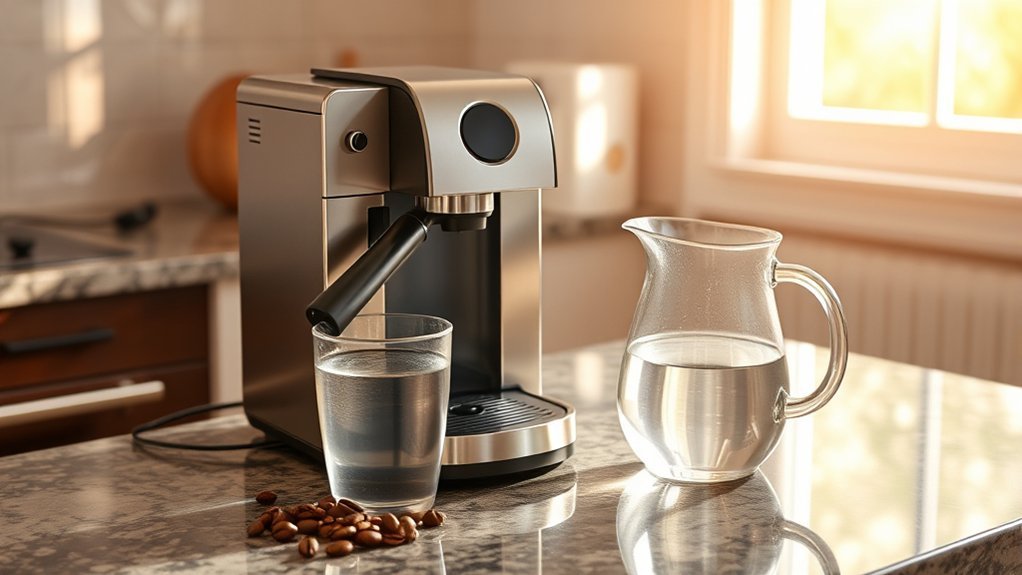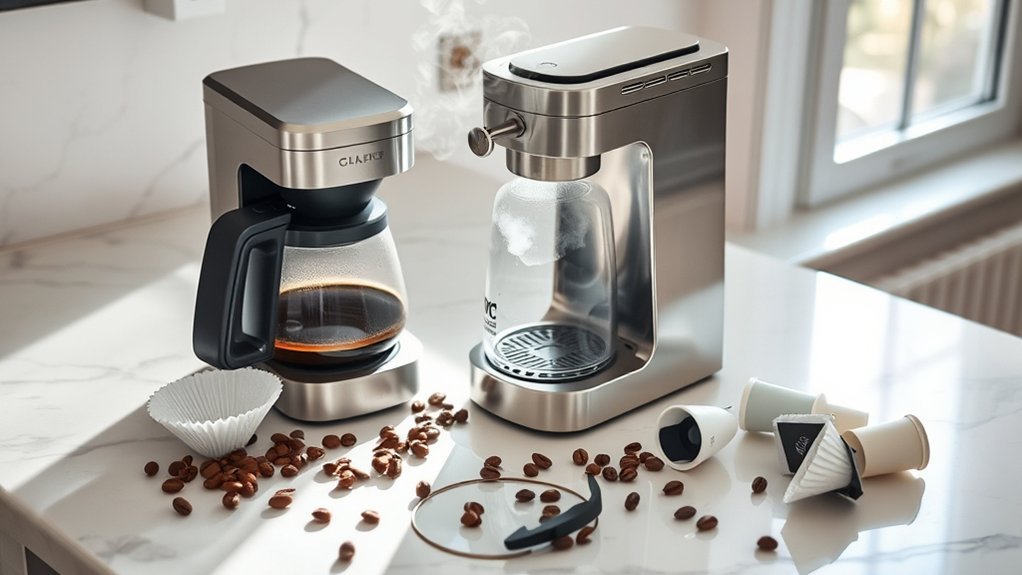
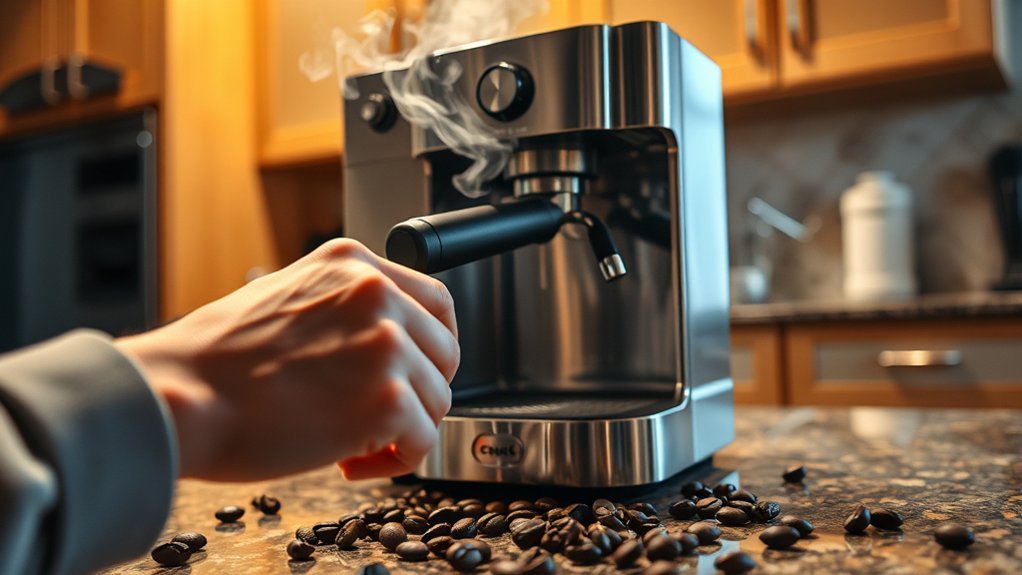
A coffee maker can become louder when its reservoir is low, a removable part is loose, air has entered the water system, the brew path is restricted, or mineral scale has built up. Depending on the machine, some clicking, gurgling, grinding, hissing, and rhythmic pump sounds are normal. The most useful clues are when the noise occurs and whether water flow, heat, or brewing performance has changed.
Quick Answer
A loud coffee maker is often caused by a low or poorly seated water tank, trapped air, a loose removable part, restricted water flow, or scale. Some pump pulses, grinder noise, clicks, hissing, and end-of-cycle gurgling are normal. Check when the noise happens, then follow your model’s manual before cleaning, priming, or descaling.
Key Takeaways
- Rhythmic pump pulses, grinder operation, heating clicks, brief hissing, and end-of-cycle gurgling can be normal depending on the machine.
- A low, empty, or poorly seated reservoir may cause loud pumping, sputtering, or little water flow.
- Loose removable parts, nearby objects, and an uneven counter can amplify rattling or vibration.
- Trapped air, a restricted water path, an incorrectly installed filter, or mineral scale can make some pump-driven machines sound unusually strained.
- Descaling, priming, filter care, grinder cleaning, and brew-group maintenance are model-specific. Follow the instructions for your exact coffee maker.
- Stop using the machine if you notice smoke, a burning smell, electrical arcing, a hot cord or plug, repeated breaker trips, uncontrolled steam, or water entering the electrical base.
At a Glance
| Time Required | About 10–20 minutes for basic external checks; model-specific priming, cleaning, or descaling may take 30–60 minutes or longer |
| Difficulty | Easy for external checks and manufacturer-approved cleaning; professional service for internal faults |
| Tools Needed | Owner’s manual, fresh water, large mug, soft cloth, and the manufacturer-supplied cleaning tool if applicable |
| Cost | Usually $0 for basic checks; approved descaler, filters, cleaning tablets, or replacement maintenance items vary by model and seller |
Warning: Unplug the coffee maker and let hot parts cool before removing parts or cleaning an opening. Never immerse the machine, cord, or plug in water. Do not open the housing or touch internal wiring, pumps, heaters, valves, or capacitors. Descaling may release hot water or steam, so follow the model’s instructions and keep your hands clear of the outlet.
Why Is My Coffee Maker So Loud? Main Causes
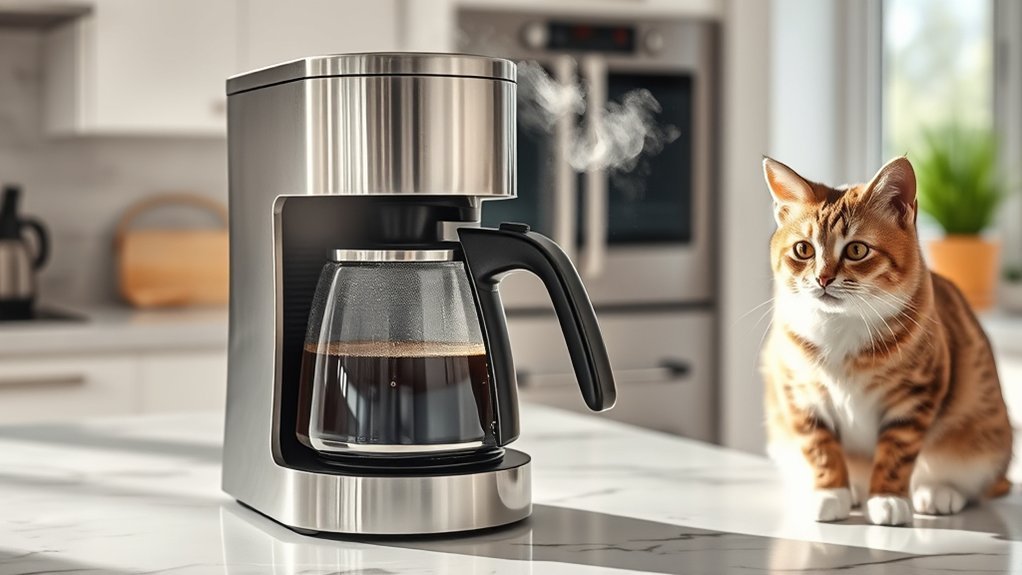
The sound itself provides a clue, but it rarely proves that a specific internal component has failed. First, notice whether the noise begins while the machine is grinding, heating, drawing water, brewing, steaming, or shutting down. Then check whether the sound is new and whether it appears with weak flow, an error message, leaking, or another change in performance.
Power your essentials anywhere with a 999Wh pure sine wave power station delivering up to 1000W continuous with 2000W surge. It supports fast charging via USB-C PD 60W and USB-A QC 18W, plus simultaneous output for multiple devices through AC, USB, wireless, and car/DC ports. Recharge using AC, car, or solar with a built-in MPPT controller and dual cooling fans, while the upgraded battery management system protects against surges, short circuits, and overheating.

Perfect Replacement Fit for Multiple Breville Models: If your Breville espresso machine has weak frothing or loud running noise,our ULKA EP5FM vibratory pump is your perfect repair part It matches models 800ESXL, BES820XL, BES830XL, BES840XL, BES860XL, BES870XL, BES900XL, BES920XL, BES980XL, BES990, BES500, BES878 completely, works seamlessly as a direct swap for old, worn-out factory pumps

✅PROFESSIONAL 20 BAR PRESSURE - Embrace barista-style brewing with Neretva espresso machine! With a 20-bar pressure system and a robust 1350W boiler, the espresso maker extracts premium coffee for lattes, cappuccinos, and more.
Rhythmic Pumping or Pulsing
Pump-driven espresso and capsule machines normally make a repeating hum or pulse while moving water. The Breville Barista Pro instruction manual, for example, identifies pulsing or pumping during espresso extraction or milk steaming as normal pump operation.
The sound becomes more concerning when it is much louder than usual, becomes continuous, or occurs with little or no water flow.
Loud Humming With Little or No Water
A loud, continuous pump sound can occur when the reservoir is empty, below its required level, or not seated correctly. The Breville Bambino Plus troubleshooting guidance lists low water and reservoir-related water-flow problems among causes to check when a machine becomes loud and water does not flow.
If the machine ran without water, air may have entered the water path. Nespresso explains that an air bubble can block water flow after a compatible machine is operated without water or has been unused for a long period. The correct priming steps differ among models, so use the procedure for your exact machine rather than repeatedly running the pump dry.
Gurgling or Sputtering
Some gurgling is normal as a drip coffee maker finishes brewing or as water and steam move through a hot system. Persistent sputtering with weak or uneven flow may point to trapped air, a poorly seated tank, a restricted outlet, an incorrectly installed filter, or scale.
If the machine still produces the expected amount of coffee at the normal temperature and the sound occurs only near the end of a brew cycle, the gurgling may simply be part of normal operation.
Rattling or Buzzing Against the Counter
Vibration can be amplified by an uneven surface, a loose reservoir lid, a poorly seated drip tray, an empty carafe, a brew basket, a pod holder, or accessories stored against the machine. A coffee maker touching a wall, backsplash, utensil holder, or another appliance can also sound much louder than it actually is.
Before assuming an internal problem, move nearby objects away and verify that the machine sits firmly on a flat, solid, dry surface.
Grinding, Clicking, or Clacking
A grind-and-brew or automatic espresso machine will be loud while its grinder is operating. A new clacking, scraping, or stalled-grinder sound may indicate a foreign object, coffee buildup, a blocked chute, or a grinder problem that needs model-specific cleaning or service.
Do not confuse grinder noise with water-pump noise. If the sound occurs before any water moves and stops when grinding ends, inspect only the user-accessible bean hopper, chute, or grinder pieces described in the manual. Never reach into a powered grinder.
Heating Clicks, Hissing, and Expansion Sounds
Depending on the machine, light clicks may come from normal heater, thermostat, relay, or valve operation, and materials can make small expansion sounds as they warm. Brief hissing can also occur around a steam or hot-water system.
Stop using the appliance if hissing is accompanied by uncontrolled steam, leaking from the housing, a burning smell, smoke, electrical arcing, or another sign of overheating or electrical trouble.
Water Filter or Brew-Group Issues on Automatic Espresso Machines
Some automatic espresso machines have a water filter and a user-removable brew group. On models that use these parts, an incorrectly seated or poorly prepared filter can interfere with water flow, while coffee residue in a removable brew group may contribute to abnormal operation.
Follow only the maintenance procedure supplied for your exact model. If the manufacturer instructs you to remove, rinse, or lubricate a brew group, use the specified method and approved lubricant. This is different from lubricating an internal water pump, which you should not attempt.
A sound is most useful when you pair it with its timing and symptoms: note what the machine is doing, whether water is flowing normally, and whether the noise is new or getting worse.
Signs a Noisy Coffee Maker Needs Immediate Attention
Turn the machine off and unplug it immediately if you notice any of these warning signs:
- Smoke, sparks, electrical arcing, or a burning-plastic smell
- A cord, plug, or outlet that becomes unusually hot
- Repeatedly tripped breakers or ground-fault outlets
- Water leaking into or from the electrical base
- Uncontrolled steam or hot water escaping from the housing
- A metal-on-metal grinding sound that continues after the grinder or brew cycle should have stopped
- A pump that runs loudly without moving water after the approved priming steps
Do not continue testing an appliance that shows an electrical, overheating, uncontrolled-steam, or internal-leak symptom. Contact the manufacturer, an authorized service center, or a qualified appliance technician.
Note: A louder-than-usual machine is not automatically dangerous. Normal pump pulsing, grinder operation, heating clicks, brief hissing, and end-of-cycle gurgling do not require repair when the machine brews normally and shows no leak, odor, overheating, electrical problem, or error condition.
How to Troubleshoot Loud Coffee Maker Noises
-
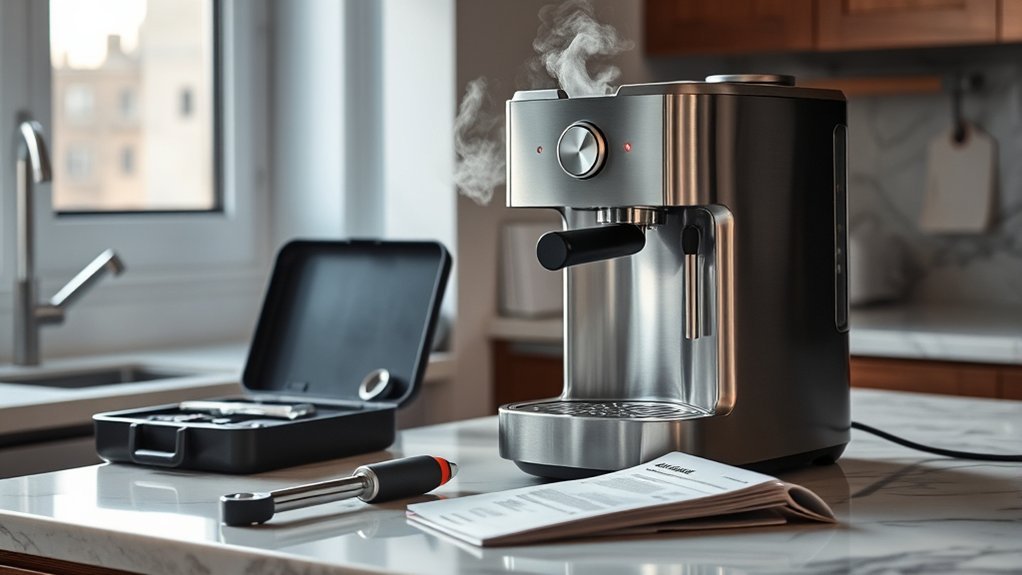
Identify when the noise occurs. Run only a normal test that is safe for your model. Note whether the sound begins during grinding, heating, water intake, brewing, steaming, or shutdown. Also note any warning light, error message, reduced flow, unusual smell, or leak.
-
Turn the machine off and inspect the setup. Unplug it before handling removable parts. Let the machine cool if it has just brewed or steamed.
-
Move it away from nearby objects. Place the coffee maker on a flat, solid, dry counter. Make sure it is not touching a wall, backsplash, utensil container, or another appliance that could amplify vibration.
-
Remove and reinstall user-removable parts. Depending on the machine, check the reservoir and lid, water-filter holder, drip tray, carafe, brew basket, pod holder, bean hopper, portafilter, grounds container, or user-removable brew group. Each part should sit in its normal locked or fully seated position.
-
Fill and reseat the water reservoir. Fill it with fresh, potable water to at least the required minimum without exceeding the maximum line. Remove and reinstall the tank so its outlet connection seats correctly. Check that a water-filter holder is not tilted or preventing the tank from fitting properly.
-
Prime the water system if it ran dry. Remove any capsule or coffee grounds when the manual requires it, then follow the machine’s priming, purge, hot-water, cleaning, or water-only procedure. Nespresso’s own troubleshooting illustrates why priming instructions must be model-specific. Do not let the pump run dry for extended periods.
-
Check the accessible brew path. After unplugging and cooling the machine, inspect the brew basket, reusable filter, pod holder, shower screen, filter basket, outlet, or other user-accessible area identified in the manual. Remove visible grounds and rinse removable parts as directed.
-
Check a removable water filter or brew group only if your model uses one. A filter may need to be prepared, installed, replaced, or temporarily removed according to the manufacturer’s troubleshooting procedure. Clean or lubricate a removable brew group only when the manual specifically instructs you to do so.
-
Use only the approved cleaning tool. Some machines include a pin for a specific needle, steam tip, or filter-basket hole. Do not substitute a paper clip, knife, sewing needle, drill bit, or other improvised object unless the manufacturer explicitly instructs you to use that item.
-
Descale when the manual or indicator calls for it. Mineral deposits can reduce water flow and brewing performance. Use the manufacturer’s approved solution, amount, and descale mode. Do not assume vinegar is safe for every machine.
-
Check an integrated grinder separately. With the machine unplugged, remove only the hopper or grinder pieces designated as user-removable. Look for foreign objects and clear the chute as the manual directs. Never put water into a grinder chamber unless the manufacturer specifically permits it.
-
Run one controlled test. Reassemble the machine, dry the outside and counter, and run the approved water-only or normal brew test. Stop if the noise worsens, water leaks into the base, the machine overheats, or normal water flow does not return.
Pro Tip: Record a short video that captures the sound, control-panel lights, and water flow. A manufacturer’s support team can often narrow the problem more quickly when it can hear when the noise starts and see what the machine is doing.
Coffee Maker Noise Clues by Machine Type
Different brewing systems make different normal sounds. Use the table below as a starting point, then confirm the behavior in your machine’s manual.
| Machine Type | Often Normal | Check When It Changes |
|---|---|---|
| Drip coffee maker | Heating clicks, bubbling, and end-of-cycle gurgling | Excessive sputtering, unusually slow brewing, weak output, or vibration |
| Capsule or pod machine | Pump hum, valve clicks, and brief pressure-related sounds | Loud continuous pumping with no water, weak flow, or repeated errors |
| Pump espresso machine | Rhythmic pumping during extraction or steaming | Very loud pump noise with an empty tank, restricted flow, leakage, or inability to prime |
| Automatic grind-and-brew espresso machine | Grinder noise, brew-group movement, pump operation, and rinsing sounds | New scraping, stalled grinding, loud pumping with no water, or persistent error messages |
Cleaning and Maintenance Tips That Help Prevent Noise
A model-specific maintenance routine is safer and more effective than one fixed schedule for every coffee maker.
Clean Removable Parts Regularly
Empty used grounds and rinse the carafe, brew basket, filter basket, pod holder, portafilter, drip tray, grounds container, and user-removable brew group as applicable. Coffee oils and loose grounds can interfere with seating, clog small openings, or allow removable parts to vibrate.
Check the manual before placing parts in a dishwasher. Some finishes, filters, seals, grinder components, brew groups, and lightweight plastic parts require hand-washing or another specific cleaning method.
Descale According to the Manual
The U.S. Geological Survey explains that mineral buildup can occur in home coffee makers. Scale may slow brewing, reduce output, affect temperature, or make a water-moving system sound more strained.
Descaling frequency depends on water hardness, use, and machine design. Keurig guidance illustrates why one interval should not be applied to every model: some brewer instructions use different schedules or rely on a descale indicator. Check Keurig’s descaling guidance or, for another brand, the current instructions for your exact machine rather than relying on a universal calendar rule.
Use vinegar only when the manual permits it. Some basic drip coffee makers accept diluted white vinegar, while many espresso and capsule machines call for a branded or manufacturer-approved descaling agent.
Replace Water Filters on the Model’s Schedule
Do not rely on a universal six-month filter rule. Follow the filter packaging, machine manual, water-hardness setting, or replacement alert. An overdue, incorrectly installed, incompatible, or poorly prepared filter can reduce water flow on machines that route brewing water through the filter.
Use Suitable Water
Potable tap water is suitable for many coffee makers, but local hardness and water quality vary. U.S. readers can use the EPA’s Consumer Confidence Report resources to find information about their local public water supply.
Check the manual before using distilled, deionized, heavily softened, or highly filtered water. Some espresso machines specifically warn that highly filtered, demineralized, or distilled water may affect taste or how the machine is designed to operate.
Use Compatible Cleaning Products
Cleaning tablets, descaling liquids, powders, filters, and lubricants are not interchangeable. Use a product only when its label and the machine manual confirm compatibility. Never combine vinegar, descaler, bleach, detergent, or other cleaning chemicals in the reservoir.
If your machine has a user-removable brew group that the manufacturer instructs you to lubricate, use only the specified food-safe or manufacturer-approved product and procedure. Never add lubricant to the water reservoir, brew path, or internal pump.
When to Call for Coffee Maker Repair
Contact the manufacturer or an authorized repair provider when basic external checks, approved cleaning, priming, filter care, and descaling do not restore normal operation.
Professional service is especially appropriate when:
- The pump remains unusually loud and no water moves through the machine.
- The machine leaks from the housing rather than a removable tank, tray, basket, carafe, or other user-serviceable part.
- A grinder produces repeated scraping or metal-on-metal sounds after accessible obstructions have been removed according to the manual.
- The machine displays a persistent pump, valve, heater, grinder, brew-group, or electronic error.
- Water flow repeatedly stops after the reservoir and accessible brew path have been checked.
- The appliance overheats, shuts down unexpectedly, or repeatedly trips an outlet or breaker.
- The machine is still under warranty and internal inspection could affect coverage.
Do not open the housing to inspect a pump, solenoid valve, heater, control board, capacitor, or internal tubing. The Breville Barista Pro manual, for example, specifically tells users not to open or service the espresso machine and directs maintenance beyond cleaning to support or an authorized servicer. Internal parts may remain hot or electrically hazardous after the machine is switched off.
Frequently Asked Questions
Can different coffee bean types affect brewing noise levels?
Bean type is not a likely cause of pump, gurgling, or vibration noise. Different roasts may sound slightly different in an integrated grinder because beans vary in brittleness and surface oil. A sudden scraping, stalling, or repeated clacking sound should be treated as a grinder problem rather than assumed to be a normal bean difference.
Is it safe to use tap water in my coffee maker?
Potable tap water is suitable for many coffee makers. However, hard water can increase scale, and local water quality varies. Check your machine manual and local water-quality report. Avoid distilled or demineralized water when the manufacturer warns that it may interfere with taste, sensors, or normal operation.
How often should I descale my coffee maker?
Follow the interval or descale alert in your exact model’s current instructions. Timing depends on machine design, water hardness, and frequency of use. Some current brewer guides use roughly three-month schedules, while other models or older guides may use different intervals. Do not apply one descaling schedule to every coffee maker.
Does the age of my coffee maker affect noise levels?
It can. Years of use can change how moving or sealing parts sound, while accumulated scale or coffee residue can reduce flow. Age alone does not identify a failed component, so rule out the reservoir, removable parts, trapped air, vibration, filters, accessible blockages, and approved maintenance first.
Can using a different coffee grind size reduce noise?
Grind size should be adjusted for proper extraction, not as a general noise treatment. In an espresso machine, coffee that is too fine or packed too tightly can severely restrict flow. If espresso barely drips, follow the manual’s dose, tamp, and grind guidance rather than automatically grinding finer.
Is a pulsing pump sound normal in an espresso machine?
Often, yes. Many pump-driven espresso machines pulse while extracting coffee or producing steam. Investigate when the sound becomes much louder than usual, turns into a continuous strained hum, or occurs with an empty tank, weak flow, leakage, overheating, or an error message.
Why is my coffee maker louder after the reservoir ran empty?
The pump may be drawing air instead of a steady water supply. Refill and firmly reseat the tank, then use the model’s approved priming, purge, cleaning, or water-only procedure. Avoid running the pump dry for extended periods. Seek service if normal flow does not return.
Should I lubricate a noisy coffee maker pump?
No. Do not add oil, grease, or another lubricant to the reservoir, brew path, grinder, or internal pump unless the manufacturer provides a specific service procedure and approved product. Some automatic machines separately allow approved lubrication of a user-removable brew group; that does not mean the water pump should be lubricated.
Why is my coffee maker loud but not brewing?
Start with the water supply. Check that the reservoir contains enough water and is fully seated. If the machine recently ran dry, use its approved priming procedure. Then inspect only the user-accessible basket, pod holder, filter, outlet, or brew path described in the manual. Descale if the manufacturer’s schedule, indicator, or troubleshooting guide calls for it. Seek service if the pump remains loud and no water moves.
Is a loud coffee maker dangerous?
Not by itself. Pumps, grinders, valves, heaters, and boiling water can make noticeable sounds during normal operation. Stop using the machine when the new noise is accompanied by smoke, a burning smell, sparks, an unusually hot cord or plug, repeated breaker trips, uncontrolled steam, overheating, or water entering the electrical base.
Conclusion
A noisy coffee maker does not always need repair. First identify when the sound occurs, then check the simple external causes: fill and reseat the reservoir, reinstall removable parts, reduce vibration, prime a machine that ran dry, and clean only the user-accessible areas approved for your model. Follow the manufacturer’s instructions for water filters, removable brew groups, grinders, cleaning products, and descaling. Stop troubleshooting and seek qualified service when the noise comes with electrical problems, overheating, internal leakage, uncontrolled steam, or a continued loss of water flow.
Sources
- Breville Bambino Plus Instruction Manual — supports troubleshooting for loud operation, low water, reservoir seating, restricted flow, approved cleaning tools, and model-specific maintenance.
- Breville Barista Pro Instruction Manual — supports normal pump-sound guidance, descaling precautions, water guidance, and the warning against internal servicing.
- Nespresso Air-Bubble Troubleshooting — explains how operating without water can introduce air, interrupt flow, and require model-specific priming.
- Keurig Descaling Guidance — supports brewer-specific descaling guidance and the need to follow the appropriate maintenance procedure for the model.
- U.S. Geological Survey: Hardness of Water — explains mineral hardness and mineral buildup in home coffee makers.
- U.S. Environmental Protection Agency: Consumer Confidence Reports — provides access to local public drinking-water quality information.